

I’m 50 and I Live in a Minivan. One $1,700 Emergency Changed the Way I Think About Freedom.

The morning in Lassen was one of the hardest days I’ve had on the road. It was also the day the most important financial system I’ve ever built was born.
*This post may contain affiliate links. Please read our disclosure policy for more info.
By: Catina Borgmann, The Van Lifestylist
I was parked at Lassen Volcanic National Park when everything went wrong at once. Henry — my 9-pound Havapoo and full-time co-pilot — had been outside next to the van on his leash while I got ready to head out for the day.
By the time I moved to the front seat to get going, something was clearly wrong. Henry was limp. A rag doll.
I picked him up, and he lay against my chest, looking up at me with eyes he could barely keep open. He couldn’t focus.
I knew I needed to drive. Get to a city. Find a vet. I reached for the gear shift.
The Van Wouldn’t Move. The Dog Was Limp. I Had No Plan.
Here’s the thing about van life that the Instagram version never shows you: sometimes
the dog gets sick and the van breaks down on the same morning, in a national park, on
a Sunday, with no vets open within 40 miles.
I sat there for what felt like a long time, Henry against my chest, willing the van to shift
into drive. I’d been having intermittent transmission issues — nothing that triggered a
warning light, nothing a mechanic could pin down without more to go on. Just
occasional reluctance in the mornings that always resolved itself eventually.
It resolved itself that morning too. Eventually.
Van working for the time being, I drove to the nearest town of Chester and found even more bad news.
Three vets in town, none open on Sunday. Henry had perked up slightly on the drive — he wanted his head out the window, which felt like a good sign —but then he moved to the back of the van and sat behind my seat. He has never done that. He always wants to be next to me.
I kept a hand on him while I drove. He felt cold. I want to be honest about what was
going through my mind on that drive — I was preparing myself. He was that still. That
unresponsive. When a 9-pound dog goes quiet and moves away from the person he
never leaves, you start thinking about things you don’t want to think about.
I decided to head to Reno — nearly two hours away, but the only real option. Bigger city.
Emergency vet if we needed one. I talked to him the whole drive.
By the time we got to Reno, Henry was alert enough to pee and poo normally at a park
— but he still hadn’t eaten or had anything to drink. Something was still off. I took him to
a vet. His vitals were normal. His gums were pink. His stomach wasn’t distended. The
vet thought he looked sedated. They gave him fluids under the skin and told me to
come back if he wasn’t better by morning.
He wasn’t better by morning.
$1,700 in 48 Hours — and it didn’t stop here….
Over the next day, Henry had blood work, X-rays, more fluids, and anti-inflammatory
medication. The vet suspected either a back injury or something he’d ingested at
Lassen — they never confirmed which. I Ubered between the vet and the repair shop
because the van was being worked on at the same time.
The repair shop found a significant transmission leak. They fixed it the same day. They
were compassionate about the fact that I was also dealing with a sick dog. Small
mercies.
Henry’s bills: close to $1,200. Van repair: around $500. Total spent in Reno:
approximately $1,700.
And that wasn’t the end of it. The transmission continued to have problems. Later that
year, I had it completely replaced. That repair cost significantly more — and by that
point, the debt from the Reno trip was still sitting there, quietly compounding.
Here’s what I didn’t have that week in Reno: a financial buffer designed for exactly this
kind of situation.
Here’s what I learned: van life debt snowballs faster than almost any other kind.
When your home and your transportation are the same vehicle, every mechanical problem is
also a housing problem. Every unexpected expense hits harder because there’s no
stable base underneath it.
That crazy day in Reno showed me what I was missing. And I made the decision to build something that would keep me financially stable.
I’m a Federally Credentialed Enrolled Agent — a tax professional licensed by the U.S.
Department of the Treasury. I spend my professional life helping people understand
financial systems. And I’d been living nomadically for years — a motorhome, two tiny
house communities, an 80-day road trip that started everything — before I settled into the Sienna. And I still went into this chapter of the journey without the financial
architecture specifically designed for life on the road.
I figured it out. I paid off the debt. And then I built the system I wish I’d had in Lassen.
I call it the 3-6-9 Buffer™ — a three-tiered financial safety net built specifically for the volatility of life on the road.
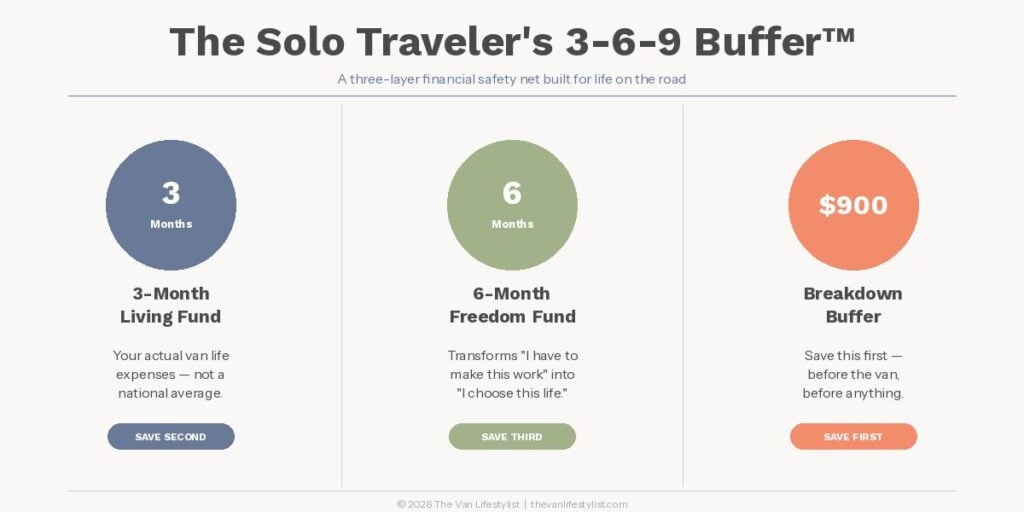
The 3-Month Living Fund covers three months of your actual road expenses — not what
you spent before van life, your real monthly costs on the road.
The 6-Month Freedom Fund is the tier that stops the financial fear altogether, gives you
options — and delivers the freedom van life actually promises.
The 9 in the name is the $900 Breakdown Buffer — the most protective tier. This fund
covers the repair that can’t wait. The alternator. The emergency tow. The transmission
leak in Reno on the worst day of the year. Nine hundred dollars is the starting threshold,
not a ceiling.
Despite the $900 Breakdown Buffer appearing last in the name, it’s the first fund you
save.
Secure that before you launch. Then build the 3-Month Living Fund. The 6-Month
Freedom Fund grows with you over time.
I didn’t have any of these tiers in Lassen. I have them now. The difference in how I
experience van life — the quality of the decisions I make, the absence of the low-grade
financial panic that used to sit underneath everything — is hard to overstate.
What I Know Now That I Wish I’d Known Before I Left
Van life at 50 is not the same as van life at 28. You likely have more financial
obligations, more at stake, and less runway to absorb a financial hit and start over.
That’s not a reason not to go. It’s a reason to build the foundation before you do.
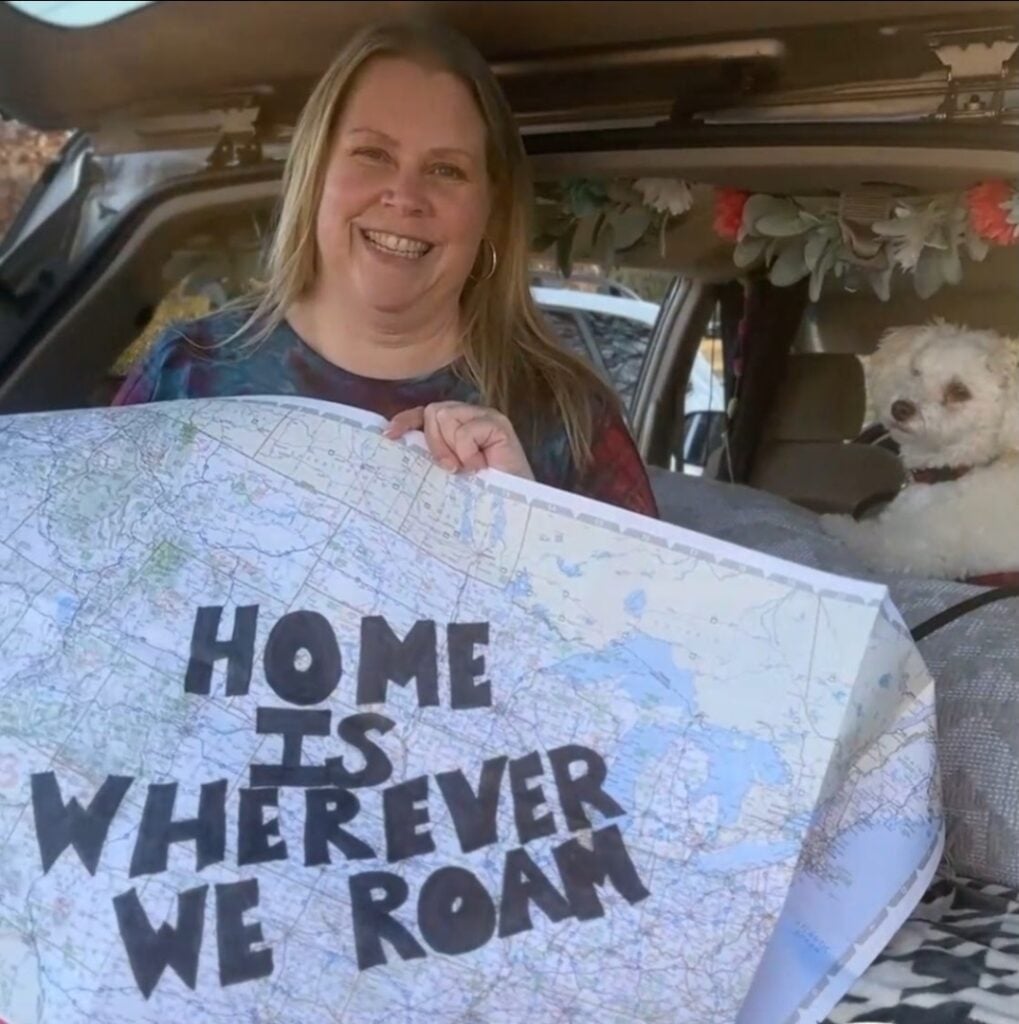
The Roadloft removable conversion kit in my Toyota Sienna gives me a comfortable,
functional home on wheels that I can adapt as my needs change.
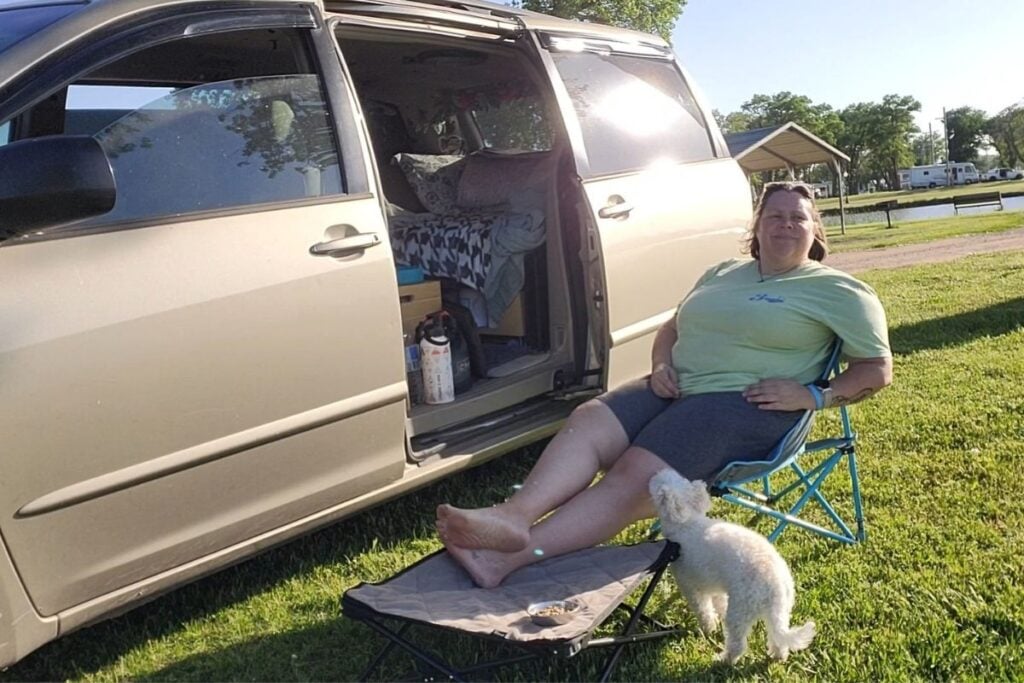
Henry has recovered fully and remains my co-pilot, still convinced every campsite is his personal territory.
And the buffer? It exists now. The transmission is replaced. The debt is gone.
The morning in Lassen was one of the hardest days I’ve had on the road. It was also the
day the most important financial system I’ve ever built was born — I just didn’t know it
yet.
Catina Borgmann is a Federally Credentialed Enrolled Agent and the creator of The Van
Lifestylist, where she provides logistical and financial systems for sustainable


What a story. I have a small dog, his name is Webster. He is actually very sociable, but he is known as “10 pounds of furry fury”. I’m still trying to sell my house and get free of the things that tie me down. Maybe some day we’ll meet on the road.
Webster and Henry would absolutely have something to say to each other — that much I know! 😄 Ten pounds of furry fury sounds like he’d hold his own just fine on the road.
Selling the house is the big first domino. Once it falls, the rest starts moving. Wishing you a smooth and speedy process — and who knows, maybe we’ll cross paths somewhere out there!
Hi Cantina,
I loved your article. Nice to know one can be on the road with a their dog. I was introduced to your article as I follow and have ongoing correspondence with Kristin Hanes. As I approach retirement I’m looking to utilize many of “The Wayward Home” teachings in how much time to spend in the Van or RV life. In reading your article, I was caught by a piece of information you shared about your background. That being that you are a “Federally Credentialed Enrolled Agent” for the IRS. I’m curious if you might be willing to offer some advice from the perspective of that role.
A bit about me. My career is in Risk Management, both as a Commercial Insurance Large Account underwriter and as a Risk Manager. Most recently I was the acting Risk Manager for the City of Chicago. Much like your story of difficulties above, life does hit us all with bumps in the road. My bump was from over twenty years ago where I was hit with a divorce that came out of left field. Part of the breakup meant selling the family home. That resulted in an IRS tax liability for that year. Unfortunately, I had not anticipated that and was consequently unable to pay the tax liability. Since then, many of my returns which were refunds were applied to the balance outstanding for that tax year. However, the balance remains fairly close to $10K.
At one time when not in my profession I had an opportunity to work for a back tax assistance firm. That’s how I learned about your career as mentioned previously. As you probably know ,many of these back tax assistance firms assert or advertise they can help the client with clearing the back tax liability and potentially reduce the amount owned by considerable amounts. From the short time I was with the firm in South Carolina, I quickly learned that many of these firms don’t really do much in terms of providing a remedy. Many, including the one I worked with shorty are unscrupulous and essentially are ripping off the client.
Apparently, there is a list provided by the IRS of individuals with unpaid back taxes. I get an email or call almost everyday and often several times a day with a solicitation from one of these firms. The problem is it’s difficult to determine which are truly legitimate and credible. My question to you, is in the course of your career working as “Federally Credentialed Enrolled Agent”
did you work with any of these firms that you could possibly recommend?
Any and all assistance and guidance graciously appreciated.
With warm regards,
Steve Harris
So what happened. To Henry? How did he recover and how long did it take? Do you have medications in your van? Did you find him tangled in a leash? Was he at the bottom of a cliff? What kind of campground were you at? Did it happen right after you fed him? How are you going to prevent it happening in the future if you don’t know the cause? What’s your intuition say about what happened? Being financially prepared for the unexpected is basic common sense. For those unable to save I recommend an emergency credit card that you never use except in real emergencies.