Want to Keep an Eye on Your Pet in your Camper? I Tested Two Waggle RV Pet Cams

Traveling with your pet can be both a delightful and stressful experience, especially when you have to leave Fido inside your rig to run errands,…
*This post may contain affiliate links. Please read our disclosure policy for more info.
Traveling with your pet can be both a delightful and stressful experience, especially when you have to leave Fido inside your rig to run errands, go out to dinner, or go on a hike.
You might be constantly wondering how your dog is doing, if they’re anxious, barking, or chewing on something they shouldn’t be.
This is where a pet camera comes in handy. You can tap into the app from anywhere and watch live videos of your dog, or even talk to it through the camera.
I spent weeks testing two Waggle cameras inside a large hangar at the boatyard in Mexico where we are currently based. One runs on WiFi, the other uses a 4G cellular signal. Both have pros and cons, but one came out consistently on top, especially for capturing movement.
I should mention that my testing environment was different than the use case for most RVers, who would mount the camera inside an RV or possibly, outside one of the doors to monitor exterior movement. I’m using them more as security in a large hangar in a boatyard rather than for monitoring pets.
The WiFi camera, known as the Waggle RV Cam AI Mini, came out consistently on top for capturing movement in a large space. The Waggle RV 4G Mini Camera runs on a cell signal, and while it didn’t capture much movement in a larger area, we believe it would work just fine in the smaller space of an RV or within close range of an RV exterior.
Here’s more about what I learned about both types of camera.
Waggle Pet Monitoring Cameras At a Glance
| Waggle RV 4G Mini Camera | Waggle RV Cam AI Mini | |
| Best for | No WiFi access (RV, garage, cabin) | Reliable event/motion detection |
| Connectivity | Cellular (no WiFi needed) | WiFi |
| Motion detection range | Short — only close-proximity events | Reliable, caught activity across the room |
| Subscription required? | Yes – $29/month | Yes – $2.50 per month if purchased annually |
| Indoor/Outdor | Can be used inside and outside | Inside only |
Meet the Two Waggle Cameras I Tested
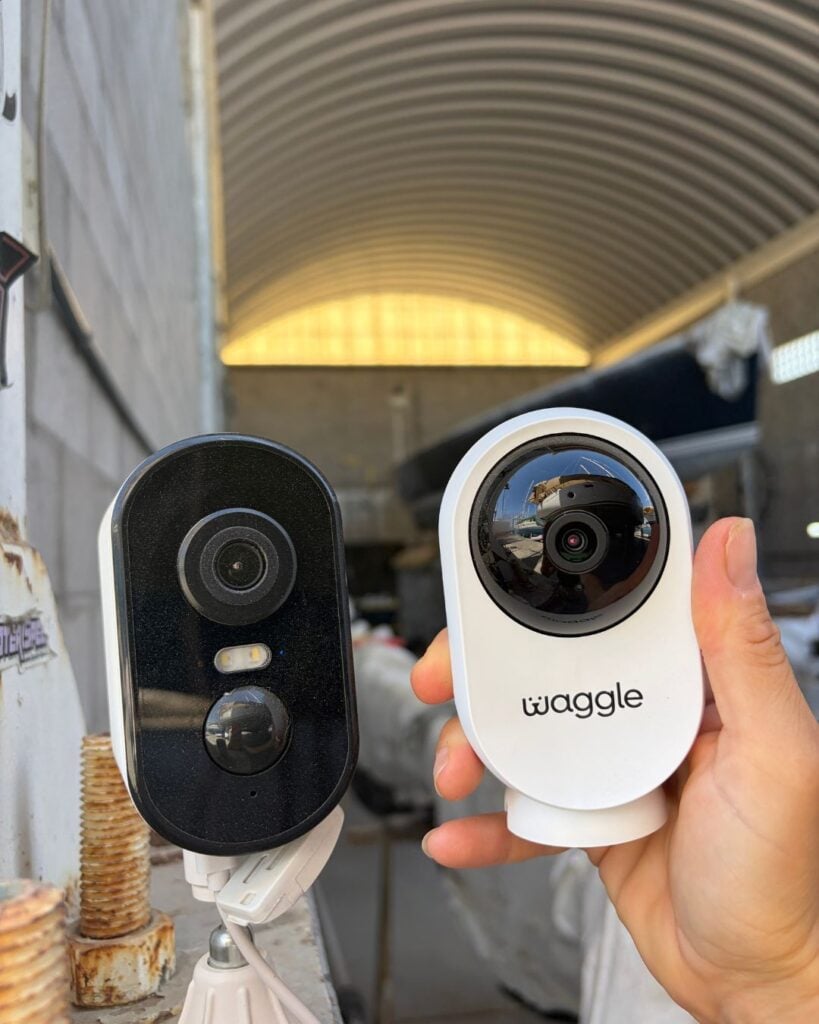
Here are the two different pet monitoring cameras I tested.
Waggle RV 4G Mini Camera
This one’s built for life off the grid. It runs on cellular, not WiFi, using a 4G LTE SIM that’s already installed and works across major carriers. That means no hunting for campground WiFi or setting up a hotspot….you just mount it and go. It’s compact and weatherproof, so it works just as well strapped outside your rig as it does inside, and the battery stretches up to three months (longer with the included solar panel). Waggle built this one for boondockers and full-timers who need coverage no matter where they park for the night.
Keep in mind you WILL need a good cell phone signal to use this device and that it also works in Mexico, which is where we tested it.
Waggle RV Cam AI Mini
This is the WiFi-based option, and it leans into AI features that are tougher to pull off on a low-power cellular camera: auto-tracking that follows movement around the room, plus motion and sound alerts that are actually reliable. It has to stay plugged in and connected to WiFi, so it makes the most sense when you’re parked somewhere with a signal like a campground, an RV park, or your wifi via a Starlink device. Think of it as the more “hands-off” pick: set it up once and let it do the watching.
Waggle RV 4G Mini Camera — Full Breakdown
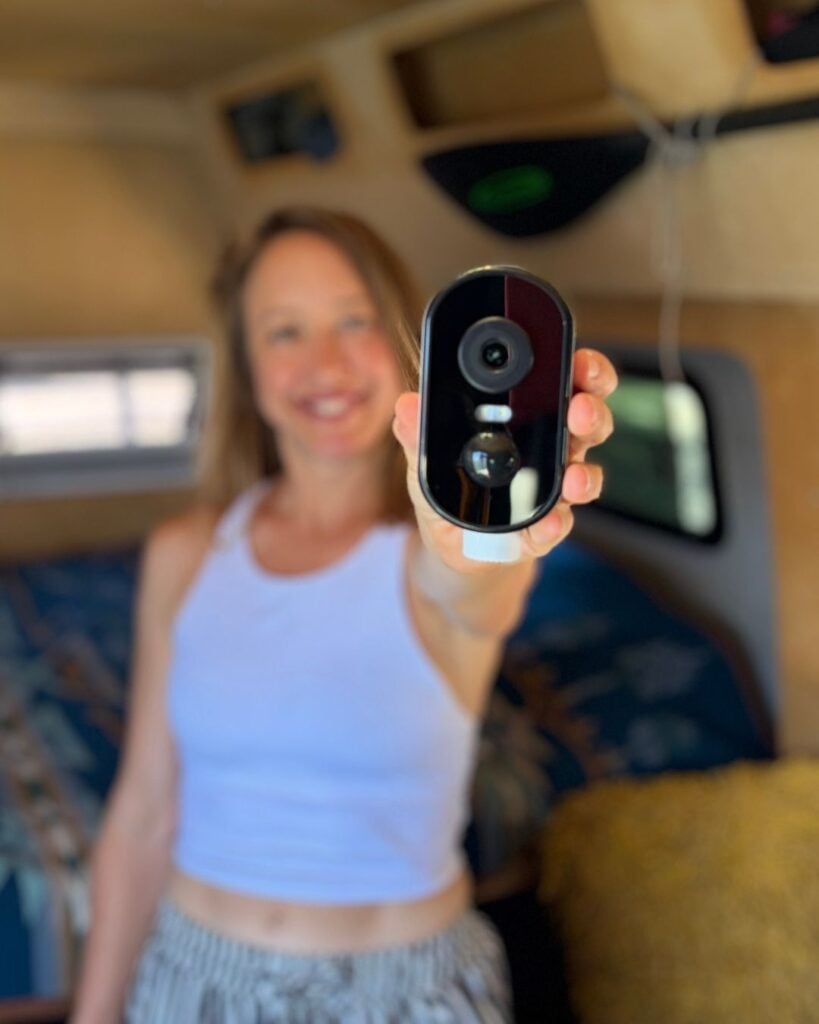
The RV 4G Mini Camera skips WiFi entirely. It ships with a 4G LTE SIM already installed, and it’s built to work across major carriers — AT&T, Verizon, and T-Mobile — so you’re not locked into one network. For RVers, that’s the whole selling point: no campground WiFi to log into, no hotspot to burn data on, no dead zones to work around. You mount it, and as long as you’ve got cell signal, it’s connected.
I tested this device south of the border in Mexico, where it also picked up a 4G signal, which makes this very versatile for RVers who love going to Baja and Sonora in the winter months.
Video & image quality
I’ve used other security cameras before, and was impressed by the video quality of the Waggle 4G Mini. You get 2K HD video with a 300° pan lens, so it covers a wide field of view without needing to physically reposition the camera. Night vision is infrared, so it’ll pick up movement in the dark without extra lighting.
AI/smart features
The camera uses motion and human detection to trigger alerts and recordings, and it has built-in siren and light deterrence, which is useful if you’re leaning on it for security as much as pet-watching. It’s also got two-way audio, so you can talk through it if your dog needs a “hey, knock it off.”
Battery & power
Battery life runs up to three months on a single charge with normal motion-based recording. Add the included solar panel and you can extend that indefinitely, which matters a lot if you’re boondocking somewhere without easy access to an outlet.
We tested this device using a solar panel, and every time I looked at the battery it was 100%.
Durability
It’s IP65-rated for weather resistance, so it’s built to handle being mounted outside. This is great for people who want to monitor comings and goings outside the RV…more like a security camera for RV usage. Would also be great for a remote cabin.
App experience
Setup and control both run through the Waggle app (iOS and Android). It stores footage locally on a 64GB SD card and gives you both continuous and event-based recording. I thought it was very easy to access the live video feed, but I did notice quite a bit of lag time when trying to access the recordings. Sometimes, I couldn’t access the recordings at all and would just get a spinning wheel.
Motion detection length can be extended in Performance mode to capture the entire motion rather than the shorter clips in Power Saving mode. However, I tested both modes and I didn’t notice a difference with capturing motion from far away. Also, this camera includes a privacy mode for controlled recording.
Subscription/plan cost
Because it runs on cellular instead of WiFi, a network plan is required to get real-time alerts. The monthly service plan isn’t particularly cheap at $29/month. Waggle gave us one month free to test for this review, and we are going to pay for a few more months to monitor our sailboat at the boatyard while we’re away for summer.
Pros
- Works without WiFi
- Holds battery charge well
- Solar panel keeps battery at 100%
- Great for remote monitoring the livestream
- Built in deference features such as voice and sirens
- Easy to set up and mount (hardware includes things magnets and stickers)
Cons
- Motion detection range was short in real-world testing, really only triggering when we got very close to the camera. Worth nothing it was testing in a large hangar, not a small RV which night narrow the gap
- Lag time when trying to access recordings, sometimes, recordings wouldn’t come through
Waggle RV Cam AI Mini — Full Breakdown
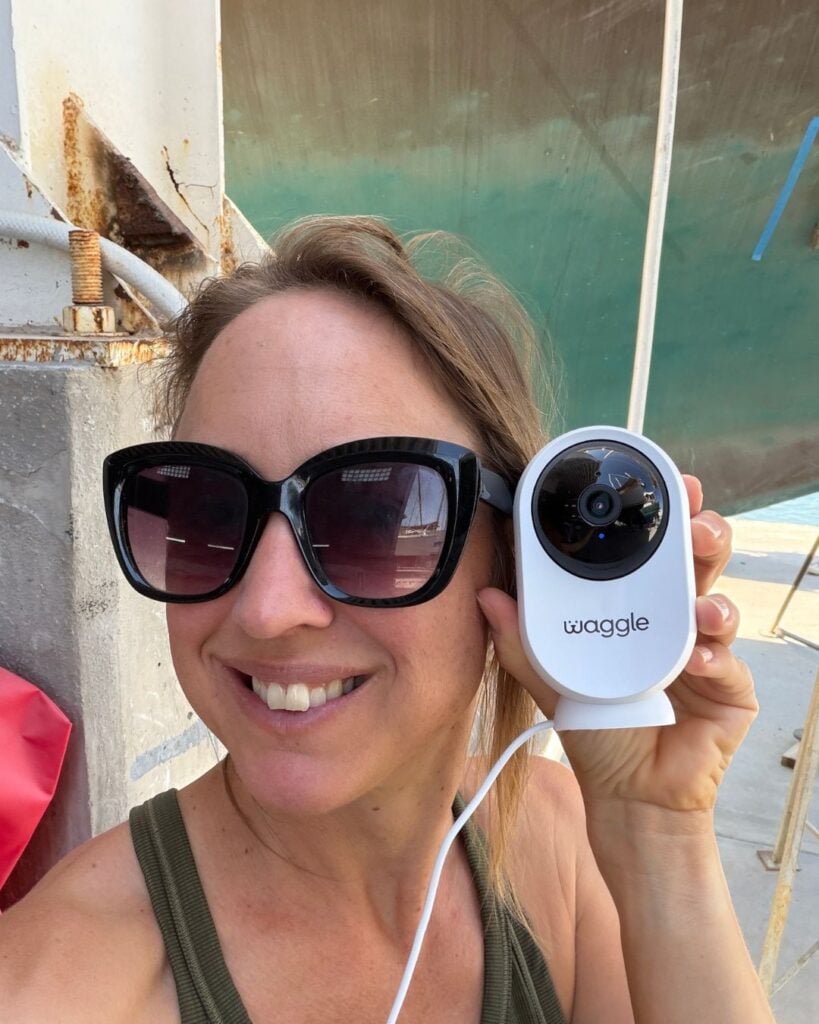
This one runs on WiFi, with dual-band 2.4GHz/5GHz support for a more stable connection. It needs to stay connected the whole time, so it’s a better fit when you’re parked somewhere with dependable WiFi — a campground, an RV park, or your own Starlink. This camera Supports both all-day recording and event-based recording and is designed for reliable event/motion detection indoors. Motion detection works effectively across the room and can capture activity consistently.
Video & image quality
Video quality is 1080p HD, with night vision for after-dark monitoring. It also has 360° rotation with pan/tilt control, so you can reposition the view remotely instead of being stuck with a fixed angle.
AI/smart features
The standout here is AI auto-tracking — the camera actively follows movement around the room instead of just watching a static frame. Paired with motion and sound detection alerts, it’s built to actually catch what’s happening rather than just record a wide shot and hope something useful is in frame. Two-way audio is included as well.
I turned off tracking when I was testing this device as it kept trying to follow any movement, even fabric moving in the wind.
Power
It has to stay plugged in….there’s no battery option. That’s a trade-off for the more reliable detection and tracking performance. You’ll just need to make sure your RV has a good WiFi signal if you’re going to depend on this camera.
App experience
The app includes an event history / “go back in time” feature, so you can scrub back through recorded events instead of only ever catching things live. I found it very easy to access past events through the app.
Subscription/plan cost
This camera has a very affordable annual plan – just $29.99/year to access past events. To simply use streaming, you don’t need a plan.
Pros
- Captured events more reliably than the 4G Mini in the same test environment
- Crystal-clear livestream video
- Very easy to access event recordings
- Ability to track movement
Cons
- Indoor-use only (we did test it in an outdoor environment but I wouldn’t recommend this for long-term)
- Has to be plugged in all the time, no battery
- Needs good WiFi to work
The Huge Difference in Event Detection
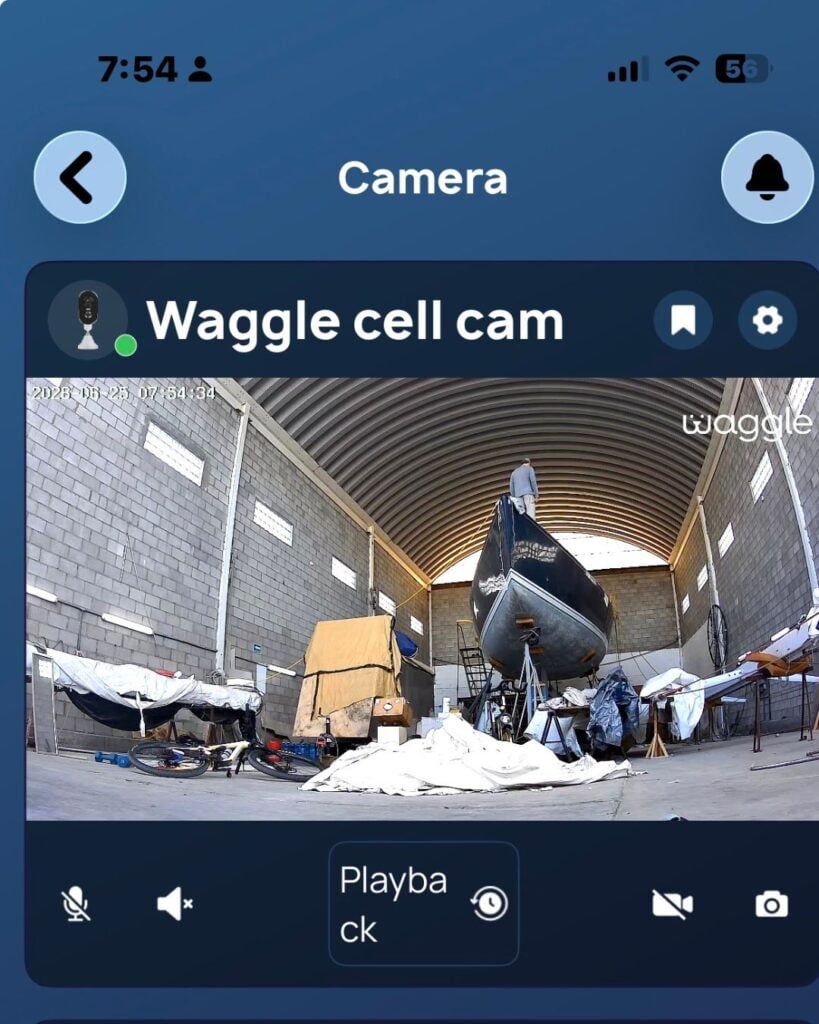
On paper, the 4G Mini actually wins the spec sheet. It shoots sharper 2K video compared to the AI Mini’s 1080p, runs on cellular instead of WiFi so you’re never hunting for a signal, and its battery stretches up to three months (longer with the solar panel), while the AI Mini has to stay plugged in at all times. The 4G Mini also covers a 300° field of view, close to the AI Mini’s full 360° pan and tilt.
But specs only matter if the camera actually catches what’s happening, and that’s where the two really split. In my testing, the RV Cam AI Mini picked up movement consistently, no matter where in the boat hangar it happened. The 4G Mini only triggered when something moved right in front of it…. activity even a few feet away didn’t register consistently. It’s worth remembering I tested both in a large hangar, so in an actual RV’s smaller footprint, that gap may narrow some. Still, it was a clear, repeated pattern throughout my testing.
Sometimes, the RV Cam AI Mini would pick up twenty events throughout the day to the 4G Mini’s three, so there was a clear standout when it came to capturing motion.
Here is what Waggle said about the event detection behavior and why it differs so greatly between the two cameras:
- WiFi Camera: Since the camera remains active continuously, it can capture motion events without needing to wake from a sleep mode. This allows it to detect and record more frequent events.
- 4G/Cellular Camera: The camera is designed with battery efficiency in mind and operates in a low-power sleep mode. It records when motion is detected, with recordings typically captured as event-based 7–10 second clips.
This means the movement has to last quite awhile for the 4G camera to pick it up and record it. Briefly walking in front of the camera from more than a few feet away probably won’t record anything.
But like I said before, if your goal is to record INSIDE your camper, and to be able to livestream and see how your dog is doing, the camera would work just fine. Or if you have the camera monitoring your RV’s door at close range, the output should be satisfactory.
If you’re hoping to capture motion within a larger area, it might not pick up movement that’s less than a few seconds, like an animal or person walking past, or motion that’s more than a few feet away.
Comparison of Other Key Areas
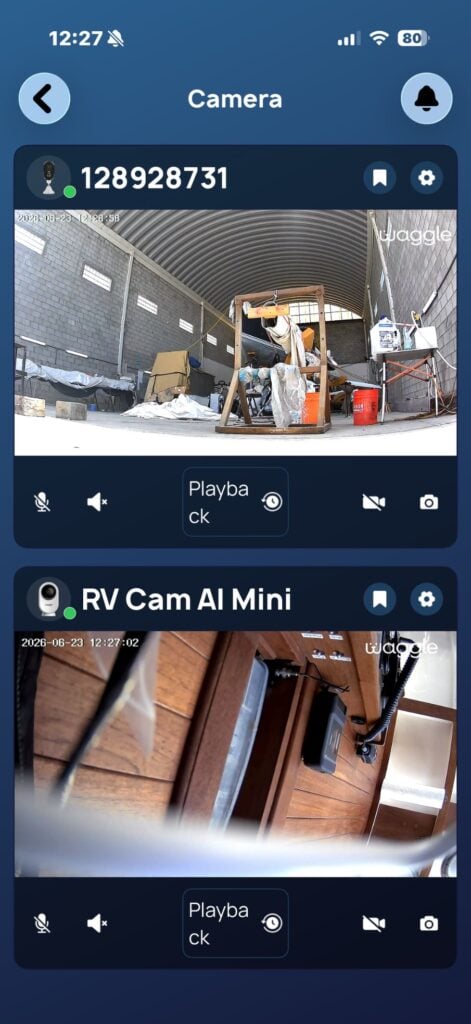
Cost is another thing to factor in. The 4G Mini requires an ongoing network plan to get real-time alerts over cellular, which adds a recurring cost of $29/month.
The Wifi model can be used for free for live streaming, or a very affordable $29/year to capture events.
Setup in the app for both devices was very easy, and I like that I can use both cameras within the same app.
I also contacted support with a couple of questions directly through the app, and they emailed me back within just a couple of hours.
Which Waggle Camera Should You Get?
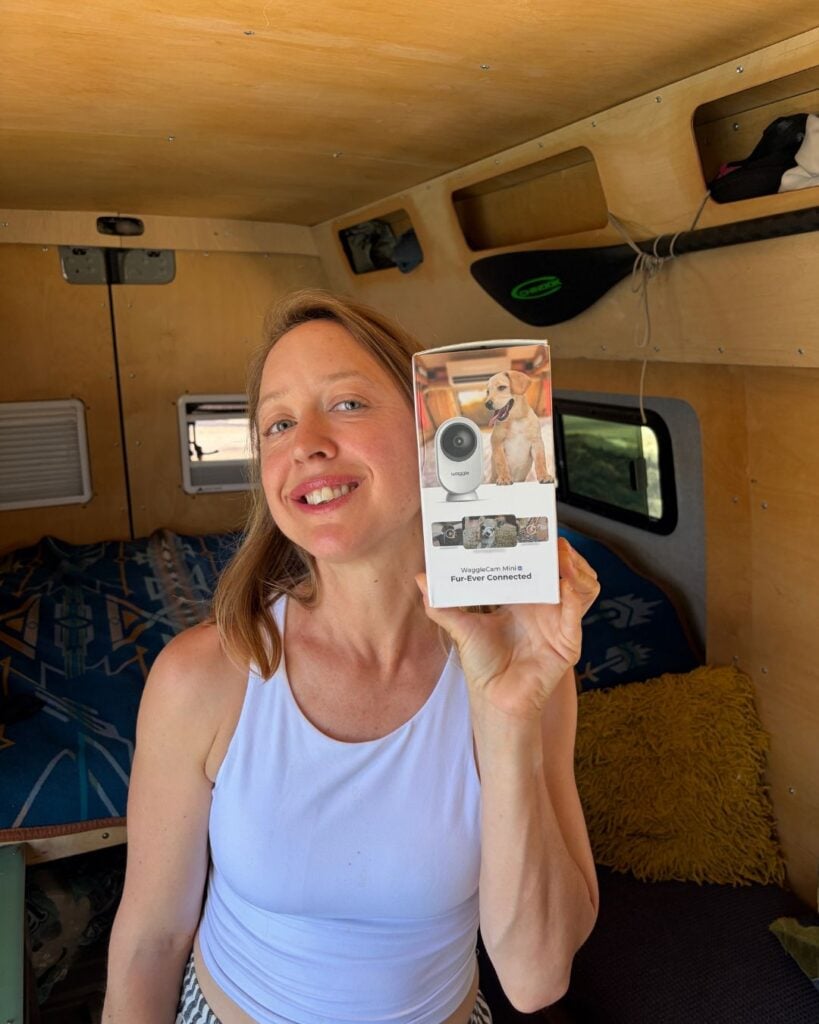
If you’re mostly boondocking or camping in spots without reliable WiFi, the RV 4G Mini Camera is worth considering. Cellular connectivity means it works no matter where you park (as long as there is cell signal!), and in an actual RV’s smaller footprint, that short detection range is less likely to be the dealbreaker it was in my much larger test space. It’s also the better pick if you want something you can mount outside to keep an eye on the exterior of your rig, since it’s weatherproof and doesn’t need to stay near an outlet. I loved that it stayed at 100% charge with the solar panel.
If you’ve got campground WiFi, or you’re running your own Starlink, the RV Cam AI Mini is the one I’d point you toward if your goal is to catch movement inside your RV. It was the more dependable of the two at actually catching movement. The trade-off is that it needs to stay plugged in and it’s rated for inside-use only, so it makes more sense as an inside-the-rig setup than an exterior one. But if you have a robust electrical system, this device can also be used while boondocking using your Starlink. This would work very well if you are so far off-grid that you don’t have a cellular signal to run the RV 4G Mini.
And you don’t necessarily have to pick just one.
Plenty of RVers run a setup like this: the 4G Mini as a backup or exterior camera for boondocking, and the AI Mini as the daily driver whenever you’re hooked up. That way you’re covered whether you’re parked at a full-service site or out in the middle of nowhere.
Or you could use the 4G Mini on the exterior of your rig and the AI Mini on the interior. That way, all bases are covered.
Final Thoughts
Both of these cameras do what they promise, but they’re built for different situations, and that’s really the takeaway here. If I had to pick just one for most RVers traveling with pets, I’d go with the RV Cam AI Mini. It was the more dependable of the two at catching real movement, and when you’re trying to figure out whether your dog is anxious or just napping, that reliability is what actually matters.
That said, I wouldn’t count the 4G Mini out. If you’re someone who boondocks often or spends a lot of time somewhere WiFi isn’t a given, having a camera that doesn’t depend on a signal is genuinely valuable, even with the detection range being tighter than I’d like. And since I tested both in a much bigger space than a typical RV, that gap may not even show up the same way inside your rig.
If your setup allows for it, running one of each isn’t a bad idea, the AI Mini inside for day-to-day peace of mind, the 4G Mini as backup or exterior coverage for when you’re off-grid.
And if you pair these with one of Waggle’s RV pet temperature monitors that show you temp, humidity and power outages inside your rig, you’ll have the peace of mind to go on hikes, errands or out to dinner without constantly worrying about your pet. And that’s what RVing is all about, right?