

Gas Heater Kills Couple Sleeping in Their Campervan. It Looks Almost Identical to Heaters Many Van Lifers Own.

An inquest found a married couple died of carbon monoxide poisoning after running an outdoor-only gas heater inside their campervan.
*This post may contain affiliate links. Please read our disclosure policy for more info.
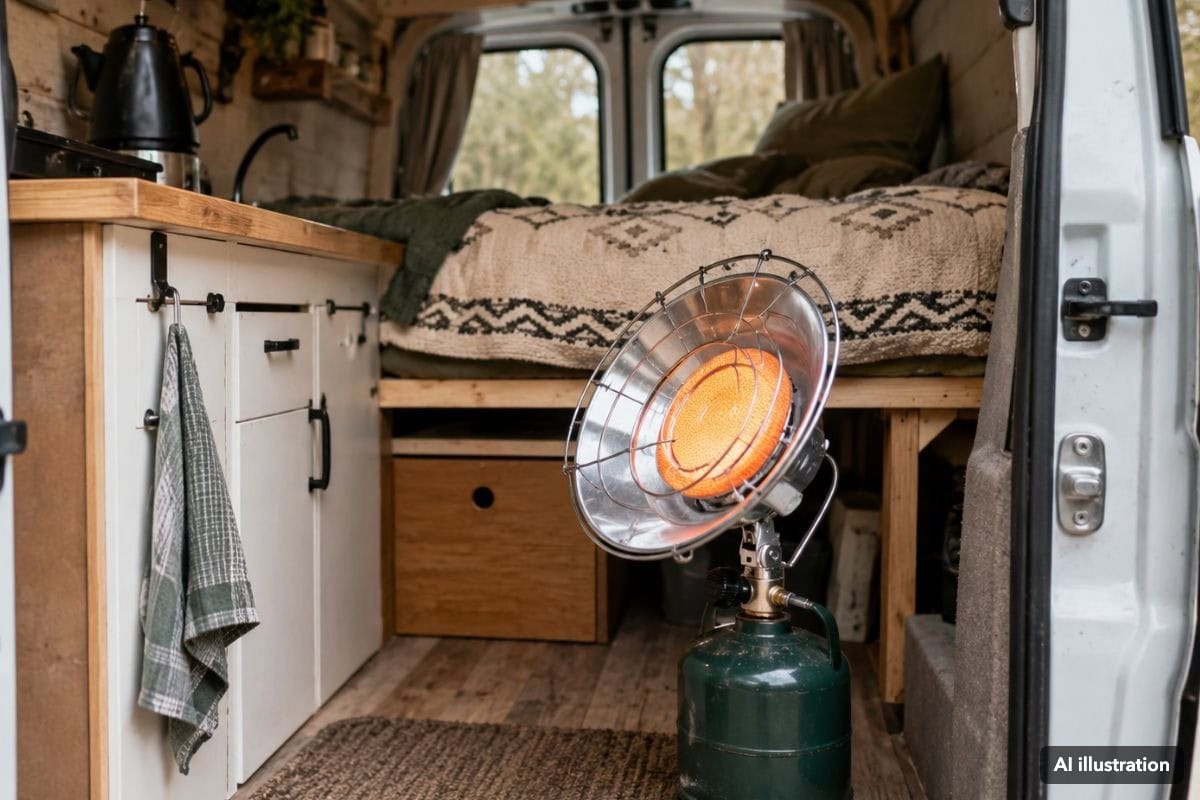
Featured image is an AI illustration: an outdoor-rated parabolic heater burning inside a van — the exact setup that killed two campers. Never do this.
A married couple died of carbon monoxide poisoning while sleeping in their campervan at a festival in England’s New Forest, after running a gas heater that was never designed for indoor use, an inquest concluded this week.
Christopher Coll, 45, and Kayleigh Coll, 38, of Blandford Forum, Dorset, were selling crafts at a cider festival in Burley last October. Overnight, they ran a parabolic gas heater, a dish-style radiant unit that mounts on a propane cylinder, inside their van.
The type the couple used to heat their van is rated for outdoor use only but looks very similar to the Mr. Buddy heater, a propane heater many van lifers use inside. Both died in their sleep. A fellow exhibitor found them the next morning after they failed to open their stall.
The inquest at Winchester Coroner’s Court recorded a verdict of misadventure. The coroner said she would ask the heater’s manufacturer whether its products carry sufficiently clear warnings against indoor use.
Why this matters to every van lifer
Here is the detail that should stop every vehicle dweller mid-scroll: the heater that killed the Colls looks almost identical to the indoor-rated portable heaters that thousands of van lifers own and use safely. Same glowing radiant element. Same propane bottle. Same dish shape. Lined up in a gear pile, most people could not tell you which one is designed to keep you alive.
The difference is entirely internal. Indoor-rated portable gas heaters carry an oxygen-depletion sensor that shuts off the flame before the air in a small space becomes dangerous, plus a tip-over switch. Outdoor-only units, including patio, tank-top, and parabolic heaters, have none of that protection. They were built for open air, where carbon monoxide disperses instantly.
And this was not a freak event. In Kennewick, Washington, a man and his Labrador died the same way in his van: the same type of outdoor parabolic propane heater, used inside, with its safety systems bypassed. Two continents, one pattern.
Carbon monoxide gives you no warning
Carbon monoxide is odorless and invisible. Its early symptoms, headache, drowsiness, dizziness, feel exactly like ordinary end-of-day tiredness. In a small sealed van, concentrations rise fast, and if it happens while you sleep, there is no warning at all. The CDC attributes hundreds of American deaths to accidental carbon monoxide poisoning every year, with small enclosed spaces like vehicles, campers, and boats among the highest-risk settings.
How to heat a van safely

I have slept in vehicles for nine years, and have only used an electric heater inside my van while connected to power. Many people use diesel or gas heaters that are meant to tap into your fuel tank. Here are some heater rules to keep in mind:
1: Check the heater’s rating, not the look. If the box, manual, or data plate says outdoor use only, believe it, no matter how much it resembles the safe one. This single habit is the difference in both deaths above.
2: Carry a battery carbon monoxide detector. It costs about as much as a tank of gas and it is the one non-negotiable item in any van. It leads our van life essentials list for exactly this reason.
3: Ventilate, always. A cracked window or open roof vent, even in winter, even when it feels wrong. You must do this when running any sort of propane heater, even if its rated for indoor use.
4: Never modify or bypass a heater’s safety features. The Washington death involved defeated shutoffs. Those systems are the entire difference between an appliance and a hazard.
5: For overnight heat, use gear built for sleeping. Warm the van, then shut portable propane off for the night. If you need continuous heat, that is the moment for a vented diesel heater or electric heat. Our guides to campervan heating and diesel heaters cover the systems full-timers trust.
FAQs
Can you use a portable propane heater in a van?
Only if it is rated for indoor use, meaning it has an oxygen-depletion sensor, and only with ventilation and a carbon monoxide detector. Warm the space, then shut it off to sleep.
Can you use a patio or tank-top parabolic heater in a camper?
No. Never. These are outdoor-only appliances with no low-oxygen shutoff, and they have killed campers who used them inside.
Do I need a carbon monoxide detector in a van?
Yes. Carbon monoxide is odorless and its symptoms imitate simple tiredness. A battery detector is the cheapest life insurance in van life.
What is the safest heater for sleeping in a van?
A vented diesel heater or electric heat. Both keep combustion out of your breathing space, which is why they are the full-timer standard for winter nights.


I saw that dreadful article about he couple, now I am seeing about the man and his dog, so very sad, plus all the other incidents that we have not seen. So important to read the labels especially if the heaters look the same, now that is scary. I wonder how experienced these people were, if they knew better and maybe assumed it was ok and rushed trhough their packing and grabbed the wrong one, who knows. So devastating. Kristin I know you guys are experienced and are careful, be safe and come back home to the boatyard alive, OK? I am curious what more can a company do? Besides place a warning label on an item and hope the customer/end user reads it.
This is so sad to see. Please do research on the safest heaters before you purchase one. When I was looking at them online I saw the Mr…. brand and was in the process of placing the order, then when I entered my address a message came up that in couldn’t be shipped to my state. I thought that was strange, never had that happen before. I checked to see if I could pick it up locally- then it said not allowed to sell in it in my state. But could have drove a half hour to the next state to pick one up at the same big box home improvement store. When I found out why, I was glad I didn’t purchase this. I never did buy any kind of heater. I didn’t really want to get an electric heater because I don’t always have access to power. I have a power station and solar panel for everything else. It’s just not enough power to run a heater. Don’t have diesel fuel, my van runs on gas so I’m not sure what to use.