

I’ve Wintered in the Desert for Years. Here’s Where Van Lifers Actually Go When It Gets Cold.

The six places the van world goes when it gets cold, from Quartzsite and the Slabs to Baja and the Texas coast, with what each costs, who ends up where, and why the migration exists.
*This post may contain affiliate links. Please read our disclosure policy for more info.
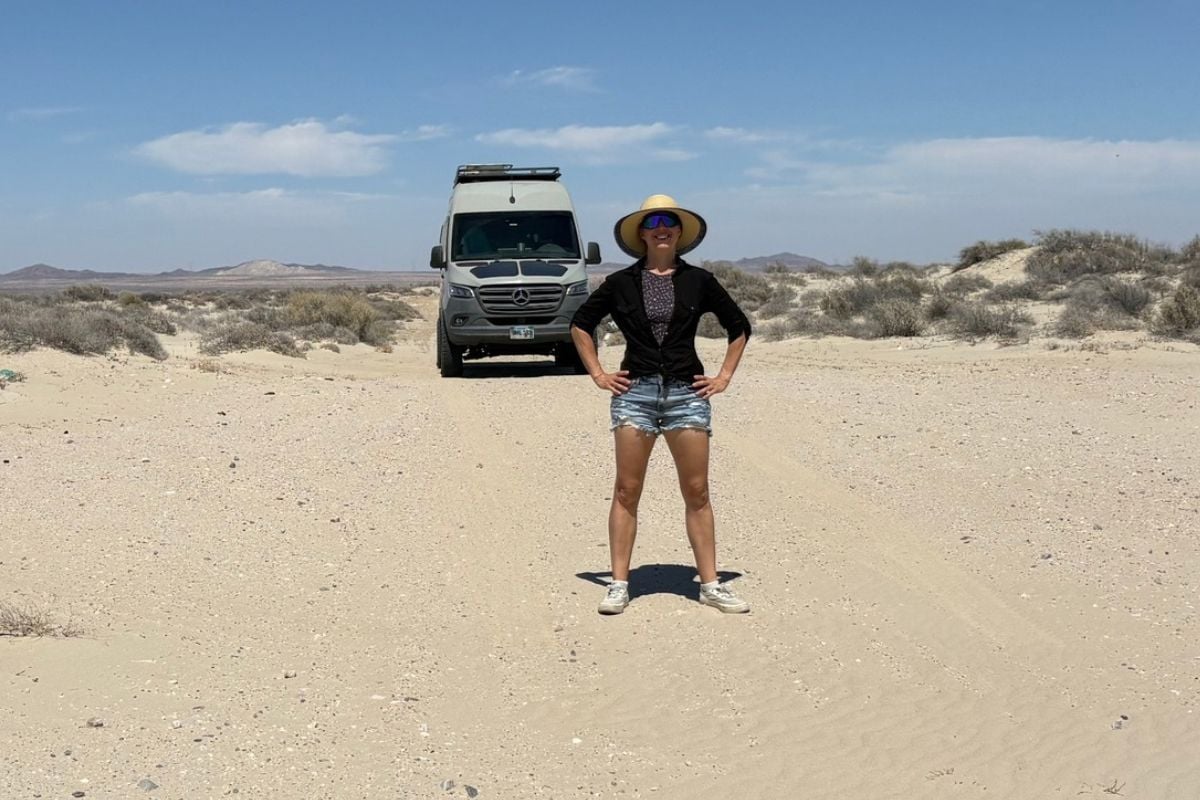
Every fall, when the nights in the campervan turn cold, I point it at Mexico. Our sailboat lives in a boatyard an hour south of the Arizona border, on the northern tip of the Sea of Cortez, and that is where my winter ends: warm in January while so may other states are under snow. I have made that crossing every year since 2021, and the van comes with me.
It was not always like this. For years my winter was the same 1972 sailboat tied to a dock in San Francisco Bay, and anyone who has spent a January on a boat there knows it is not the warm version of boat life. Before the boat there was the Astro van, and the Arizona desert in spring is still one of my favorite places I have ever camped.
Most van lifers do not have a boat waiting at the far end. They have a desert, and a desert is not a bad second place. Here are the seven places the van world goes when it gets cold, what each one is actually like, what it costs, who ends up where, and the honest reason the migration exists at all.
Quartzsite, Arizona: the capital
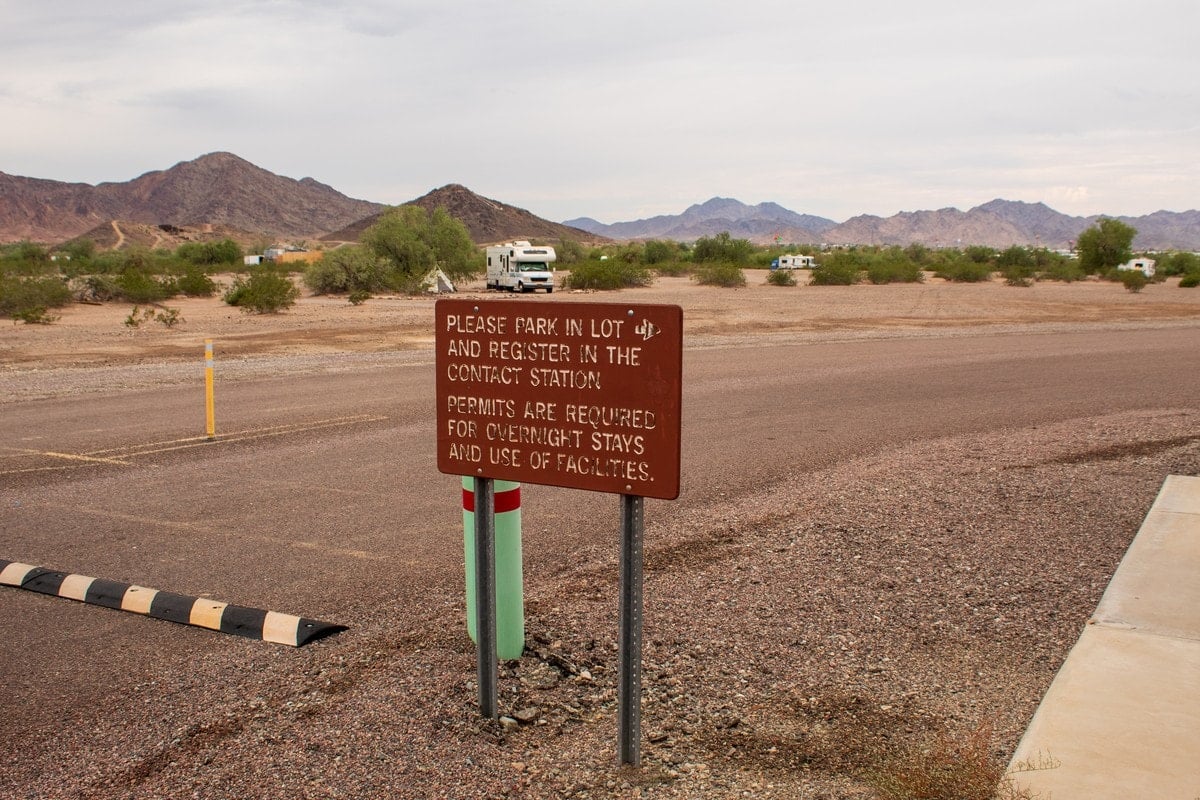
Quartzsite is a town of a few thousand people on Interstate 10 that turns into one of the biggest gatherings of vehicle dwellers in the country every winter. The reason is the Bureau of Land Management’s Long-Term Visitor Areas. La Posa LTVA, two miles south of town, sells a long-term permit for $180 that covers September 15 to April 15, seven months, and a short-visit permit for $40 that covers any fourteen consecutive days in that window and can be renewed as many times as you like. Either permit works at every BLM LTVA in Arizona and California. For that you get vault toilets, water faucets, dump stations and trash service, which in the desert is luxury.
Thousands of rigs spread across the creosote in loose neighborhoods: the solar nerds, the rock hounds, the big-rig retirees, the vans. January brings the Quartzsite Sports, Vacation and RV Show, the swap meets and more people than the town can hold. If you want other vans within shouting distance, a mailing address and a dentist within reach of a free desert, this is where you go.
Who goes: first-timers, retirees on a budget, and anyone who wants company without a campground fee.
Slab City: the other end of the spectrum
Slab City sits on the concrete pads of a decommissioned Marine base near Niland, California, by the Salton Sea. No fees, no hookups, no rangers, and no rules beyond the ones the residents keep among themselves. There are art installations, a library, a hot spring, a stage, and a permanent population that stays through the summers when the desert hits 115 degrees. People either love it on the first afternoon or leave by dinner.
Who goes: artists, the broke and proud, and the curious for a night or two. It is not the place to leave a van unattended for a week, and I say that as someone who likes it.
The Mojave and the low desert: the quiet middle

Between those two extremes is the biggest chunk of the migration, and it never names itself: the BLM land around Joshua Tree, the Mojave Preserve, Lake Havasu, the washes outside Ajo and Why, and the country around the Imperial dunes. Most of it is free. The BLM’s own rule for dispersed camping is fourteen days within any twenty-eight-day period, after which you move, usually at least 25 miles, and the exact limit varies by field office, so read the signs.
One exception worth knowing before you follow a line of rigs toward the dunes: the Imperial Sand Dunes require a permit from October 1 to April 15, $55 a week bought ahead or $70 on site, and a season pass is $185. That is the off-road crowd’s winter, and it is loud.
You can park on the other side of the road, past the railroad tracks, for free camping up to two weeks tha’t doesn’t require a permit.
Warm days, cold nights, enormous skies, and a cell signal more often than not. This is where the people who want to be left alone go, and it is where I first learned to boondock. How to find these spots is its own article; the apps do most of the work now.
Who goes: anyone with a solar panel, a full water tank and a reason to be alone for two weeks.
The Superstitions and Gold Canyon: the desert with a city attached
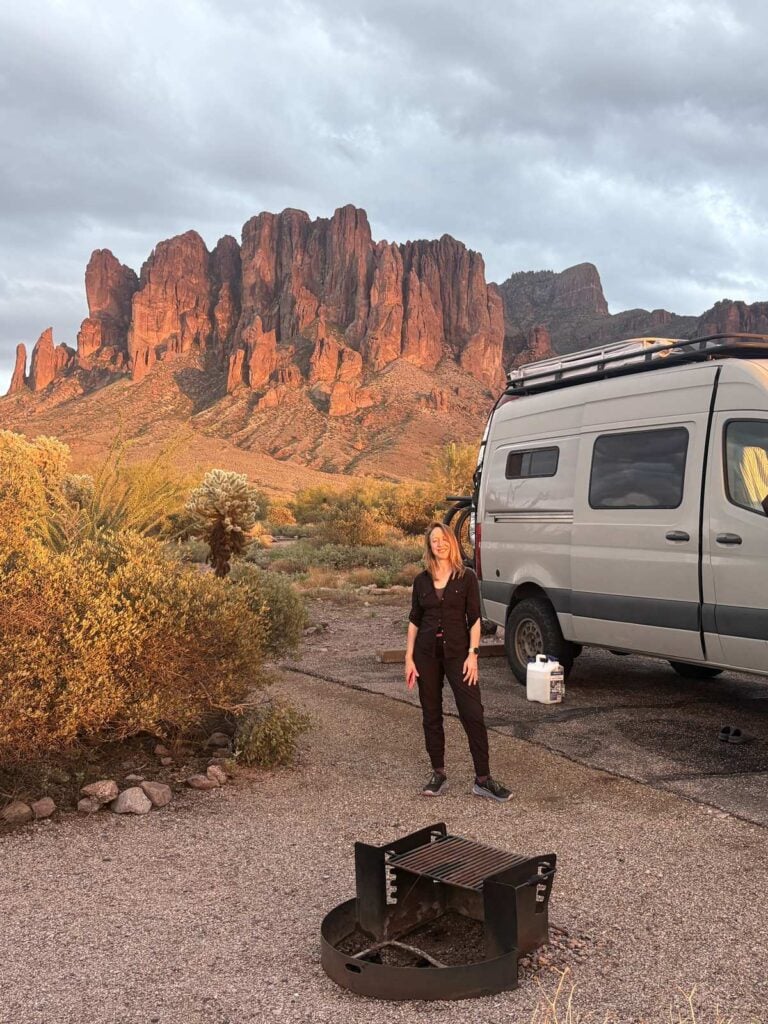
Forty-five minutes east of Phoenix, the suburbs stop at a wall of rock, and the van world has wintered at the foot of it for years. Gold Canyon and Apache Junction sit where the Superstition Mountains meet the last stoplight, which means saguaro country by day and a Costco, an urgent care and a Trader Joe’s inside half an hour. For a lot of people that is the whole point of wintering here instead of Quartzsite: you get the desert without giving up the town.
The famous free spot is gone, for now. The dirt stretch of Peralta Road on Arizona State Trust Land, where rigs lined up every winter with the Superstitions filling the windshield, was trenched off and posted no overnight camping in the fall of 2024, after years of overstays and trash, and the camping listings mark it closed. If a video from two winters ago sends you there, you will find signs. State Trust Land itself still allows camping elsewhere with a recreational permit ($15 a year for one person, $20 for a family), but with a hard limit of fourteen camping days per year, counted across every parcel in the state.
What is left is good. Hewitt Station Road, Forest Road 357 off US-60 past Queen Valley, is Tonto National Forest, with a long run of dispersed sites, fire rings, and a road that turns rutted and steep past the first lot; the Forest Service limit is fourteen days in any thirty, and the pack-it-in, pack-it-out rule is doing real work here, since volunteer crews clean the lower sites every winter. Bulldog Canyon, on the other side of the range, needs the Tonto OHV permit to drive in ($80 a year) and has a camping closure in force along State Route 88, so it is a day trip, not a bed. And when you want a shower, Lost Dutchman State Park has 134 sites at the base of the mountains for $35 a night without power and $50 with, and the trailheads start at the campground. Nobody books it at the last minute in January.
Who goes: people with a job, a dentist, or a family within an hour of Phoenix; first-timers who want the desert with a safety net; anyone who tried Quartzsite and missed having a grocery store.
Baja and the Sea of Cortez: Heading to Mexico

Every winter a convoy of vans and trucks crosses at Tecate, Tijuana or Sonoyta and heads down the peninsula or along the Sonora coast. Beach camping that costs little or nothing, fish tacos, whales in the lagoons from January, and a week of 70-degree days when the rest of the country is scraping windshields. Our own winter is here, on the Sonora side, where the boat sits on stands an hour south of the Arizona border and the van parks next to the hull.
The paperwork is real but small. Everyone entering by land needs the tourist permit, the FMM: free for stays of seven days or less, about $54 for up to 180 days, and there is no 72-hour exemption whatever the guy at the campground tells you. You need Mexican liability insurance, because a U.S. policy does not count there, and you need pesos, because the beach vendors and the small-town stores are cash only. The whole Baja peninsula is a free zone, so the van comes in on its U.S. plates with no import permit. The full crossing checklist, the checkpoints and the one mistake first-timers make are in our Baja road trip guide.
Who goes: surfers, windsurfers, the people who did Quartzsite once and wanted fewer neighbors, and anyone whose rig is simple enough to fix in a small town.
South Texas and the Gulf: the Winter Texans
The Rio Grande Valley, Padre Island and the state parks along the Texas coast fill up every winter with people from Minnesota and Manitoba who have been coming for thirty years; the valley’s universities even survey the Winter Texans as a population. Mild, humid, flat, cheap, and more sociable than the desert.
The prize for a van is Padre Island National Seashore, where you can camp on the beach itself. North Beach, South Beach and Yarborough Pass need no camping permit, only the park entrance pass ($15 to $25 for seven days, or $45 for the year), and there is a dump station and a freshwater fill by the main campground. The limit is fourteen consecutive nights and twenty-eight nights a year, first come, first served, no reservations. Check the tide chart before you drive out, because the beach closes when the Gulf comes up.
Who goes: East Coast and Midwest van lifers who do not want to cross the whole country, families, and anyone who needs an airport nearby.
Florida: the other coast
Florida is warm all the way down and green in January, and it is the hardest of the seven to do cheaply. The state parks book out months ahead for the winter, the national forests in the panhandle mostly do not, and the Keys are a once-a-winter splurge. Free camping is thin, the no-overnight signs are everywhere, and the people who winter in Florida tend to have a plan and a reservation before they cross the state line.
Who goes: East Coast van lifers, people with a campground budget, and anyone who wants a beach without a border crossing.
How to pick
Ask yourself three questions.
- How much company do you want? Quartzsite is a city, the Mojave is a wilderness, the Slabs are a commune, and the Texas coast is a neighborhood.
- How much money? BLM land and the national forests are free or close to it; Padre Island is the price of a park pass; Florida is not free.
- How far will the rig go? Baja rewards a simple vehicle and some Spanish. The Gulf coast rewards nothing in particular, which is its charm.
Then pack for cold nights wherever you land. Every one of these places drops into the thirties after dark in January, and the desert does it with a clear sky that pulls the heat out of a van by midnight. Our winter camping tips cover the bedding, the condensation and the heater question; the short version is that the migration solves the days and you still have to solve the nights.
The honest part
The migration exists because living in a vehicle through a northern winter is miserable: short days, wet bedding, a propane bill, and ice on the inside of the windows. Going south is not a vacation. It is the sensible response to the fact that your house has no furnace.
The lucky ones have a boat waiting at the far end. The rest have a desert, and a desert in January, with a fire ring and nobody within a mile, is a better place to spend a winter than most houses I have lived in. Where does your van go when it gets cold, and how did you pick it?
Winter migration questions, answered
Where do van lifers go in the winter?
South, to seven places: Quartzsite, Arizona and the BLM Long-Term Visitor Areas around it; Slab City near the Salton Sea; the free BLM land of the Mojave and the low desert; the Superstitions and Gold Canyon outside Phoenix; Baja and the Sea of Cortez in Mexico; the Texas Gulf coast and Padre Island; and Florida. Each has a different price, crowd and climate, and most van lifers settle into one and return to it every year.
How much does it cost to winter in Quartzsite?
The BLM’s La Posa Long-Term Visitor Area sells a long-term permit for $180 that covers September 15 to April 15, or a $40 short-visit permit good for fourteen consecutive days and renewable. Both include vault toilets, water, dump stations and trash service, and both are valid at every BLM LTVA in Arizona and California.
How long can you camp for free on BLM land?
Dispersed camping on BLM land is generally limited to fourteen days within any twenty-eight-day period, after which you must move, often at least 25 miles. The exact limit varies by state and field office, so check the posted rules for the area you are in.
Can you camp on the beach at Padre Island in a van?
Yes. North Beach, South Beach and Yarborough Pass at Padre Island National Seashore allow primitive beach camping with no camping permit, only a park entrance pass. The limit is fourteen consecutive nights and twenty-eight nights per year, first come, first served, and the beach can close when tides or storms flood it.
What paperwork do you need to drive a van into Baja for the winter?
A tourist permit, the FMM, which is free for stays of seven days or less and about $54 for stays up to 180 days; Mexican liability insurance, because a U.S. policy is not recognized in Mexico; and pesos for the cash-only towns. No vehicle import permit is needed anywhere on the Baja peninsula, which is a free zone.
Is it cold at night in the desert in winter?
Yes. Even in Quartzsite and the Mojave, January nights regularly drop into the thirties under clear skies, and a van loses its heat fast. The migration fixes the days; bedding, a vented heater and condensation control fix the nights.
Sources
Permit prices and stay limits checked October 2026. Bureau of Land Management, La Posa Long-Term Visitor Area · BLM, Camping on Public Lands (dispersed camping stay limits) · BLM, Imperial Sand Dunes permits · National Park Service, Padre Island National Seashore camping · NPS, Padre Island fees and passes · Baja Bound, Guide to the Mexican Tourist Card (FMM) · Quartzsite Sports, Vacation and RV Show · Florida State Parks reservations · UTRGV Winter Texan research · Tonto National Forest, dispersed camping FAQ and Forest Order 03-12-00-18-329 (fourteen days in thirty) · Arizona State Parks fee schedule (Lost Dutchman) · Arizona State Land Department recreational permits · Recreation.gov, Tonto National Forest OHV permit. The Peralta Road closure is reported from the camping listings and their reviews (October–November 2024), not from an official notice. Slab City is described from general public knowledge and our own visits, without figures.


