

7 Salty Rules We Learned the Hard Way at Sea (And That You Should Know, Too!)

When you live full-time on a sailboat, the ocean becomes your teacher — and she doesn’t hand out participation trophies.
Here’s a taste of what she taught us:

*This post may contain affiliate links. Please read our disclosure policy for more info.
(This is a guest post by Norm & Kathy on Endless Summer. Check out their YouTube channel here)
Sailing has a way of stripping life down to its essentials. Out on the water, every decision matters — from when to reef the sails to how you handle stress with your partner. Over the years living aboard our sailboat Endless Summer, my wife, Kathy and I discovered that the lessons learned at sea don’t just keep the boat afloat — they keep us afloat too.
Those lessons became the heart of my book, “If It Works, Don’t F#%K With It… and Other Rules for Sailing and Life.” It’s a collection of 60 hard-earned rules, born from both the joys and the chaos of long-term cruising. Some are practical, some are funny, and some are surprisingly philosophical — but all of them are real.
Whether you’re a seasoned sailor, a weekend dreamer, or just someone curious about what life looks like when your backyard is the ocean, this book is for you.
Here are just a few of the rules you’ll find inside our book.
Rule 1: If It Works, Don’t F#%K With It

On a sailboat, perfection doesn’t exist. Something will always look slightly off — a line too loose, a screw just a little wobbly, a sail that could use a minor trim. The temptation to tweak is constant. But more often than not, tinkering with something that’s working fine leads to bigger problems.
We’ve learned that many of our onboard disasters started with “just a small adjustment.” Overtighten a screw, and you strip it. Over-trim a sail, and you stress the rig. That instinct to intervene is human nature, but it’s often best ignored. Sometimes the smartest move is to do nothing at all.
Rule 2: Reef Early, Not Late

“If you think you need to reef, it’s already too late.” This rule is a rite of passage for every cruiser, and we learned it the hard way. When we first started sailing, we’d often set full sail with the idea that we could always reef later. That mindset worked—until it didn’t.
On a passage from Curaçao to Aruba, light winds carried us most of the way, even under spinnaker. But as we neared Aruba’s eastern point, the wind suddenly built into strong gusts. With a full main and jib, we rounded up violently, our jib backwinded, and we were forced into a sudden tack. Reefing the main was nearly impossible without the engine holding us into the wind, so we pressed on with just the jib reefed.
The experience was a wake-up call: had it been night, the consequences could have been dangerous. Now, we reef before things get hairy, not after
Rule 3: Go Now — Next Year You’ll Only Be One Year Older

One of the hardest choices couples face is deciding when to go cruising. Careers, family, and finances all argue for waiting “just one more year.” For us, it meant early retirement: I was 48, and Norm was 58. Once we left, there was no guarantee we could return to our careers if it didn’t work out.
At first, we dipped our toes in the water. We rented boats, took courses, and cruised weekends while working remotely. But boat maintenance and full-time jobs don’t mix well — Wi-Fi and deadlines kept us tied to marinas more than we liked, and breakdowns collided with conference calls.
Eventually, it became clear that if we waited any longer, our window might close. Cruising is physically demanding — hoisting sails, crawling into bilges, lugging groceries — and age only makes it harder. Our advice: don’t wait for the “perfect” time. It doesn’t exist. Go now, or risk never going at all.
Rule 4: There’s No Such Thing as Being Over-Anchored
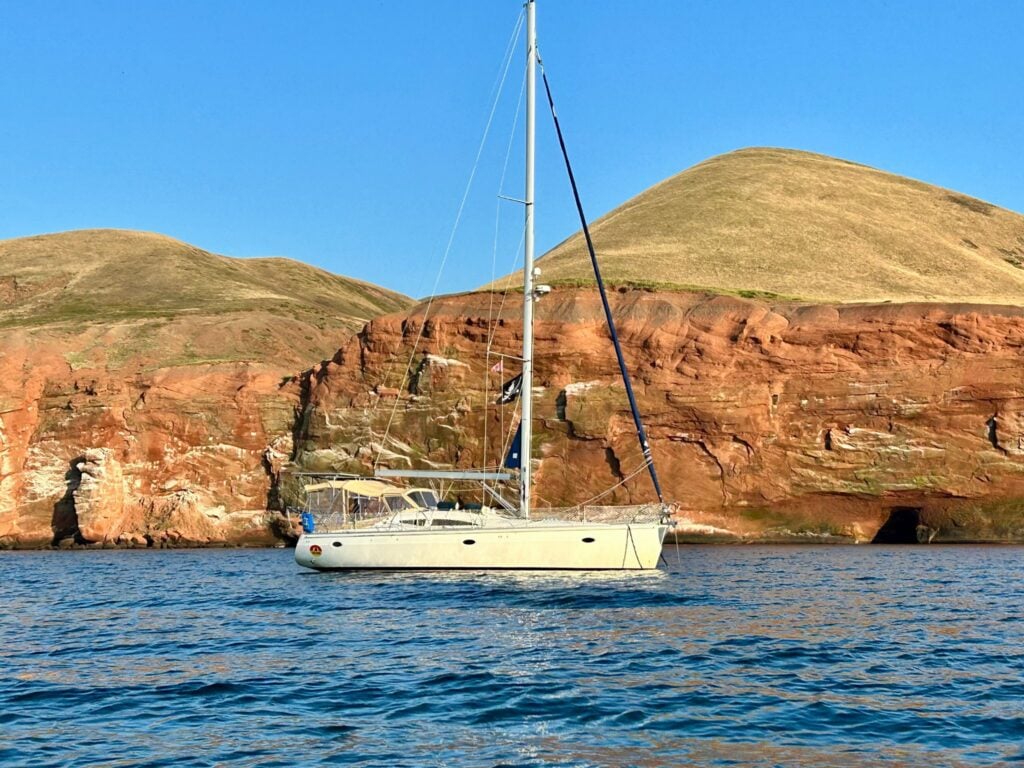
Anchoring is where safety meets sleep. When we bought Endless Summer, she came with a 45 lb Bruce anchor and 300 feet of chain. We thought it was fine — until a seasoned cruiser told us, “If you’re serious about the Caribbean, buy a Mantus. One size bigger than recommended. You’ll sleep better.”
Reluctantly, we spent the money, and it turned out to be some of the best money we’ve ever spent. After two years of squalls, crowded anchorages, and questionable holding, our oversized Mantus has never let us down. We’ve sat through 40+ knots of wind in soft mud without dragging an inch. That peace of mind is priceless. When it comes to ground tackle, bigger is always better. Sleep is worth the weight.
Rule 5: Don’t Panic

The golden rule of seamanship — and of life — is simple: don’t panic. Panic makes small problems big and big problems catastrophic. We were reminded of this when our spinnaker hourglassed during a jibe, twisting itself tight while flogging violently against the rig. For a few moments, chaos threatened to take over.
But instead of yanking lines and making it worse, we stopped, breathed, and calmly talked through the steps. One of us eased the sheets, the other worked the sail free, and soon it filled again as if nothing had happened. That day, we proved to ourselves that calm thinking always beats adrenaline. On a boat — and in life — panic is the enemy of good decisions.
Rule 6: Don’t Buy Problems — You Get Enough for Free

Sailboats are problem factories — Endless Summer proves that almost daily. There’s always something needing attention: a leaking fitting, a stubborn line, or a breakdown at the worst possible moment. That’s why we live by one of our core rules: “Don’t buy problems — you get enough for free.”A good example? We once had the chance to buy a used wind generator at what seemed like a bargain price.
Tempting as it was, we passed — and we’re glad we did. Every cruiser knows how finicky those things can be, and the last thing we wanted was to spend our anchorages troubleshooting someone else’s castoff. Instead, we stuck with what we knew worked for our boat.
That decision saved us time, money, and frustration, and let us get back to why we’re out here in the first place: diving, biking, exploring, and watching the sun set at anchor. Cruising already hands you more than enough surprises for free — no need to add to the pile.
Rule 7: Don’t be opposed to doing things the correct way

There is an old adage: “The right way takes 10 minutes. The wrong way takes all afternoon — and probably a few choice words.” Nothing could be truer on a sailboat. The sea doesn’t forgive shortcuts, and small mistakes have a way of multiplying when you try to outsmart them.
On Endless Summer, we’ve proven that old saying more times than I care to admit: “The right way takes 10 minutes. The wrong way takes all afternoon — and sometimes three weeks and $150.”
Take the time I needed to hoist Kathy up the mast. Instead of just using the cabin top winch — the way we always had — I decided to get clever. I rigged the spinnaker halyard back to our electric main winch in the cockpit, thinking I could let the motor do the work instead of my arms. It seemed brilliant… until it wasn’t. The angle of the line put stress on the winch’s self-tailing mechanism, and under load it snapped clean off. Suddenly, I wasn’t saving time — I was staring at a broken winch, a three-week wait for parts, and an unplanned $150 repair bill.
If I’d just done it the right way from the start, it would’ve taken me maybe three extra minutes and zero dollars. Instead, I bought myself a long delay, a lighter wallet, and a reminder that shortcuts at sea usually cost more than they save.
Final Thoughts:
Life aboard Endless Summer has taught us more than just how to handle a sailboat. These rules are philosophies that shape how we handle change, challenge, and even each other.
If these stories resonate with you, you’ll find 60 more lessons in my book, If It Works, Don’t F#%K With It… and Other Rules for Sailing and Life — now available on Amazon. And if you’d like to follow our adventures in real time, subscribe to our YouTube channel, where we share the highs, lows, and everything in between: (https://www.youtube.com/@SVEndlessSummer).
Fair winds,
Norm & Kathy




My golden rule is KISS (keep it simple, stupid). The more equipment you have, the more there is to maintain, go wrong and have to replace. My new boat won’t have a spinnaker/gennaker/code zero and will only have one winch. I would rather lose one knot of speed in light winds than have to store, repair and replace a rarely used sail.
The second rule, related, is only have a boat as big as you actually need. There has been a trend for decades, especially in the charter market, to have forever larger sailboats. In the charter market I can understand it as a group of friends sharing the charter fee reduces the cost per person. On a privately-owned boat, they make absolutely no sense. The cost of maintenance and other costs is approximately proportional to the cube of the LOA. The cube! If you are one or two people, you only need one bed and one heads. At most, two cabins so as to accommodate guests.
As to ‘rule’ no. 4, it is not a question of having a larger anchor, it is having a matter of having more than one anchor of different types for different holding conditions. I would never have an all-chain cable due to the tugging that can disturb sleep and even cause damage to the boat. A boat length of chain and the rest in stretchy nylon makes for more comfortable sleep.