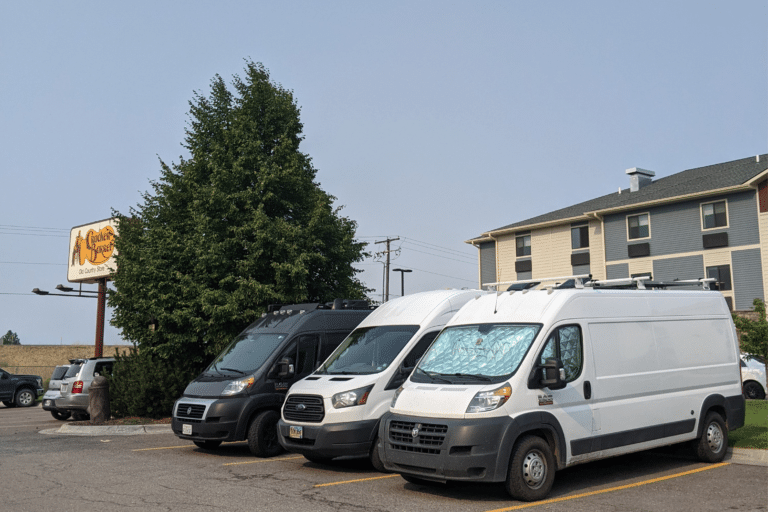
My Van Has No Bathroom. I Asked Hundreds of Van Lifers What They Use for #2.

Eight years in a van with no toilet, and hundreds of van lifers answered what they use instead: buckets and litter, fold-out loos, cassettes, composting toilets, wag bags, night bottles, and why the shower is the harder problem.

*This post may contain affiliate links. Please read our disclosure policy for more info.
My campervan has never had a toilet for a few reasons. #1, it grosses me out to think about going poop so close to my kitchen and bed. #2 it takes up valuable space in a 144-inch Sprinter van.
Usually, I’m fine without. We are usually close enough to a public toilet or far away enough that digging a hole isn’t a problem.
The van life toilet debate has always been a big one, so I asked members of my van life Facebook group what they think about it. By the end of the weekend, more than 300 people had responded. Some agreed. A lot of them to tell me, in detail, what they use instead.
Most full-timers without a built-in bathroom use one of five things: a bucket with a liner and a scoop of litter, a fold-out dry toilet, a cassette toilet or porta potti, a composting toilet, or bags made for the job. For the middle of the night, almost everyone has a bottle, a jar or a funnel. For showers, the honest answer is a gym membership.
The catch, which the comments made very clear, is that there is no setup that makes a van a house. Every one of these is a trade: space, smell, the chore of emptying, or the morning drive. Here is what hundreds of van lifers told me they actually do, grouped by method, with my own answers where I have them and the rules on disposal where there are rules.
What my own mornings look like, since people asked
We built our Sprinter ourselves, while boondocking, with no workshop, and it has never had a toilet. I have used a bucket toilet in it exactly once, in an emergency, and I have not done it again. What I do keep is a pee cup: a cat litter jug, the opaque white kind, so nobody can see what is inside.
The bathroom is gyms, campgrounds and public restrooms, and some mornings it is a drive. Other times if we are out in the middle of nowhere, I dig a cathole following Leave No Trace principles.
Showers are a solar bag behind the van or a Planet Fitness, and I plan whole days around where the next one is.
The bucket is the most common answer, by a wide margin

If the thread had a winner, it was a five-gallon bucket. Dozens of readers described the same build in their own words: a bucket, a snap-on toilet seat and lid, a bin-bag liner, and a layer of something absorbent on top of each use. Cat litter was the most common, then horse-bedding pellets, sawdust, pine shavings and coconut coir. “Bucket toilet, small and has proper toilet seat,” one reader wrote. “We now use cat litter, no slopping chemical liquid and easier to empty as it’s in a bin liner and no smell.”
The build costs almost nothing, which is most of the appeal. “That is what a $5 five gallon bucket is for,” a reader said. A solo traveler nine months in uses “empty garbage bags and an empty 5 gall paint bucket for emergency.” One reader’s version came with assembly instructions: “Home depot bucket, garbage bags, round foam floated cut and trim top. Toilet paper fits on handle. You’re set.” Another swore by “equine pellets” in an old kitty-litter bucket with a raised toilet seat on top, which “fits perfectly.”
The two rules that came up again and again: keep liquids out of it, and change the bag often. “A bucket will do but not for a poo,” one reader argued, and the people who disagreed still separated the two, with a bottle for one and the bucket for the other. The solo reader above disposes of the bag “once a day.” One reader has used the bucket method for almost twenty years; another’s name for it, offered with a straight face, was “bucket and chuck it.”
What nobody said, and what matters: the bag has to go somewhere that is allowed to take it. In the United States the National Park Service says a bagged waste kit “will then be disposed of in a designated receptacle or a trash can,” and a bucket liner with litter is the same category. Not a dog-waste bin, not the bushes, and not a campground vault toilet, which gets pumped out and is usually signed for no trash. If you want a bucket that is a little less of a bucket, the fold-out dry toilets and the better bucket kits are in our roundup of campervan toilets that are not disgusting.
The fold-out dry toilet is the bucket with manners
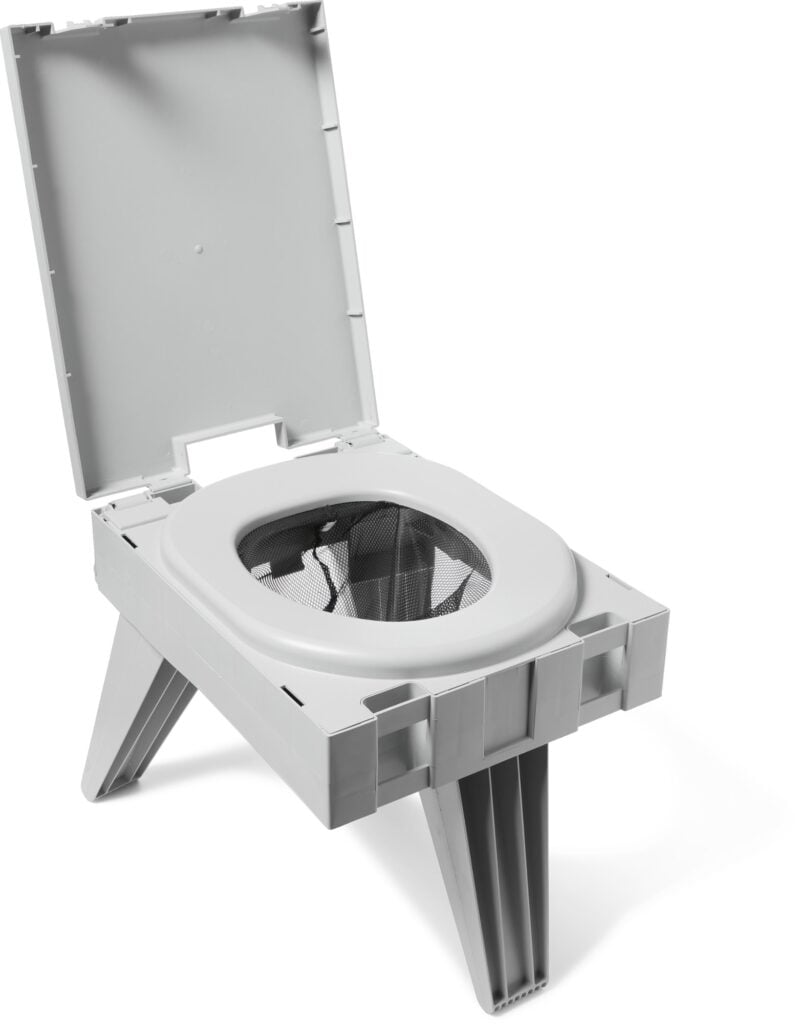
The second camp bought the same idea in a box: a folding frame with a real seat, a liner and a gelling powder. “Why not just have a fold out dry toilet?” a reader asked me. “I got mine for under $50 and it has a toilet seat cover. Liners and a little cat litter and some toilet paper. Either go in the van or a secluded spot.” A British reader uses a carp-fishing bivvy loo: “I love it. No emergencies. Can order gelling powder from Amazon and dispose in regular waste.” Another keeps a Cleanwaste folding toilet with the powder: “No mess no smell.”
The porta potti people think I am being stubborn

The largest single group in the comments owns a cassette toilet or a porta potti, and a lot of them could not believe I do not. “What!? You can’t fit a portable potty in that huge van? I’ve got one in my VW T4!” “No toilet and stubbornness go hand in hand.” “Well not having a toilet is a simple problem to solve. Driving round looking for one may work for now but wait until you are old!” Fair. I do not have a defense that will satisfy them, only the description above.
Their case is strong. A reader who has used a Thetford Porta Potti in three different vehicles: “No smell, easy to service. I can’t go all night without using it. Can’t imagine traveling without it. I’ve used it when public facilities were too dirty to use.” Several keep it “between the 2 front seats.” One empties hers “every 5 days.” Another described the cassette itself better than any product page: “like a laptop bag with handles, breaks into two parts, carry in and empty out.” An older reader made the point that outlasts every other argument: “when you get older, time is a factor for emergency bathroom time.”
The trade is the dump. A cassette holds a few days and then has to be carried to a dump station, a campground toilet that allows it, or a home toilet, and the chemicals matter if you empty into a septic system. The readers who love theirs have made peace with that chore; the readers who sold theirs mostly did not.
Composting toilets came up less than you would think

For a method that gets most of the YouTube airtime, composting toilets drew only a handful of comments, and almost nobody named a brand. The readers who have one described it as a two-part chore rather than a miracle: a urine bottle that is emptied every couple of days and a solids bin that lasts a couple of weeks. “A composting toilet good for two weeks number 2 bagged, and easy to empty two day container for number 1s,” wrote a reader a month into touring France, Spain and Portugal in a small van. A sailor who has used one in the Caribbean for years told me to buy one or “go on YouTube and see how to build one yourself, they have pee diverters.”
That is the honest pitch for composting: no chemicals, no black tank, and the solids bin does not smell when the fan and the cover material are doing their jobs. The honest catch is the price and the space, which is why so many readers landed on the bucket, which is a composting toilet with the fan and the diverter removed. If you want the real thing, our composting toilet guide compares the ones that fit a van, and one of our writers has lived with a Cuddy composting toilet long enough to say what she really thinks.
The bag people have the simplest system of all
A smaller group skips the seat entirely. Wag bags, the commercial kits with a gelling powder inside, were one version; the other was a carrier bag or a dog bag and a bin. “DisposaJohns and a bucket will suffice,” one reader wrote. “A shewee and an empty Lenor bottle for wees.” Another: “Doggy bags and a tupperware box.” A reader who grew up with a caravan bucket in the sixties explained how she got here: dog bags gave her the idea, she found “degradable pedal bin bags with handles,” and “what started as playful experiments became habits.”
The bag kits are also the only one of these methods that land managers actively ask for. Canyonlands requires river trips to carry solid waste out and names “commercial bag systems (e.g. Wag Bag, Restop II)” as approved, stored in hard-sided containers or heavy waterproof bags labeled human waste. The maker of the original Wag Bag says each kit gels up to 32 ounces and the instructions are “just use it, seal it, and toss it in the trash.” The Park Service says the same: trash can. If you boondock in canyon country or on beaches where digging is not allowed, a box of these is the whole bathroom.
The middle of the night is a bottle, a jar or a funnel
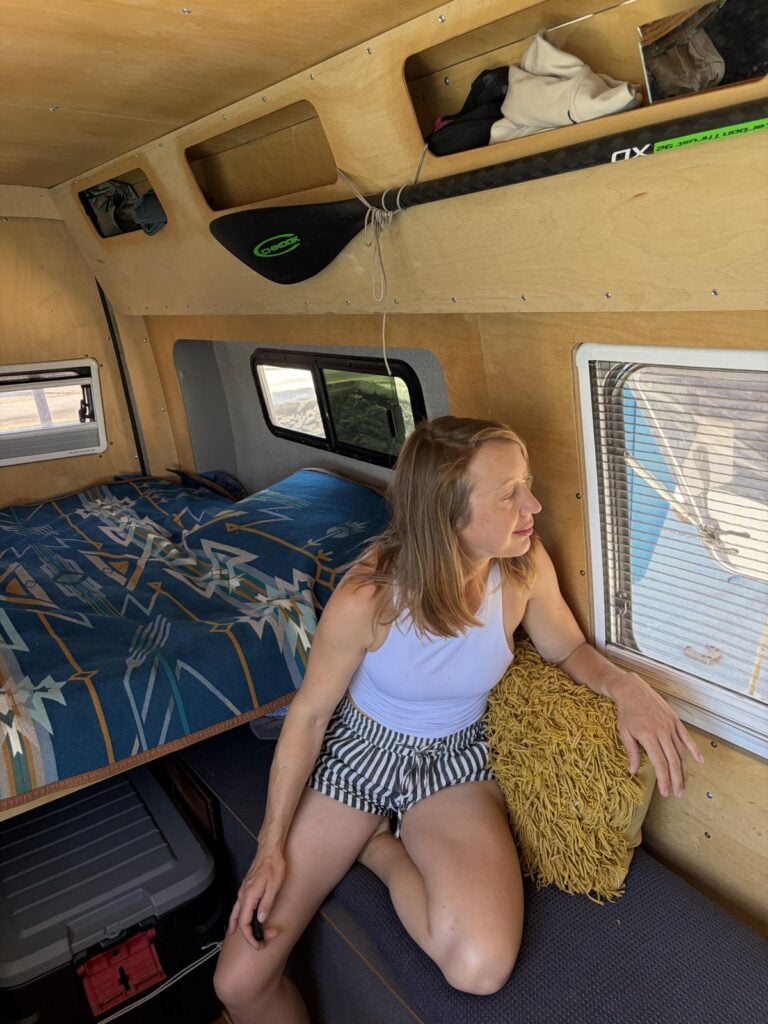
This is the part of my post people argued with most, and they were right to; my own answer is the cat litter jug above. “I’d use a bucket or portable toilet before I drove around at 7 in the morning,” a reader wrote. “And what about if u have to go in middle of the night?” Another, less patiently: “I’m too old to find a toilet in the morning. How about at 2 am???????”
The night answer was nearly unanimous and it was not a toilet. Men use a wide-mouth bottle. A former long-haul trucker used “a metal coffee can, emptied it when I stopped to fuel.” One reader uses “an empty 2.0-litre milk container” and has “only ever needed another once overnight.” Women use a funnel, a She-wee or a wide jar. “I have a she-wee but that’s only good for going number 1,” a reader wrote. “It works out great when you have to pee in the middle of the night.” “She wee and bottle for no1, collapsible bag toilet for 2s,” said another. A reader with diabetes who is up several times a night uses a medical urinal bottle made for the purpose, and a few people confessed to a Tupperware pot, a large coffee-shop cup and a “pee billy.”
One reader offered the counterpoint I did not expect: “After living the life for years, my body has adjusted. I very rarely need to use a toilet at night anymore. Things change.” I would not plan a build around that. But it is true that the first year of anything is the hardest version of it.
The shower is the harder problem, and the readers agreed
I said in my post that showers are a solar bag behind the van or a gym, and that I plan whole days around where the next one is. The readers who have lived without a bathroom for a while said the toilet was never the thing. “I find the shower the toughest thing,” one wrote. “Toilet and cooking is fine. But the shower. Boiling a kettle, standing in a tub so I use just 7.5 litres is a pain. Then having to get the water down a drain! I joined a gym. Life got better.” A reader on another of our threads, who had been overthinking the toilet before moving in, found the same: the toilet turned out fine, “the shower situation however, that’s another story.”
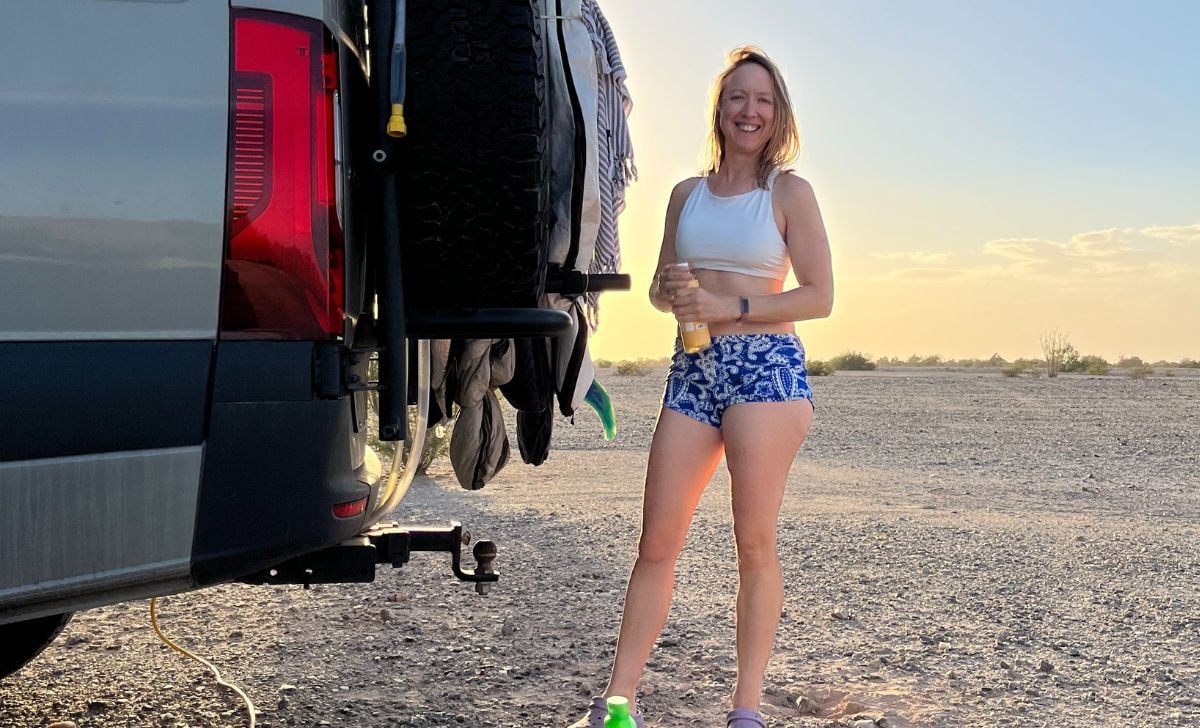
The workarounds were the ones I use. “Join LA Fitness or Planet Fitness and then you always have a nice shower to go to in almost every town,” one reader wrote, and that is exactly how I typically shower now; the membership is the cheapest shower network in the country. Others boil water into a twenty-litre drum, carry a pop-up shower tent, or use a leisure center. A few readers pointed at the people on the other side of the line: “I’d want a shower everyday, so couldn’t compromise on that.” If that is you, nothing on this page will change it, and a van with a wet bath is a reasonable thing to want. For the rest of us, here are the van shower setups that actually work and every way we have found a public shower on the road.
Where the no-toilet people go in the morning

The readers who do it my way had a system, and it was mostly about parking. “I always ensure to free camp next to a toilet, ie. truck stop or petrol station,” wrote a reader four years in. Twenty-four-hour fast food, coffee shops, campground restrooms and truck stops were the list, and one reader’s best tip was simply to “dot places on google map” before dark. British readers warned that public toilets there are “like finding hens teeth” and recommended a RADAR key, a few pounds, which opens locked accessible toilets across the UK. A reader with a diesel van put the counterargument in one line: “diesel is too expensive to waste on toilet trips.”
Out on public land, the rule is the cathole. The National Park Service says to walk “200 feet or 70 large steps away from trails, campsites, and any water source,” dig a hole six to eight inches deep, cover it completely and pack the toilet paper out. Some parks and many desert rivers require you to pack everything out in a bag, which is where the wag bags come back in. Where to park in the first place is its own subject; our guide to where to park a van overnight and the boondocking guide cover the legal part.
The thing the comments were really about
The toilet was the hook, but the post was about the first year, when every small thing is a fight, and the readers who have been out a while answered that part too. “BINGO! If you want to BE a nomad you have to live like one,” one wrote. “It seems lots of folks try to move the house-plus-house mindset into the van. It requires a different way of being.” A reader coming up on eight years: “It’s humbled me like no other.” A reader seven months into a minivan: “I’ve learned that freedom may not be convenient.” Someone only fifty-one days in, without a bathroom, said it was working, and someone in the hard stage said today was easier than last week.
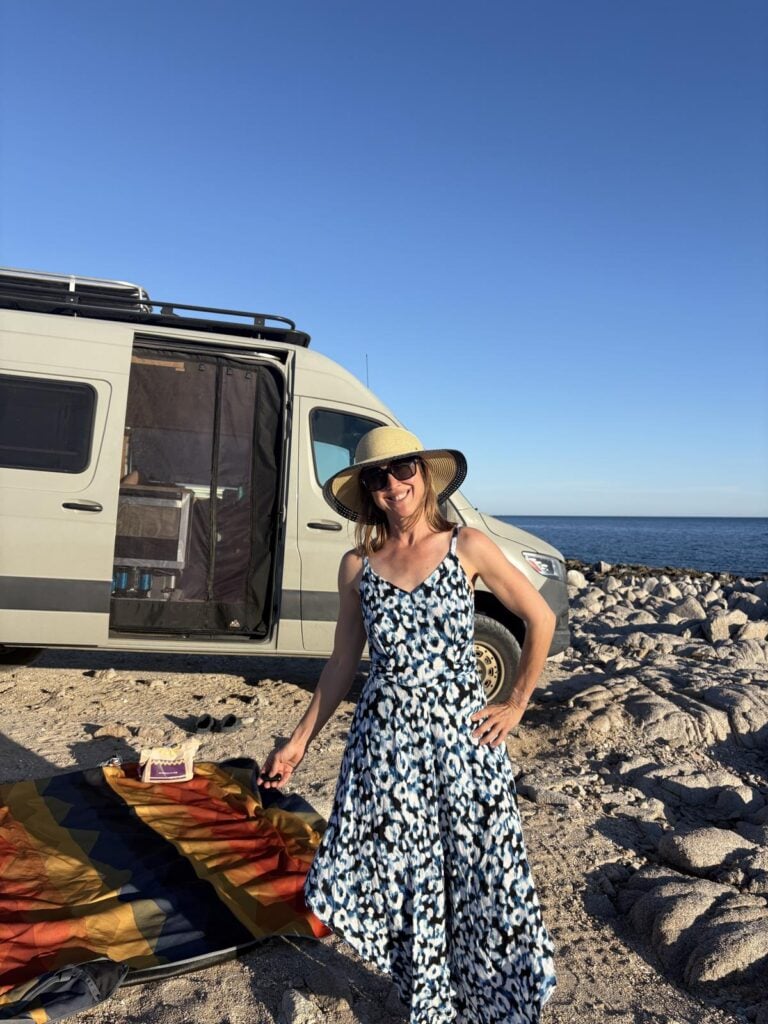
The ones who disagreed were honest too. A reader who spent ten years in and out of vans: “now I just love stability. It’s everything.” Another: “when at home I miss being away in my van, then when I’m away in the van I miss being at home with water on tap. Can’t win, or maybe it’s a win win.” That one is me, exactly. I crave stability so badly some days it almost hurts, and then the bathroom drive is just a morning, and the two pots make everything I want to eat. I did not get tougher. I stopped measuring the van against a house, and started measuring it against the life it lets me have. One reader read that line and wrote back, “means you’ve already cracked it.” I would not go that far. But I have stopped apologizing for the toilet I do not own.
One more thing the comments taught me. Most of the readers who carry something described it as insurance rather than furniture. “I carry a luggable loo for an emergency,” one wrote. “I’ve only used it once for novelty. My daughter appreciates it though.” A reader with a VW California bought a porta potti before her first long trip and “rarely” uses it, “but it is there if needed.” One reader summed up the whole thread in a sentence: the bucket in her van is “amazing” for “the sense of security it gives, even if you never use it.” That is the real product. Not the toilet, the not-worrying.
If the bathroom is the thing stopping you, the readers of our house-or-van thread had the same fear and the same answers, and one of our writers explains why she chose not to build a bathroom into her Sprinter at all. The van life mistakes that actually end people’s trips are not the toilet.
What do you use, and what do you wish someone had told you in the first year?
Frequently asked questions
Can you live in a van without a bathroom?
Yes, and many full-timers do, including the author, whose van has never had one. The working system is a gym membership for showers, public restrooms, campgrounds and truck stops during the day, a bottle, jug or funnel at night, and a bagged emergency option for bad weather. Expect some mornings spent finding a bathroom; if that is a deal-breaker, plan a cassette or composting toilet into the build.
What do van lifers use for a toilet?
In a thread of several hundred van lifers, the most common answers were a five-gallon bucket with a snap-on seat, a bin-bag liner and cat litter or horse-bedding pellets; a folding dry toilet with liners and gelling powder; a cassette toilet or porta potti, with Thetford the brand named most; a composting toilet with a separate urine bottle; and commercial waste bags such as Wag Bags. Most people keep liquids separate from solids.
What do van lifers do at night without a toilet?
Almost everyone uses a container rather than a toilet: a wide-mouth bottle for men, and a funnel, a She-wee or a wide jar for women. Readers also described coffee cans, milk jugs and medical urinal bottles. The container is emptied into a toilet or at a dump station in the morning.
How do you dispose of waste from a bucket toilet or a wag bag?
Seal the bag and put it in a trash can bound for a landfill. The National Park Service says bagged waste kits go in a designated receptacle or a trash can, and Wag Bag’s maker gives the same instruction. Never empty a bag into a vault toilet, a dog-waste bin, a storm drain or the bushes. Cassette toilets are emptied at RV dump stations or toilets that allow it, never on the ground.
Is a bucket toilet or a cassette toilet better for a van?
A bucket with liners and litter is cheaper, lighter and never needs chemicals or a dump station, but each bag has to be thrown away. A cassette toilet flushes, holds several days of use and feels more like a real toilet, but it has to be carried to a dump station or toilet and emptied, usually every few days. Solo travelers and minimalists in the thread leaned bucket; couples, older readers and anyone who is up at night leaned cassette.
How do van lifers shower without a bathroom?
A gym membership is the most common answer, because chains such as Planet Fitness have showers in almost every town. Others use a solar shower bag behind the van, a pop-up shower tent with a drum of heated water, campground and truck-stop showers, and swims. Most readers said the shower, not the toilet, was the hardest part of living without a bathroom.
Sources (checked October 2026): reader comments on The Van Life Collective’s “The van has never had a toilet” post (347 comments and replies, quoted without names); National Park Service, Leave No Trace Principle 3: Dispose of Waste Properly (catholes 200 feet or 70 steps from water, six to eight inches deep; bagged kits to a receptacle or trash can); National Park Service, the Leave No Trace Seven Principles; Gates of the Arctic National Park, Human Waste; Canyonlands National Park, River Regulations (solid waste must be removed; Wag Bag and Restop II approved); Cleanwaste, the original Wag Bag (gels up to 32 oz; seal it and toss it in the trash).