Would You Give Up a House to Live in a Van? Here’s What Stops the People Who Say No.

I asked my van life Facebook page whether they would give up a house for a van. Nearly 300 answered.
*This post may contain affiliate links. Please read our disclosure policy for more info.
I recently asked the people who follow my van life Facebook page a question I thought I already knew the answer to: would you ever give up a traditional house and live in a van full-time? I expected a few dozen replies. Nearly 300 people answered in two days, and the thread is still going.
Here is the short version. About a third of the people who answered already live in a vehicle, some of them for decades. Another third said yes with nothing attached. Only about one in fifteen said no. The interesting group is the forty or so in the middle: the people who want to, and have one specific thing stopping them.
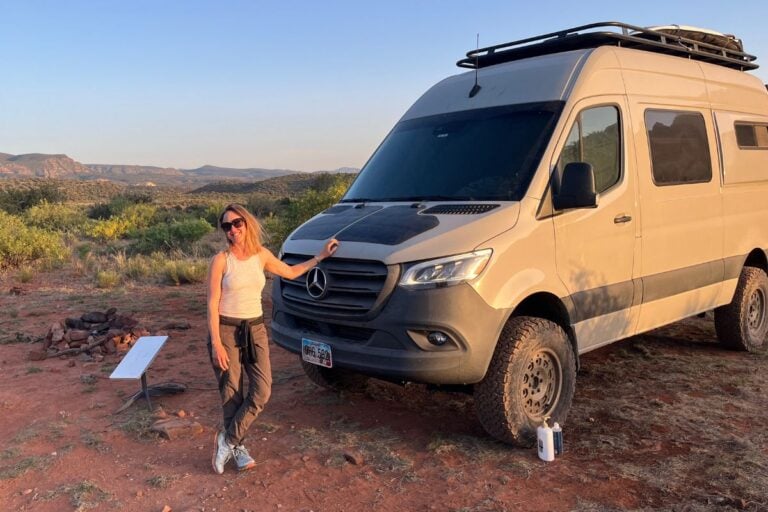
The honest catch is that most of those things are real. I have lived in vehicles since 2015, a Prius, then a Chevy Astro, now a Sprinter, with winters on a 1972 sailboat, and the bathroom question, the money question and the what-if-it-goes-wrong question never fully go away. They just get smaller once you know the actual answer.
So this is that list: what stops people, in their own words, and my honest answer to each one, including the ones where my answer is “then don’t.”
The ten things that stop people, and my honest answer to each

1. The bathroom, the shower and the laundry
This came up more than anything else. “If I could pee and poo anytime I needed to,” one reader wrote, and then dared the page to post about the bathroom at all. Another: “I love bathing and smelling fresh so I can’t.” Another would do it “if said van had a shower cubicle, fridge, and oven,” and several said yes only with a way to shower and do laundry.
Fair. When I moved onto the sailboat it was mid-restoration and had no bathroom at all, and I showered at the gym for a year. In the van the honest answer has three parts. A gym membership, which is the cheapest shower network in the country. No toilet on board, and I am not going to pretend otherwise: we do not carry one in the Sprinter, so it is gyms, campgrounds and public restrooms, and the part nobody puts in the highlight reel, the mornings when I am driving around at seven looking for a bathroom.
Plenty of full-timers do carry a toilet (here are the campervan toilets that are not disgusting), and we carry 10 gallons of drinking water plus a 25-gallon tank because we shower often. Laundry is a laundromat day, the same as it was in my first apartment.
If that last paragraph is a deal-breaker, that is a legitimate answer. The readers who said no for this reason were being honest with themselves, which is more than the question usually gets.
2. The money to buy the van
“Yes, the only thing stopping me is the cash to buy a van.” “Yes if I could find someone to convert my van.” A few readers are waiting on a bank balance or a settlement, and one asked, reasonably, who pays for gas and food.
The van is the big number, and it does not have to be. My first camper van was a Chevy Astro, a minivan, and before that Tom and I lived in a Prius for four months to pay off debt. I still think a minivan is the right way to start, and it is a fraction of the price of the vans in the photos. The ongoing money is more honest than people expect: living in a van might seem cheaper than an apartment, but expenses add up fast, and our two biggest are gas and food. One of our writers who lives alone in a minivan wrote the piece I point people to on this: solo van life is not automatically cheaper. The saving is real when the thing you stop paying is rent, and it is smaller than Instagram says when you drive a lot.
3. A partner, kids or parents who are not coming
“I could do it if I was on my own. Couldn’t do it with my spouse and extended family.” “If I didn’t have a school age kid I would.” “Got the ideal van, just my young kids stopping me.” Two readers are waiting until a parent, or a brother they care for, has passed. One couple wants to and “feel we can’t due to life and family restrictions.”
I do not have children, so I am the wrong person to tell you how van life works around a school schedule; the family of six who live full-time in an RV are the right people. What I can tell you about is the partner. Tom and I have shared a Prius, a minivan, a Sprinter and a 41-foot boat, and the thing I would warn you about is not the arguing. It is that there is no door to close. My office is the kitchen is the living room is the bedroom, and usually there is another person sitting less than six feet away. Here are the rules that keep us from killing each other.
And to the readers waiting for a parent: that is not an objection. That is a plan with a date you do not get to choose. The van will still be there.
4. The dogs
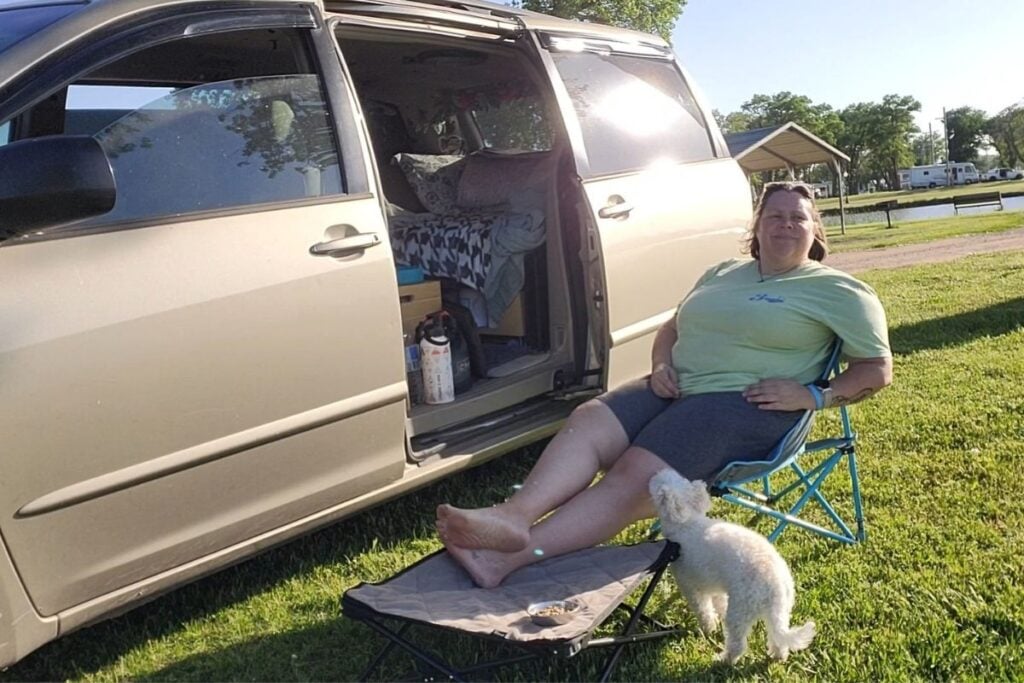
“Yes, need a van on the large size for three shepherds.” “I have to be able to bring my dogs with me and make sure they’re comfortable with van living.” One reader with two dogs decided a van would not be fair on them and chose a caravan on a year-round site instead. On the other side, two readers who already did it wrote that they left with a cat, and with two dogs who are now “free to do whatever we want.”
I do not travel with a dog, so I will hand this one to the people who do: van life with dogs, from people who have done it. The pattern in the thread was simple, though. Nobody with a dog said no. They said the dog decided the size of the rig.
5. Age, health and a body that needs room
“Yes, even though I’m 71, definitely.” “Yes, we did when we were 70.” “Not at my age now.” “I’d love to but at 61 think it’s too late.” “Would have to be wheelchair friendly.” One reader recently had an operation, needs daily physio and cannot drive, and said plainly that it is not for them right now.
The 61-year-old and the 71-year-old are in the same thread, which tells you the number is not the deciding thing. Thirteen van lifers over 60 told me what they would tell their younger selves, and a woman in her 80s built her own van. Health is different, and I will not pretend otherwise. A van is a bad place to recover from surgery, and the reader who said so was right. Van life asks for a body that can climb into a bed, carry water and crouch at a camp stove. If that is a not-now, it is a not-now, not a never.

6. The space itself
“How did you adjust to the size? I think I might get claustrophobic after a while, especially on those days when everything seems to be going wrong.” That reader asked exactly the right question, because the size is not the problem on a good day. It is the problem on the bad one.
Every time I move back into the van after months on the boat, it is a bigger adjustment than I expect: the small cluttered space, limited everything, long driving days. I know I will re-adapt. I always do. What helps is not a bigger van. It is spending the day outside the van, because the van is where you sleep and cook, not where you live. The readers who wanted “a bus or a large Class C” are not wrong either; the right size is the one you will actually drive and park, and it took me years to afford a van I could stand up in.
7. Winter
“I’ve been trying to, but winter is almost upon us and I need warmth here in Canada.” Another reader wrote that with fuel at its current price, it would have to be a static van.
My honest answer here is not a van answer: I leave. I spend summers roaming in the campervan and winters on the sailboat in Mexico. Most full-timers I know do a version of the same thing, which is following the weather, and the ones who stay north build for it: a dry-heat heater, a carbon monoxide detector, a cracked vent, and an emergency fund for the month it goes wrong. The mistakes that end van life early has the details.
8. An address, a doctor, the mail and the insurance
“How do you all manage for a postal address?” one reader asked, and the replies piled on: registering the van at a home address, the driving licence, insurance, doctors.
This is the most practical objection in the thread and the one with the most complete answer. I have lived on the road for years with no fixed address, and this is exactly how I get my mail. Here is how van lifers get health insurance, and who will actually insure a converted van. The honest catch: it is paperwork, it is boring, and it takes a few weeks to set up before you leave. Nobody has ever stayed in a house because of the mail.
9. Work
“If I could work remote, yes! Is it possible to do with a full time career? I need this in my life.” On the other side: “I live in my van wherever work takes me. Suits me fine.”
I work every single day, from wherever the van is parked. I have a Starlink, so no matter where we are camped I spend part of the day working, at camp, in the passenger seat while Tom drives, on my phone when I am away from the van. That is what makes the rest possible, and it is also why I bristle when people assume this is one long vacation. The reader with the full-time career is asking the real question, and the honest answer is that van life is easier to start with a job that already travels. A lot of people make the job portable first and the house second. Here are 56 real ways people earn on the road, and why I chose the Starlink Mini.
10. What happens when it goes wrong
“When you break down, where’s the AA going to take you if you’ve no home?” “Does anyone know anyone that did sell everything and years down the line a partner became ill or died and left with nothing?” “Once you are off the property ladder you will struggle to get back on it.” And the one I keep thinking about: “Despite the common myth, all your problems don’t just disappear.”
These four are the ones I take most seriously. The breakdown has a boring answer: money set aside before you leave, because a random repair bill in the four figures is not unusual and the campground you limp into will not be free. The property-ladder worry is real and I will not argue with it; what I can say is that we did the opposite math. We stopped seeing rent as inevitable, and the money that did not go to rent went to debt first, and then into the business I run from the van. The partner-dies question deserves a straight answer: it happens, it is why the readers with a home base have a point, and it is why insurance and an emergency fund are not optional out here.
The reader who said problems do not disappear is simply right. The hardest part of van life for me is not the lack of hot running water or a washing machine. It is the uncertainty. Where will I park and sleep tonight? Will it be safe? Decisions are constant and unrelenting. That is the price. Some people read that sentence and feel relief; some feel tired. Both are correct answers.
“Isn’t that for poor people?”
One reader asked exactly that. Another wrote that it “makes you a pikey.” And from the other side of the same thread: “Why not, I lived in my car for 10 years when I was homeless like most of the military vets.” One reader is buying a van after losing an apartment while waiting on disability, with a four-year wait for affordable housing where they live.
So, yes. Sometimes it is. I moved into a Prius because I had debt I could not pay down any other way, and the people in this thread living in vehicles because the alternative is a couch or a waiting list answered the question more honestly than anyone. The glossy version of van life is a choice. A lot of van life is a solution. Both deserve a working toilet and a safe place to park, which is why so much of this site is about where you are actually allowed to sleep.
The people who did it and came back
Three readers did the thing everyone else in the thread was dreaming about, and then stopped, and I think their answers matter more than the hundred “in a heartbeat” replies. “Now that I’ve lived full time in a skoolie for almost three years… NO.” A retired reader with a built Sprinter spends eight or nine months a year on the road, rents the house out, then comes home for “a couch, long hot showers and a full kitchen to cook in.” Someone five years in “wouldn’t mind finding another house to live in for the rest of my life.”
None of them regret going. They stopped treating full-time as the only honest version, which is where I have ended up too.
What the people who said yes to van life actually said
The word that came up most was free. “Sold my house, gave everything away. Never felt better.” “You soon realise how little all those materialistic things are.” “It’s nice to enjoy the money I earn from my job once again instead of it all going on bills.” “Started doing this after leaving my husband of 26 years, best thing I’ve done.” “Everything I had is gone and now myself and my two dogs are free.”
I wrote the long version of this half once already, in 10 things van life taught me that a house never could. Stuff loses its power over you. Comfort is a moving target. Home is not a place. Every one of those lessons showed up in the thread, written by someone who learned it on their own.
My own answer to the question
I am the wrong person to ask whether to give up a house, because I never had one to give up. I had an apartment in the San Francisco Bay Area and a job that disappeared, then a Prius, then a sailboat with no bathroom, then the vans.
What I have ended up with is not full-time van life either. It is summers in the van and winters on a 1972 sailboat in a boatyard in Mexico, and the boatyard half is the half with no decision fatigue. I like the excitement of wandering around in the van mixed with the balance of living at the boatyard. It is the best of both worlds. So my answer to my own question is the one about ten readers gave: both. Keep something still, and go.
What is stopping you? Or, if you already went, what finally did not?
Can you live in a van full-time without a bathroom?
Yes, and most full-timers do without a built-in one. The working answer is a gym membership for showers, public restrooms and campgrounds (many full-timers also carry a portable toilet; we do not), and a water tank sized for how often you wash. Expect some mornings spent finding a bathroom; if that is a deal-breaker, van life probably is too.
What is the cheapest way to start living in a van?
A used minivan you can buy outright. It costs a fraction of a built-out Sprinter, parks anywhere without drawing attention, and teaches you what you actually need before you spend on a bigger rig. The two biggest ongoing costs most full-timers report are fuel and food.
How do van lifers get mail and keep a legal address without a house?
Through a mail-forwarding service that provides a street address in a domicile state, which also covers vehicle registration, a driving licence and insurance. It takes a few weeks of paperwork before you leave and then runs itself.
Can you do van life with a full-time job?
It is far easier with a job that already travels: remote work with a Starlink or a cellular connection, seasonal work, or a trade that moves. Many people make the job portable first and give up the house second.
Is it too late to start van life after 60?
No. Readers in their 60s and 70s answered this question with a yes, and some of them are already on the road. The real limits are health and mobility, not age: a van asks for a body that can climb into a bed, carry water and crouch at a stove.
Sources: the question post on The Van Life Collective (292 top-level replies read and sorted by hand, October 2026; readers quoted without names); the author’s own articles linked above.