

How to Live in a Small Space With Your Partner (Without Killing Each Other): Rules From 4 Couples

Four couples who live in a travel trailer, a tiny house, a sailboat and a van share how they communicate, get alone time and stay together in under 130 square feet, plus what a decade taught us.

*This post may contain affiliate links. Please read our disclosure policy for more info.

Living in a small space with your partner works when you settle two things early: what you will do when you argue and there is no other room to walk into, and how each of you will get time alone when your whole home is smaller than most master bedrooms. Tom and I have shared a Toyota Prius, a tent, a Chevy Astro, a Sprinter van and two sailboats since 2015, and we are still together. So are the three couples I interviewed for this piece, who were living in a 12 by 7 travel trailer, a 130 square foot tiny house, and a sailboat when we spoke. Here is what all of us have figured out.
I first wrote this from the galley of our sailboat in 2017, right after Tom pointed out the food I had dropped on the teak while tasting dinner. I am a recovering, sort of, slob. Tom is a neat freak. That was our biggest challenge in the early days, and it taught me the first rule of this life before I had the words for it: small space living finds the weak spots in a relationship fast, and then it makes you deal with them.
How do couples communicate in a small space?
Every couple I talked to said the same thing first. Communication is the whole game when your living space is the size of some people’s closet, and it starts sooner than you expect.
Macy Miller and her partner James lived in a tiny home before they moved into a 12 by 7 travel trailer with their two young kids, and she told me it felt like they had “jumped into a twenty-year marriage.” She had dated people for years without learning as much about them as she learned about James after a month of living tiny. You get personal fast, she said, and “you either still like them or you don’t.” For the two of them it meant the big conversations about money, kids and the future happened right at the beginning instead of years in.

Arguments are where a small space really tests you. Melody DiCroce, who lived on a sailboat with her husband Chris for six years, put it plainly: “Arguments in a small space suck.” There is no other room to count to ten in, and if you are really angry you end up awkwardly dodging each other in the companionway, which she admits is almost comical after the fact. Their fix was to stop sweating the small stuff entirely and to sit down and settle anything bigger as quickly as possible, so they could both get back to enjoying the day.

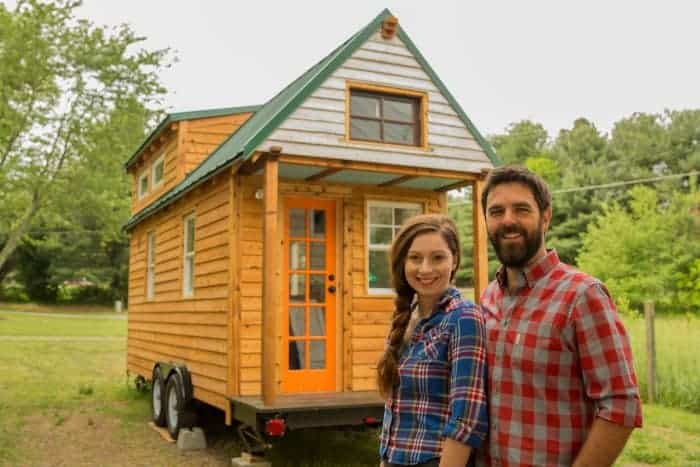
Alexis Stephens of Tiny House Expedition and her partner Christian had been in their tiny home on wheels for two and a half years when we spoke, long enough to learn that their communication styles were different and to adapt to it. Living that close, she said, made them “more intimately aware of each other’s quirks and preferences,” to the point where she can tell what his different sighs mean. That is the quiet upside nobody mentions: you get very good at reading the person you love.
How do you get alone time when you live in a small space?
Alone time does not happen by accident in a hundred square feet. Every couple had a system, and the systems looked nothing alike.
In the trailer, Macy and James take time for themselves every day, and they treasure the kids’ bedtime because it is the only stretch when they get to be a couple. She was honest that they would both like more room, but as she said, that “has everything to do with having a 2 and 3-year-old” and nothing to do with how well the two of them work things out.

Melody is an introvert with no separate room to retreat to, so her alone time came after Chris went to sleep, when she would blog, read and decompress. Her bigger advice was to talk about the need for space before you move aboard, so that when the day comes, nobody takes it personally. She and Chris even made a game of it with code phrases. If he needed the boat to himself he would suggest she go have lunch with a friend; if she needed it, she would point out what a beautiful day it was for him to go for a run. Phrased that way, she said, it was “beneficial for both of us” instead of “you’re driving me crazy.”
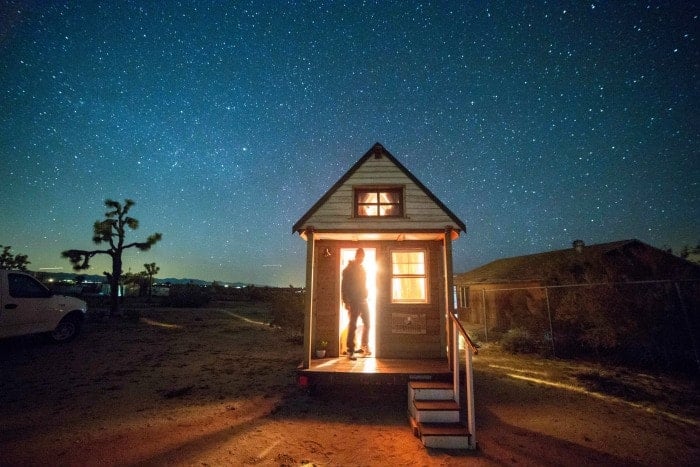
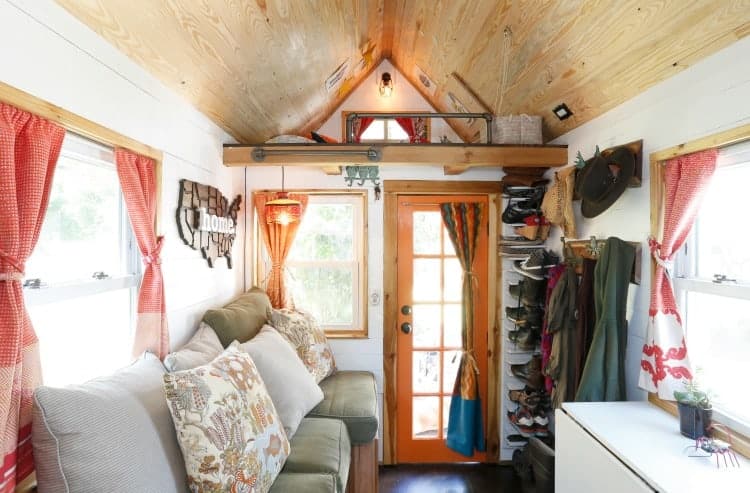
Alexis insisted alone time is possible even in 130 square feet. Reading in the loft feels like a separate room, and the mattress muffles sound from downstairs. Headphones, she said, “go a long way in creating privacy bubbles” even five feet from your partner. And when that is not enough, the answer is the door: the porch, a walk, a bike ride. Macy added the rule that ties all of it together. You have to accept that your partner’s need for space “isn’t a personal jab.”
What are the benefits of living together in a small space?
I have gotten so used to living small that I feel lost when I housesit or stay in a big house. I misplace things in rooms I forget I have, and Tom seems a world away when I am cooking in one room and he is sitting in another. The intimacy of living small is the part I would never trade, and after a decade it has not faded.

Alexis and Christian spend most of their time out filming and exploring, and she loves coming home to a place they built together that is, in her words, “well suited for cuddling.” But the benefit she rated highest was less romantic. Tiny living forced them to get good at resolving conflict, because “there’s no room for sulking” in their house. Problems get confronted as they come up, and better communication, she said, has made their relationship stronger than ever.
Melody saw the same thing on the boat. She and Chris learned to work together in ways they never had on land, and along the way grew to respect each other more; he sees how hard she works, and she sees the same in him. Macy, for her part, simply adores the adventurous life her family leads as they move from place to place. If you have ever wondered how the jobs get divided on a sailboat, that mutual respect is where it starts.

What is the worst thing about living in a small space with a partner?
None of the couples had a serious complaint about each other, which makes sense, because they are all still together. The worst part, everyone agreed, is physical. You get in each other’s way.
Alexis called it the tiny house choreography. They are good at it now, but every so often Christian really needs the bathroom while she is picking out clothes from the closet that blocks the bathroom door, and he simply has to wait. Frustrating for both of them, she said, and not bad at all if that is your main relationship complaint.
Tom and I have our own version. When dinner is underway I ask him, politely, to leave the galley, because there is not room for two people in it. Then I hope he gets absorbed in some boat research so he does not watch me flail food around, and I can wipe the carnage off the teak before we eat together in peace. Really, I would not have it any other way.
What a decade in 100 square feet has taught us
When I wrote the first version of this, Tom and I had been aboard for eighteen months. Since then we have added a Sprinter van for the summers, a second sailboat to restore, and a lot of miles. The couples’ rules above still hold. A few more have earned their place.
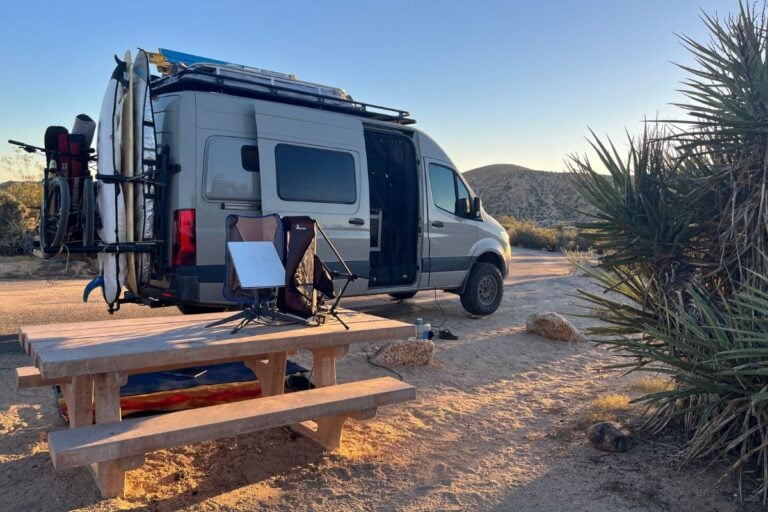
There is no door to close. On the boat there is at least a companionway to duck through; in the van, my office is the kitchen is the living room is the bedroom, and there is usually another person sitting less than six feet away. I have learned to say “I am working” out loud instead of expecting it to be obvious, and Tom has learned that a closed laptop is not an invitation.
The hardest part is not the space, it is the decisions. In the van, every day asks where we will park, whether it is safe, and where the water is, and that decision fatigue makes both of us short with each other. Our arguments cluster on moving days, so now we settle the boring logistics before the tired sets in and give each other a pass on the drive.
Stuff is the real fight. Two people in a hundred square feet do not argue about feelings nearly as often as they argue about where the wrench went. Getting rid of nearly everything was the single best thing we did for our relationship, and everything we still own has a home it goes back to.
And you get out of the box, separately, on purpose. Melody’s code phrases and Alexis’s bike rides are the same rule in different clothes. Mine is a beach walk or a ride. Tom’s is a boat project nobody else is allowed to touch.
If you are about to try this with someone, start with my eight tips for living in a van with a partner, then the relationship rules cruising couples swear by. If the two of you are still deciding between a van and a boat, I have lived in both and compared them honestly. Small-space couples are one branch of the wider alternative living world, and every one of them has a version of the galley story.
Couples who live small: what is the rule that saved you? I am collecting them for the next update.
Frequently asked questions about living in a small space with a partner
How do couples live in a small space without fighting?
Agree early on two things: how you will handle arguments when there is no other room to go to, and how each of you will get alone time. The couples in this piece resolve issues fast instead of sulking, keep their stuff minimal, and use code phrases or outdoor time to give each other space without anyone taking it personally.
How much space do two people need to live comfortably?
Less than you think, if the space is organized and both people agree on the rules. The couples here live in a 12 by 7 travel trailer, a 130 square foot tiny house, a sailboat and a Sprinter van. The size matters less than storage, a place for everything, and a way to get out of the box separately.
Can living in a tiny home ruin a relationship?
It can expose one. Macy Miller, who lives in a 12 by 7 trailer with her family, says living tiny will make or break a couple because you get personal fast. Couples who communicate well tend to get closer; couples who avoid conflict lose the room to keep avoiding it.
How do you get alone time in a tiny house or a van?
Build it in on purpose: a loft or a bunk that feels like a separate room, headphones, a walk, a bike ride, a solo errand, or a code phrase that sends one partner out without hurt feelings. Tell your partner what you need before you are already at your limit.
Is living in a van or on a boat with a partner harder than a house?
Harder in space and logistics, easier in some ways. There is no door to close and every day brings decisions about parking, water and weather, which tires both people out. But small-space couples report better communication and more trust, because there is nowhere to hide from a problem.






5
1
One of the reasons we chose our 46’ bridge deck cruiser to live aboard is the galley and saloon are forward, then we go up 3 steps to the pilothouse, and down 3 steps to the utility/workroom, head and stateroom. We also have a tiny aft deck, and space on the foredeck. This allows for alone time and space without having to leave the boat.
In terms of communication, he is the ssilor and I have always gone along for the ride, but now I am determined to learn to handle her as he does. Part of the learning curve is talking through, say, coming into a tight space between 2 vessels on a dock with people all around. He knows what I’m going to do. I know what he’s going to do. Each time. Changes are determined by wind and weather, so we talk it through EVERY time.
Hi Pamela! Your sailboat sounds really nice 🙂 I think if I needed alone time I could shut myself in our stateroom. I am in the same boat with sailing…my boyfriend is the sailor and I am the slow learner, haha! I hope one day I’ll be good at it.
Hi Kristen
A great article! We had been married for over 30 years before we moved onto our 44’ yacht and have learnt so much more about each other in the last year than we did before. After 30 odd years you would think you know the person pretty well?
We are very different personalities so it’ can be interesting at times. We have created a new word for an argument between us – we call it having a ‘Parfonay’ – Partners Fighting On A Yacht. It certainly helps if you try keep things humorous.
We find that we both need our own space so I will usually tell him he needs to take the dinghy and go fishing and he knows then that I need a couple of hours alone or I will go to a beach or for a kayak to give him space.
We actually sleep in separate cabins which some people find a bit strange but for us, it works. He is a night owl and sleeps in later in the morning. I go to bed early and rise at dawn so to be in the same cabin is restrictive and we disturb each other’s sleep, especially if he wants to read late into the night. At first it seemed strange and we weren’t sure about it but now we love it. It gives us both more alone time and better quality sleep which is important. As another couple who have a similar arrangement said, ‘you can have your fun all over the boat but when you need to sleep, you need to good quality sleep’.
One more ‘rule’ we have on the boat is that when we are playing music or watching television/movies and the other person is sleeping or doesn’t feel like listening or watching then headphones must be worn. That has made a big difference too, especially with our different sleeping patterns.
Finally, we have learnt to sort out our ‘parfonays’ pretty quickly because there is just no point in trying to avoid each other in such a small space.
We sometimes sleep separately too, especially when its hot outside. I used to be a night owl but have gotten on my boyfriend’s schedule…having the same sleep schedule is helpful for us but sometimes I miss the nighttime 🙂
It’s nice to see someone posting about this very important aspect of living in small spaces. My wife and I have lived for 2 months traveling in a small van. You hit the nail on the head.
That’s great! It does take certain skills and personality types to pull this off, I think.
I once read an interesting tip on a sailing blog. When one of the couple needed alone time, they would wear an “alone” hat. It sent the message that they wanted to be alone.
Personally, I find the introvert (my husband) extrovert (me) thing hardest to manage. The poor introvert in a partnership has a lot to put up with when their partner wants to always have company.
hahah totally! I can relate because we are also an introvert/extrovert team, but I think my extroverted bf is getting a little more introverted with time, so that is good for me! haha.
Haha, ahhh, this reminds me of the many times that Jen and I struggled with finding “alone time” while we were living in the camper. At the end of the day, i think we are def better now than we were. At least we know each other’s limits! Great article!
That’s so true! You really get to know each other well as a couple when you live in a small, enclosed space together. What’s funny is my bf doesn’t seem to need alone time since he is an extrovert, but I do! What’s nice is he lets me read in silence and doesn’t bug me.