

I’ve Lived on the Same 1972 Sailboat Since 2016. Here Is What It Actually Looks Like Inside.

A room-by-room tour of Kristin’s 1972 CT-41 after years aboard: the saloon, the galley and its Force 10 stove, the nav station, the stateroom, the head and the cockpit, with three other cruisers’ boats for contrast.
*This post may contain affiliate links. Please read our disclosure policy for more info.

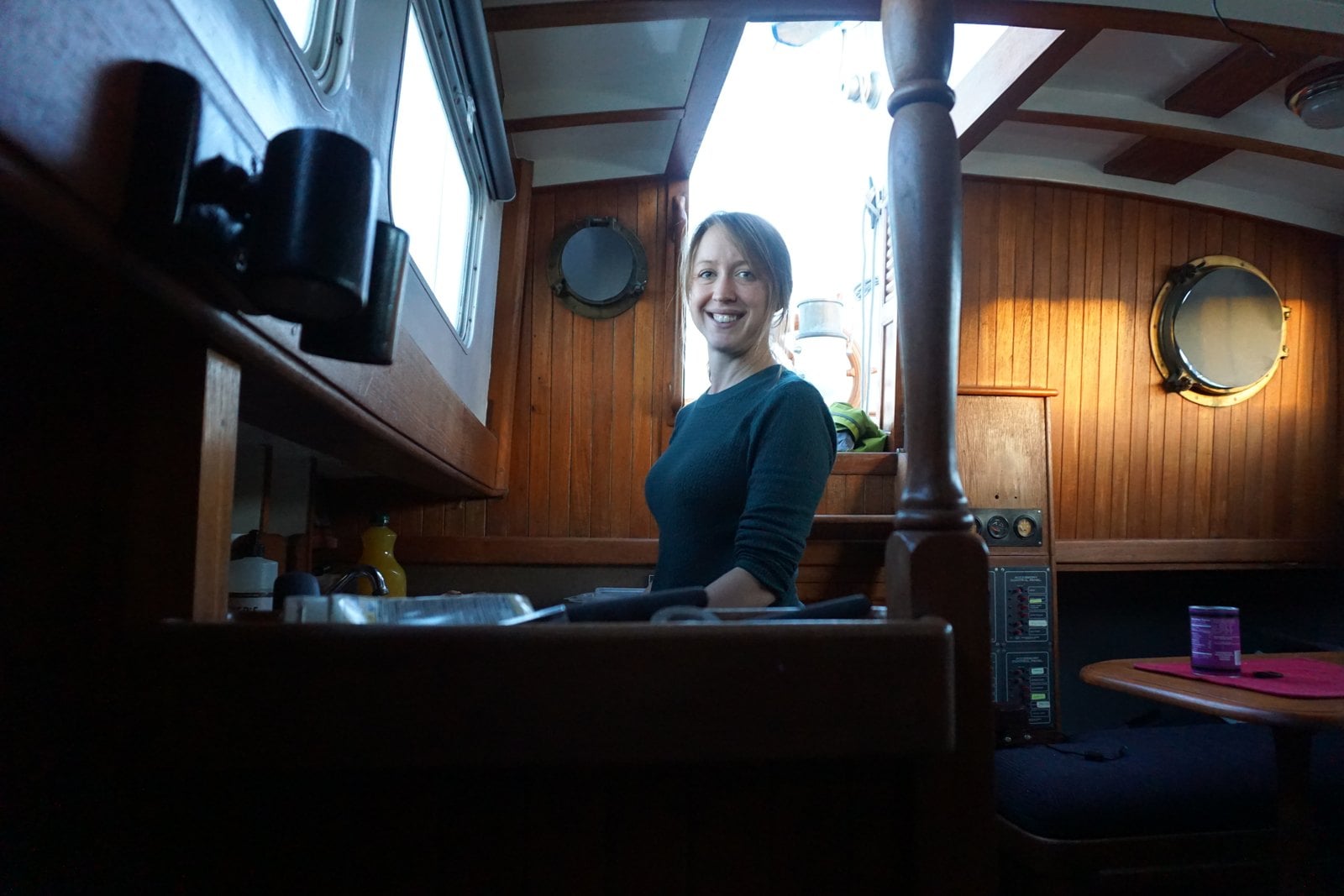
The first thing people say when they come down the companionway is some version of “oh, it’s bigger than I thought.” It is not. My home is a 1972 CT-41, forty-one feet of boat, and most of that is lockers. What they are reacting to is wood, warm light, and the fact that somebody obviously lives here.
This is the whole boat, room by room, across the years I have lived aboard since 2016: the saloon, the galley, the nav station, the stateroom, the head and the cockpit, with three other cruisers’ boats at the end for contrast. The honest catch: a liveaboard interior is a workshop that happens to be pretty. Everything in these photos is fastened down, dries fast, or fits in a locker the size of a shoebox. That is the difference between a boat you live on and a boat you look at.
The saloon is the living room, the office and the guest bed

On a boat under 45 feet, one room does everything. Ours has two settees that face each other across a drop-leaf table; one of them pulls out into a bed, and the table is where we eat, work, chart and argue about anchorages. The first year aboard, Tom and I would each curl up on a settee and read. The blue cushions are the one soft thing in a wooden box, and they are the first thing I would spend money on in any boat.
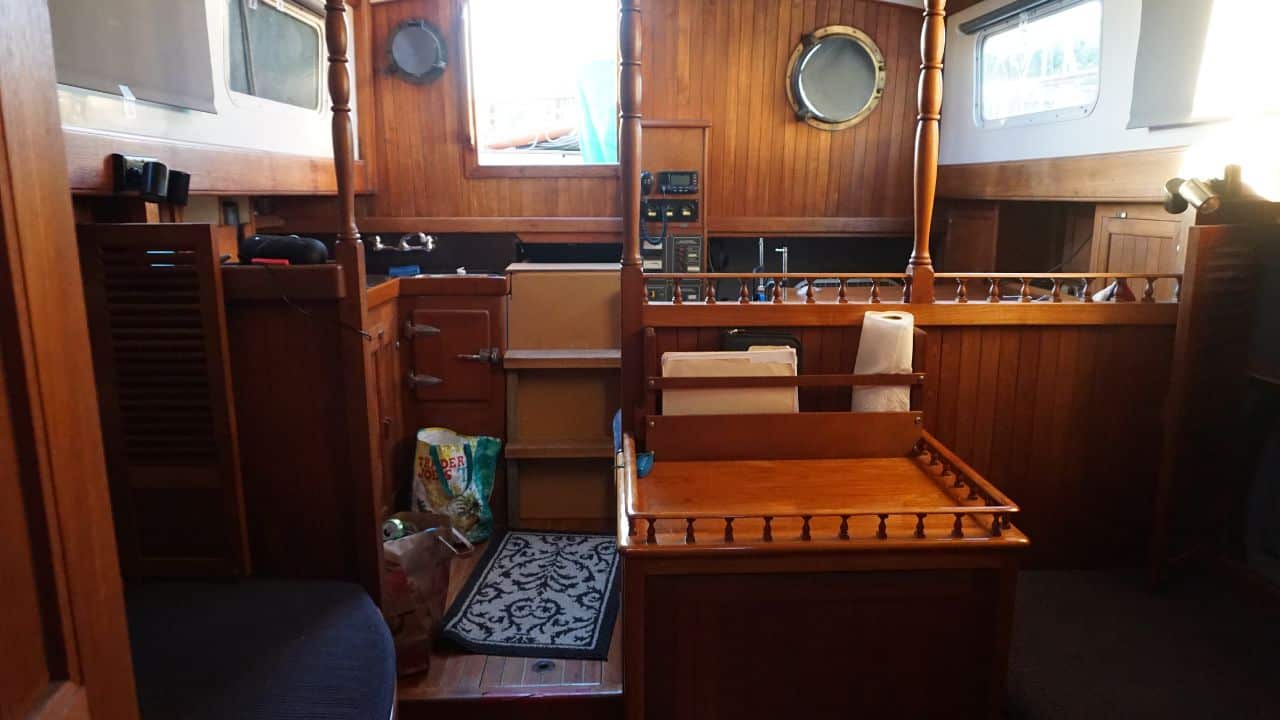
Years on, it looks lived in because it is. Boats do not reward minimalism the way vans do; you need the books, the tools, the spare parts. What keeps it from feeling cramped is that everything has a fiddle, a latch or a bungee, so the surfaces stay clear enough to use.

A throw pillow with an anchor on it is a cliché for a reason: it is the only decor that survives a passage. Everything else gets stowed before we leave the dock.
This is the cabin table from the years we lived aboard in the Bay, when this website was starting (most of the typing happened at the gym cafe, because the boat had no WiFi). Dark teak, a brass porthole, one lamp. There was no stove and no running water the first year because the boat was mid-restoration, and I still think of this corner as the best office I have had.
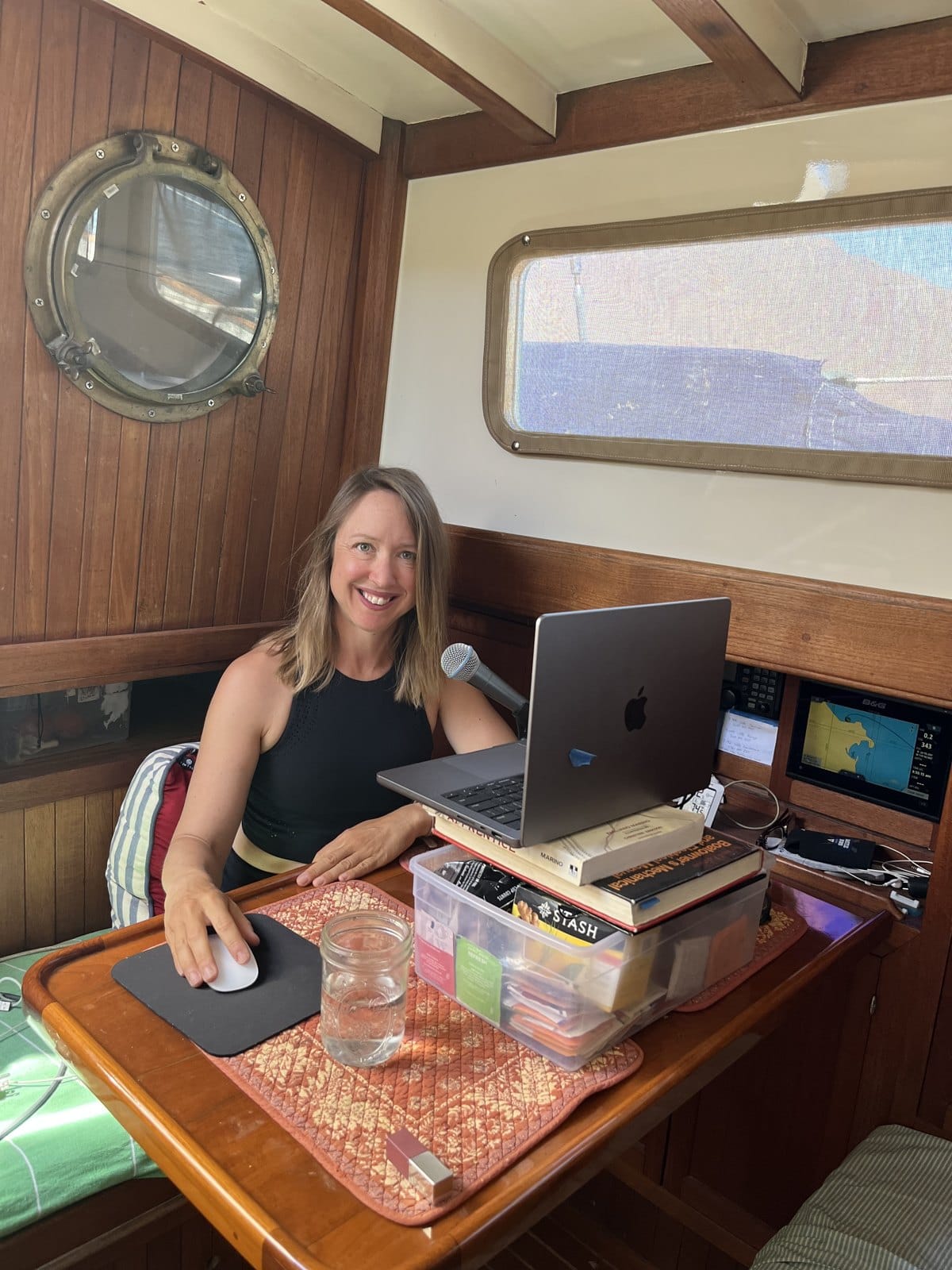
Nothing about the office has changed except the laptop. A cabin table with a porthole at eye level is the sailboat version of a window desk, and it is where most of this website still gets written.
The galley, where the gimbal earns its keep
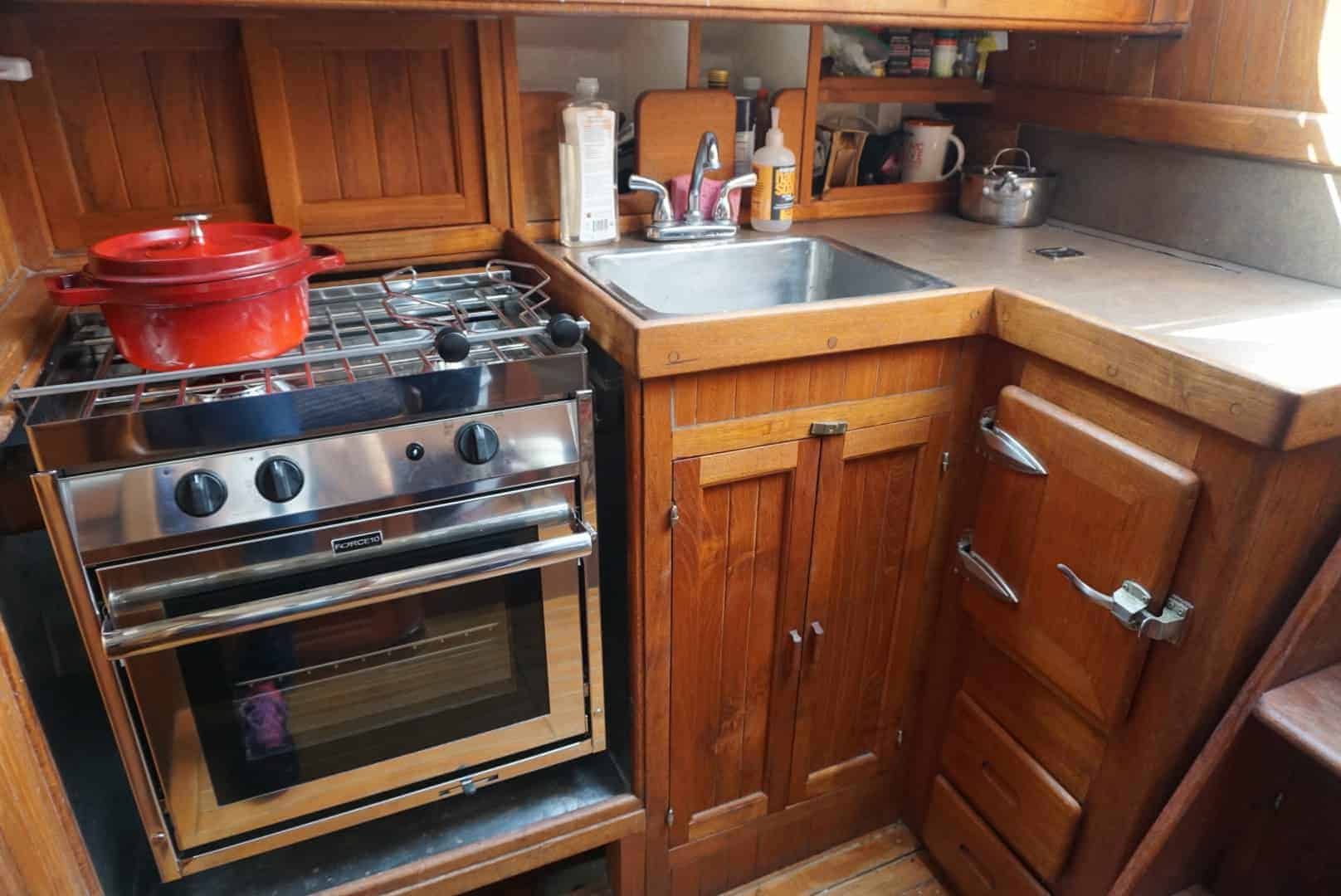
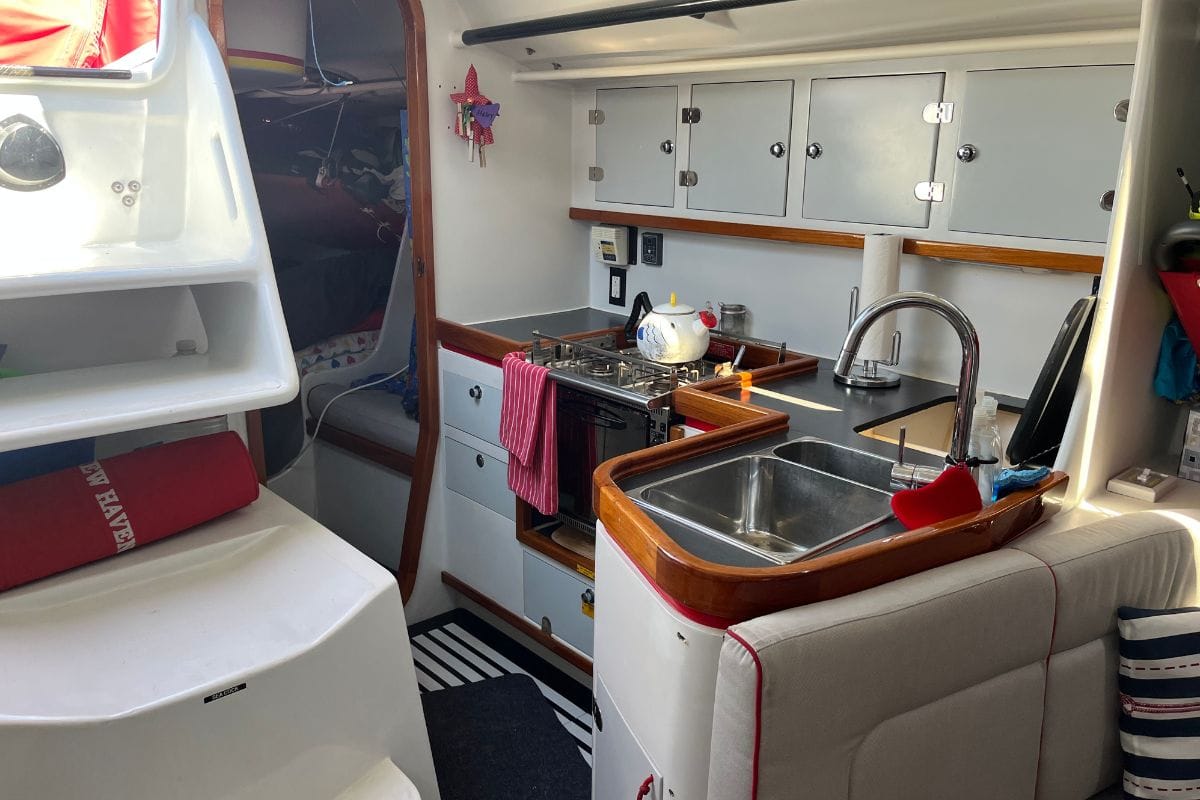
A sailboat galley is a kitchen the size of a phone booth, built around one trick: the stove hangs on pivots so it stays level when the boat heels. When we first moved aboard we cooked on a Jetboil camp stove with a pan balanced on top; now there is a Force 10 with an oven, a small sink and a square of counter the size of a cutting board. It is enough. I love cooking here because it sits right under the companionway breeze.
The bar across the front of the stove is a pot holder and a handhold at once. In a swell you cook with one hand on it, and that is the whole reason galley meals on passage are one-pot meals.
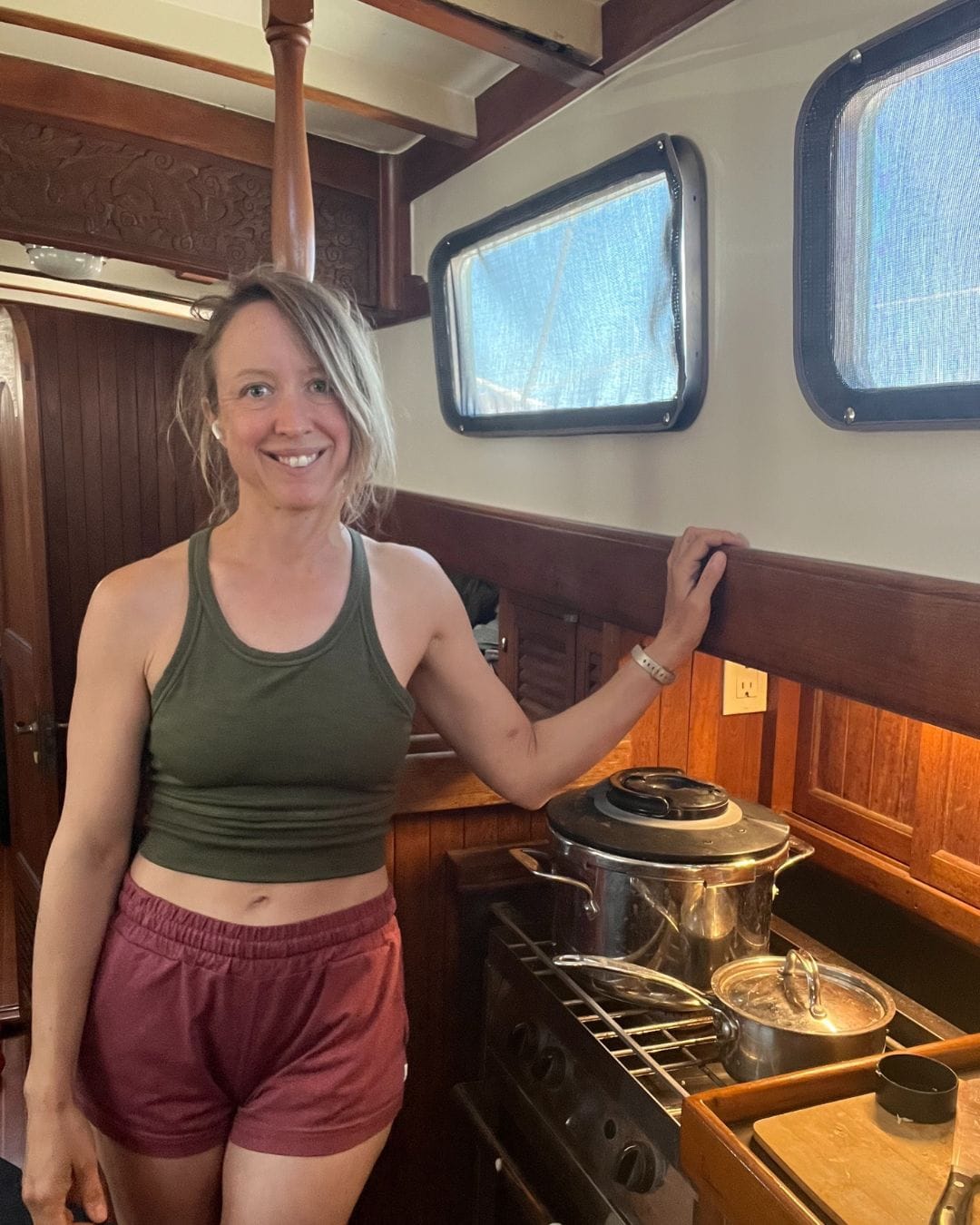
Counter space is measured in inches, so the morning kit has a routine: grinder out, coffee made, grinder away. The deep fiddles along the edge are what let anything sit on a counter at sea at all.

Boats are cold in winter and the galley is where you warm up. The pressure cooker is the liveaboard’s secret weapon: it uses less fuel, it does not spill when it is latched, and it turns dried beans into dinner on one burner.
The nav station is the one real desk aboard
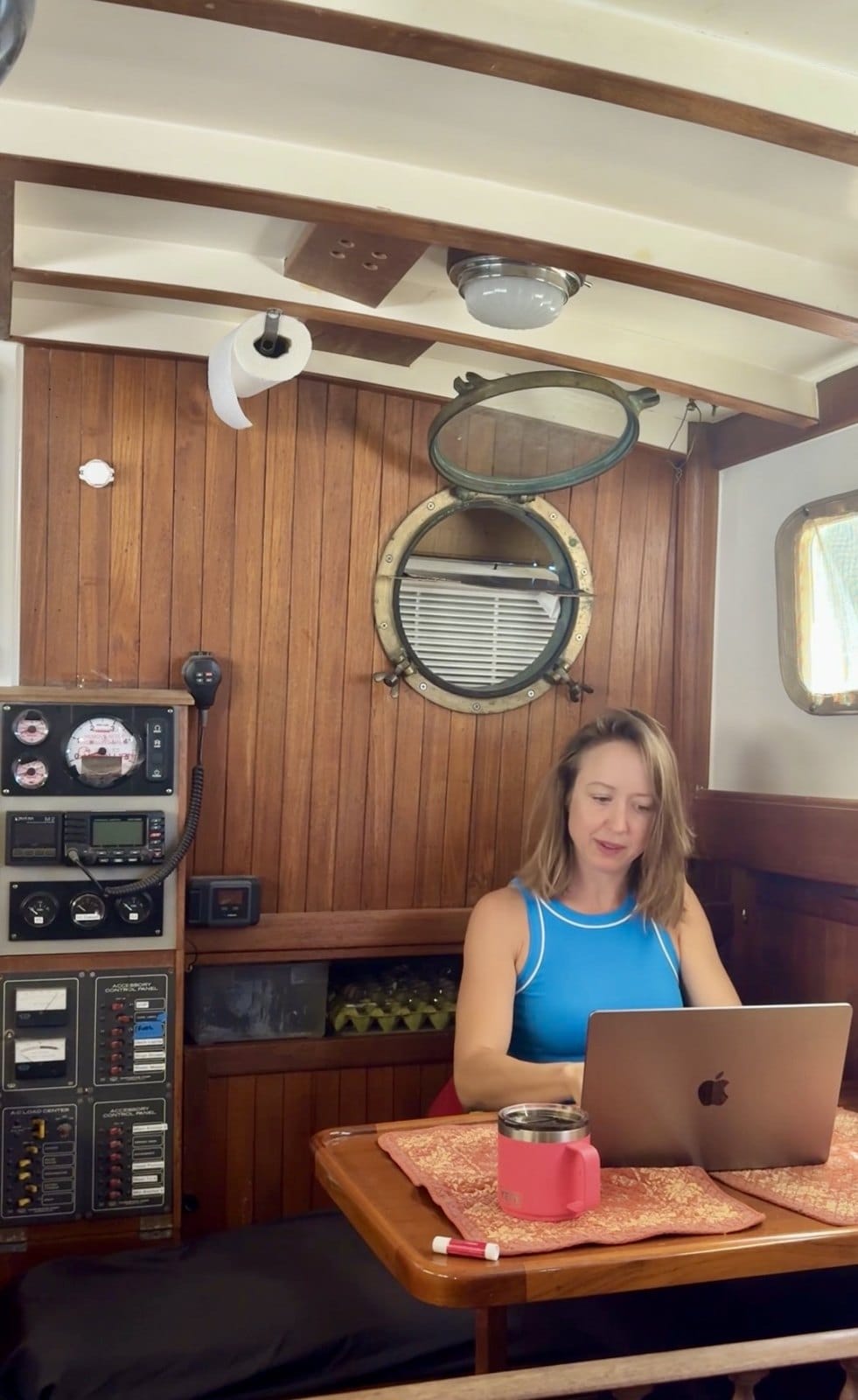
Every cruising boat has a chart table with the electronics above it, and on a liveaboard it becomes the desk, the charging station and the junk drawer. Ours sits beside the companionway, a step from the cockpit.
The louvered doors on every locker are not decoration. Air has to move through every locker on a boat or the clothes inside go green, which is why old boats are full of slats and vents and new ones are full of fans.
The stateroom, and the furnace across from the bed

The bed is small but stretches out enough for two, and the hatch above it is the best thing on the boat: I lie there with it open and the breeze on my face, listening to rain on the deck or the wakes of passing ships rocking us. Across from the bed is a little furnace that runs on kerosene. Anchored out in winter with it flickering, the boat feels like a tiny cabin that happens to float.
Forward of the stateroom is the V-berth, with the anchor locker, a bench and a huge hatch. I have always wanted to shut myself in up there and write. Mostly it holds sails.
The head, which took months to get
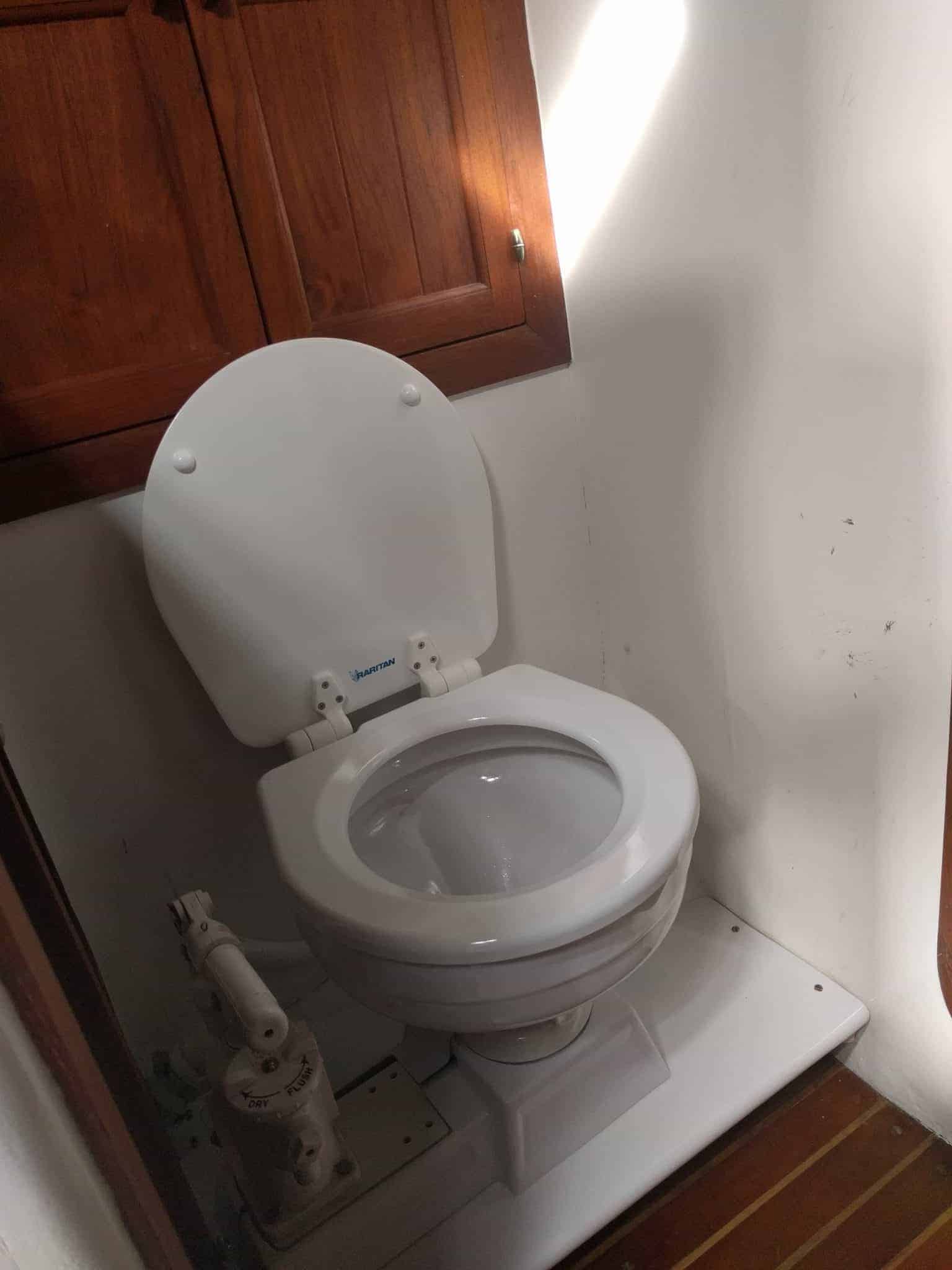
Boat bathrooms are small and the toilet is a pump, and the first question every guest asks is about it. Ours took months to get installed behind the hundred other projects of the refit, and I never thought I would appreciate a toilet this much. Sometimes it is the smallest things.
The details are the part that makes it a home
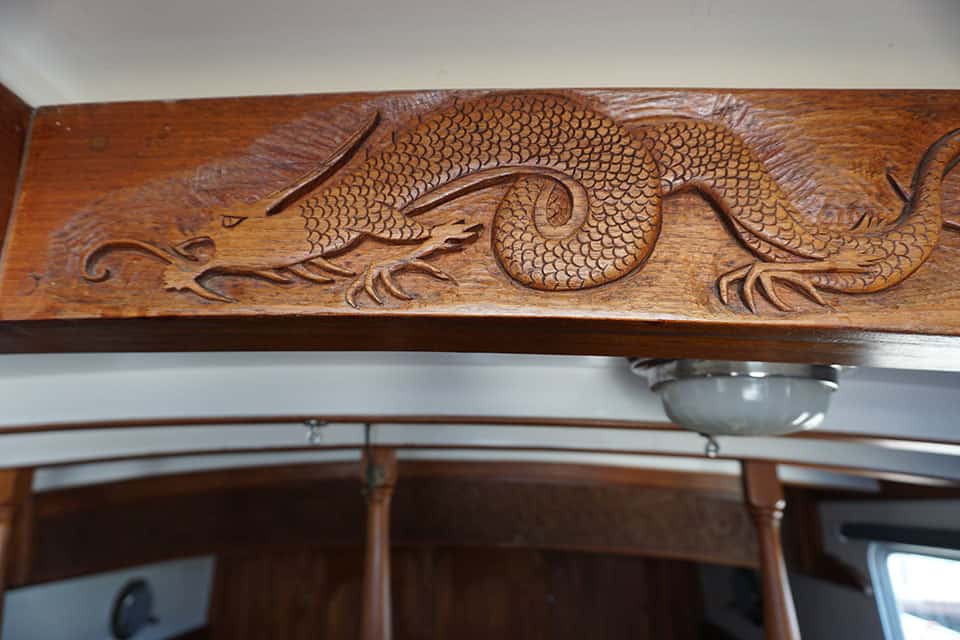
Boats built in Taiwan in the seventies came with carving nobody asked for and everybody keeps. Our dragon runs along the beam above the saloon, and it is the first thing I would save in a fire, after the people.

If you want a boat to feel like these photos, the answer is almost always more wood and less white plastic, warm bulbs in the brass lamps, and one porthole you leave open.
The cockpit is the room with the view

Ask any liveaboard where they spend the day and the answer is the cockpit. It is the porch, the dining room and the office with the best light, and it is why a boat with a small cabin can still feel like a big home.
Three other boats, for contrast
Newer boats go white and bright where ours goes teak and warm. The lesson is the same: a deep sink, a stove with a rail and a surface that wipes clean in one pass. Our eight galley mistakes cover what goes wrong in either style.

A catamaran galley is the one place where “bigger inside” is true. Morgan and Eric quit their San Francisco jobs to sail the world on theirs, and the galley that fits a whole salmon is part of why people cross over to two hulls. Their story is here.

A bimini and a dodger turn the cockpit into a real room. In the tropics the shade is the difference between living in the boat and hiding below from noon until four.
What to steal from this boat
Wood where your hands land and white where you need light. One soft thing per room, and a pillow that is yours. A stove with a rail, a sink you can wash your hair in, and a pressure cooker. Fiddles on every surface, a latch on every door, and nothing that cannot be put away in ten seconds. Then open the companionway and let the cockpit be the living room.
If you are wondering what it is like to live in one of these, start with the seven questions everyone asks me, the brutal truths about sailboat living and what owning almost nothing taught me. For the shiny version, our 19 luxury sailboat interiors are the boats these photos are not, and the 26 boat hacks are how a real one stays livable.
Questions people ask about sailboat interiors
Does a 41-foot sailboat have a bathroom?
Yes. Ours has a small head with a marine toilet that pumps rather than flushes; it took months of refit projects before it was installed. Every guest asks about it first, which is why it is the first of the seven questions people ask me.
What does the inside of a liveaboard sailboat look like?
On most boats under 45 feet, one cabin does everything: two settees facing a drop-leaf table (one converts to a bed), a galley the size of a closet with a stove on gimbals, a chart table with the electronics above it, a small head, and a V-berth or aft cabin for sleeping. Teak joinery and brass lamps on older boats, white surfaces on newer ones.
Why do sailboat stoves swing?
The stove is mounted on gimbals, pivots that let it stay level while the boat heels under sail or rolls at anchor. A rail across the front keeps pots on it, and most cruisers cook one-pot meals on passage with one hand on that rail.
How do you make a sailboat interior feel like a home?
Warm light from the lamps instead of a bright overhead, oiled wood, one cushion or pillow per room that is yours, and surfaces kept clear with fiddles and latches so the boat does not look like a storage locker. Open the companionway and use the cockpit as the living room.
Is it hard to cook in a sailboat galley?
It is small and it moves, so cooks plan around it: one-pot meals, a pressure cooker that latches shut, everything stowed between uses and a deep sink. Once you have the routine, it is a kitchen like any other, just one you can reach every part of without moving your feet.
Can you live on a sailboat with a dog?
Yes, and many cruisers do. The interior part is easy; the work is the dinghy trip to shore for walks, several times a day at anchor, and keeping the boat ventilated so a wet dog does not make a damp boat damper.
Photo credits: each photo is credited in its caption. Kristin’s photos are her own; the catamaran and Endless Summer photos belong to the cruisers named and first appeared in our articles about them.








After seeing your post on a Facebook group, I knew I had to follow you after learning you lived in a sailboat! This is so cool! It’s absolutely gorgeous inside of there and being in the bay area is a pretty place to be docked. Also, the gas range stove makes cooking so much better.
Love this! xo- Victoria
This is a dream of mine. I think I could handle the tight spaces because the great wide world would be your backyard! So cool!
Kendall
weekendall.com
We are trying hard to get our boat to the point you are at. Love what you have done inside.
Carol
sailingonseabreeze.com
Thank you! That is so sweet. Luckily, the inside came finished,….its all the mechanical stuff that my boyfriend has had to fix.
Wonderful article!!
Kristin, thanks for the tour of your boat. She is in fact a beauty. I can imagine the amount of work it takes to maintain her. And I love the interior. I much prefer warm & cozy over white & shiny. Please excuse my ignorance, but what’s a “fiddle”? Also loved the article re: Eric & Morgan.