

9 Things I Didn’t Expect to Miss from Land Life (and a Few I Definitely Don’t)

The quiet comforts land life gives you for free — and the things you realize you never needed.
*This post may contain affiliate links. Please read our disclosure policy for more info.
The quiet comforts land life gives you for free — and the things you realize you never needed.
Living on a boat changes your relationship with comfort in subtle, practical ways. You don’t notice it all at once. It happens slowly, through small daily frictions that land life quietly absorbs for you.
Before moving aboard our CT41 sailboat, we expected to miss the obvious things — space, convenience, maybe a few comforts. What surprised us was how specific the missing pieces became. Not “land life” as a whole, but the background systems that make it work. At the same time, there are parts of land life we haven’t looked back on once.
9 Things I Miss from Land Life
1. Unlimited water pressure
On land, water just comes out of the tap. You step into the shower, turn the handle, and stay there as long as you want.
On a boat, every drop counts. You’re always doing quiet mental maths: how full the tanks are, whether you’ve run the engine recently, how many showers are left before the next refill. Showers become quick and efficient. Rinsing dishes turns into a strategy.
2. Weather as Background

On land, weather is usually just atmosphere. Rain sets a mood. Wind rattles the windows. A bad forecast might change what you wear or your plans for the day.
On a boat, weather is never passive. Rain affects whether you can get ashore, how you ventilate, and how much water finds its way inside. Wind determines where you anchor, how well you’ll sleep, and whether tomorrow’s plans are realistic at all. You’re always watching it, interpreting it, adjusting to it.
3. Predictable Sleep

On land, sleep is usually consistent. You go to bed, lie still, and wake up more or less where and how you expect to. Noise fades into the background, and the ground doesn’t move underneath you.
On a boat, sleep depends on conditions. A small swell can roll you just enough to keep your body bracing all night. A halyard starts slapping at 3 a.m. A marina comes alive with clanking masts and early departures. Even when nothing is technically wrong, rest can be shallow and fragmented.
4. Leaving Things Out
On land, you can leave things where they are. A book stays on the table. A mug sits on the counter. You walk away knowing they’ll be there when you come back.
On a boat, anything left out of lockers might slide, tip, or end up on the floor as soon as conditions change. Before getting underway, you have to do a quiet sweep — securing objects, wedging cushions, stowing anything that could move.
5. Big, Cold Fridges
On land, fridges are reliably cold and very spacious. You can buy groceries for a week, forget what’s inside, and trust that everything will still be fine when you remember.
On a boat, fridge space is limited and power-hungry. You plan meals carefully, prioritise what needs chilling most, and accept that some things just won’t fit. If the batteries dip or the door gets opened too often, you notice.
6. Trash and Sewage Just… Going Away
On land, waste disappears on a schedule. You take the bin out, flush the toilet, and that’s the end of your involvement. You don’t think about volume, storage, or what happens next.
On a boat, nothing disappears. Trash piles up faster than you expect and has to be stored somewhere until you can take it to shore. Toilets require attention and occasional unpleasant jobs. Emptying tanks and finding disposal points becomes part of your routine.
7. Wide Sinks and Big Cookers

On land, kitchens give you room to work. Sinks are wide enough to catch splashes. Cookers let you run more than one pan without stacking or improvising.
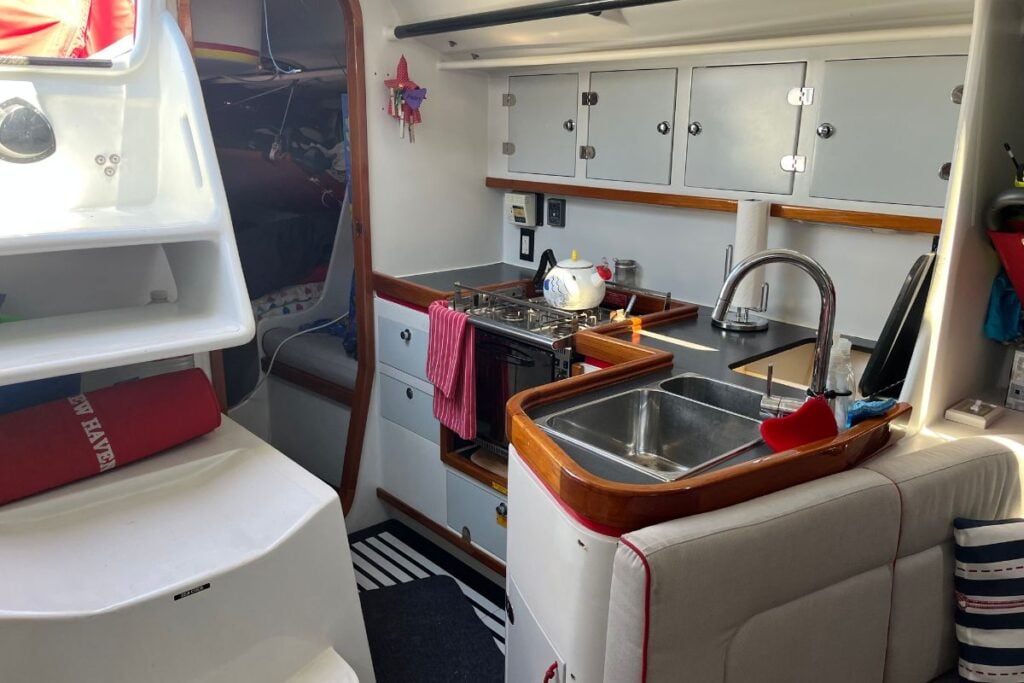
On a boat, space is tight. Sinks are shallow, surfaces are limited, and cooking becomes a sequence of small, careful actions. You’re holding things steady, timing steps, and cleaning constantly because there’s nowhere to spread out.
8. Roadside Pull-Offs
It’s not the pull-offs themselves we miss. It’s the ease behind them. On land, you can stop the car when you need to — to stretch, eat, check a map, or simply turn back around. There’s no setup and no consequences beyond turning the engine off.
On a boat, stopping is a process. You need suitable depth, protection from wind and swell, and enough room to swing. Anchoring takes time and attention. Docking depends on availability, conditions, and sometimes permission.
9. Big Tables

On land, tables are generous. You can leave your laptop open, spread out maps or papers, eat a meal, and still have room left over. Things can coexist without being packed away between tasks.
On a boat, the table does everything. It’s where you eat, work, plan routes, and fix things — often one activity at a time. If you want to switch tasks, you clear the space first. Nothing stays out for long.
6 Things I Definitely Don’t Miss About Land Life
1. Commuting
On land, commuting quietly shapes your day. Time gets boxed into traffic, timetables, and routines that exist regardless of how you feel or what the conditions are like outside.
On a boat, movement has purpose. You go somewhere because the weather allows it, the light is right, or it’s simply time to move on. There’s no daily grind of going back and forth just to return to the same place.
2. Bills

On land, there are simply more bills. Power, water, heating, internet, waste collection — each one arrives separately, whether you think about it or not.
On a boat, costs still exist, but they’re fewer and more direct. You notice what you use, because you’re the one generating the power, carrying the water, and managing the waste.
3. Stuff Creep
On land, things accumulate quietly. You buy something because you’ve seen an ad for it on social media. You keep things “just in case.” Storage makes it easy not to decide.
On a boat, space forces clarity. Every item has to earn its place. If something comes aboard, something else usually has to go. There’s no hiding clutter in a spare room or cupboard.
4. Artificial Deadlines

On land, urgency is often manufactured. Deadlines pile up, emails feel immediate, and everything seems important, even when very little actually changes if it waits.
On a boat, urgency is usually real. Weather windows close. Light fades. Tides turn. When something matters, you feel it clearly — and when it doesn’t, it can wait.
5. Rigid Routines

On land, days often run on fixed schedules. Alarms go off at the same time, meals happen by the clock, and plans stay put even when the weather, energy, or mood doesn’t cooperate.
On a boat, routine is looser. Days stretch or compress depending on light, wind, and conditions. Some days are busy, others slow.
What Do You Miss and Not Miss About Land Life?
I love living on my sailboat, and have for the past 10 years. Sure, there are both positives and negatives to this experience, but I’ve been thankful for every minute.
What do you miss and not miss about land life?







Great article. Thanks for sharing.