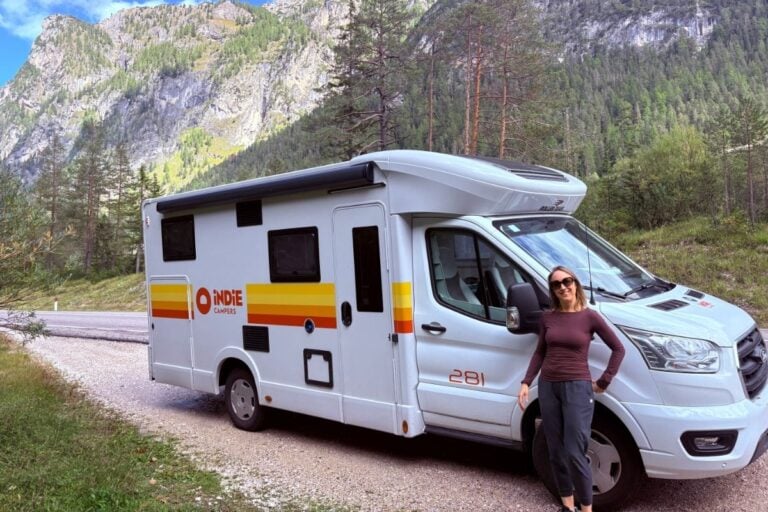
Do Van Lifers Carry Guns? We Asked, and 480 of You Answered

We asked 480 van lifers whether they carry a gun on the road. The answers split the community.
*This post may contain affiliate links. Please read our disclosure policy for more info.
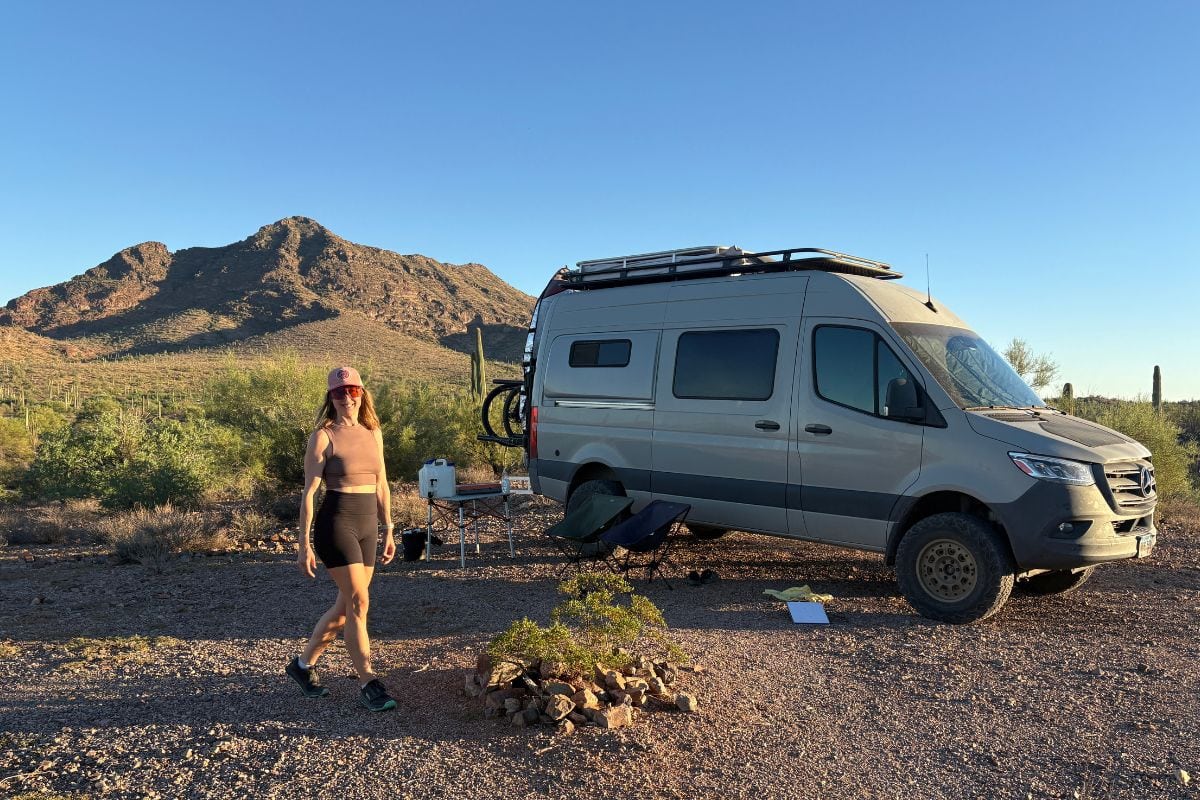
Whether I carry a gun in my campervan while roaming the United States is a question I get often. People think it is unsafe out there in the great wilds of the West where we camp in the middle of nowhere. But to be honest with you, in all our years boodocking and living off-grid, I’ve only felt creeped out once or twice.
We personally do not carry guns, but have other things on hand like bear spray, and we take precautions like never parking the van somewhere it could get boxed in. Also, we drive to Mexico frequently where hauling a gun across the border could land you in jail.
People have wildly mixed opinions about guns in campers, so I decided to ask my van life Facebook page this question: do you carry a gun for protection when camping in your van?
Within a day, 480 people had answered. And the single most popular answer, the one that got more likes than any other, was this:
“If I did, I would certainly not discuss it with a bunch of unknown folks on the Internet.”
The second most popular was its twin: “The best kind of protection is the one no one knows about.”
That tells you something right away. Before we get to yes or no, the loudest camp in the van life community is the one that treats the question itself as a security risk. Announcing what’s in your rig, they argue, is the opposite of protection.
But hundreds of people did answer, in detail, and the picture that emerged is more interesting, funnier, and more practical than the shouting matches you usually see on this topic. Here’s what 480 van lifers actually said, and the legal reality every one of them has to navigate.
The case for carrying: it’s about where help isn’t

The carriers in the comments were not, for the most part, talking about crime in the Walmart parking lot. They were talking about distance.
“I carry a gun for protection most of the time. ESPECIALLY when I am out in the wilderness, far from the help of emergency services and potentially without cell coverage.”
That was the most-liked pro-carry comment, and it captures the core argument: boondocking often means being an hour or more from the nearest sheriff’s deputy, with no bars on your phone. Several carriers also made a distinction that surprised people: it’s less about humans than wildlife. “From a camping perspective it might be more about wildlife protection than people,” one wrote.
The philosophy showed up over and over in one proverb, almost word for word: better to have it and not need it than to need it and not have it. One Louisiana commenter summed up the regional reality: “It’s not a question of if one carries one, it’s more a question of what caliber is it.”
The case against: decades on the road, never needed it

The no camp was just as confident, and slightly larger in my comment section. Their argument was experience.
“I’ve been traveling for 20 years… if you think you may need a gun, the road may not be for you… not to mention gun laws from state to state.”
One commenter, a military veteran, put it this way: their mother drove an RV all over the USA, Canada, and Mexico with two guns aboard, “and I’m the veteran in the family and I don’t feel the need or desire for firearms.”
The international van lifers piled in here too, and they were often funny about it. A UK reader reported carrying “an emotional support axe.” An Australian couple described 18,000 miles through the remote outback, “some very dodgy looking people about,” and never feeling the need. And one longtime traveler offered what might be the most quotable safety advice in the whole thread: “Travel lightly and with good humour and you will be very unlucky indeed to get into a bad situation in the first place.”
Many in this camp said the same thing solo women travelers have told me for years: the scariest thing that happens at most camps is a weird noise at 2 AM, and the answer to that is usually turning the key and driving away. I’ve written about that mindset in my solo woman’s guide to van life, and about the rare genuinely creepy nights in these true boondocking scare stories.
The third arsenal: what the non-gun crowd actually carries
Here’s where the comments turned into a gear list. The people who don’t carry firearms are not exactly unarmed:
- Dogs, first and always. “I don’t carry a shooter, my dog does, best motor home security.” Two Rottweilers, German shepherds, and various “pooches” got more endorsements than any gadget. A barking dog solves most problems before they start.
- Bear spray. More on this below, because the science here is genuinely strong.
- Prevention tech. One of the smartest comments: “My van also carries protection. Cameras and special door locks to make it hard for thieves at trailheads. We hike a lot.” Trailhead break-ins are a far more common threat than confrontations.
- Improvised classics. Three crowbars under the driver’s seat. A baseball bat, which prompted the thread’s best legal advice: “If you carry a baseball bat for protection in the USA, make sure you also carry a baseball glove and ball. Your lawyer will thank you.”
- A fire extinguisher. One commenter suggested a powder fire extinguisher as a legal deterrent. It blinds, it disorients, and every rig should carry one anyway.
One popular suggestion deserves a correction: wasp spray. The idea that hornet spray is a good self-defense tool is folklore. It has never been shown to reliably stop an attacker, and using a pesticide on a person is a federal offense under pesticide misuse laws. Bear spray, made for the job and tested in the field, is the better tool in every way.
What the science says about bear spray
For wildlife, the research is unusually clear. A study of bear encounters in Alaska published in the Journal of Wildlife Management found bear spray stopped undesirable bear behavior in roughly 90 percent of incidents, and 98 percent of the people carrying it walked away uninjured. A companion study of firearm encounters found guns deterred aggressive bears in about 76 to 84 percent of incidents, and the authors concluded that only highly proficient shooters should rely on a firearm in bear country. The National Park Service and U.S. Forest Service both recommend spray over firearms for bear defense.
Those numbers come from different datasets, so it isn’t a controlled head-to-head. But in the field records we have, spray users fared better. One caveat: bear spray is itself regulated. Some parks restrict it (Yosemite bans it), and Canada treats defense sprays as weapons unless clearly labeled as animal deterrents, so check your destination’s rules.
The part everyone agrees on: the law is a minefield on wheels

A note before this section: I’m a journalist, not a lawyer, and nothing here is legal advice. Gun law changes constantly and varies by state; verify everything against official sources before you travel.
Here’s the thing the “gun laws from state to state” commenter was pointing at. A van lifer’s superpower is crossing borders constantly. For a firearm owner, that superpower becomes a liability, because there is no such thing as one set of American gun laws. There are fifty.
Your permit probably doesn’t travel. Concealed carry reciprocity is a state-by-state patchwork of agreements. Texas, for example, honors many states’ licenses, while New Jersey honors none. The only way to know is to check each state’s own government page for every state on your route.
Federal law protects transport, narrowly. A federal provision known as the safe passage law (18 U.S.C. § 926A) protects you while driving through a restrictive state, but only if the gun is legal at both your starting point and destination, unloaded, locked in a container that is not the glove box or console, with ammunition not readily accessible from the passenger compartment. Legal commentators generally read it as covering continuous travel, and here’s the genuinely unsettled part for van lifers: nobody wrote that law with a vehicle that is also your bedroom in mind. In a van or motorhome, the entire rig arguably is the passenger compartment. There is no authoritative guidance on how “readily accessible” applies to a home on wheels, which is exactly why this deserves a conversation with a firearms attorney if you plan to carry across state lines.
Parked doesn’t mean exempt. Some states regulate guns in unattended vehicles. California, for instance, requires a handgun left in an unattended vehicle to be locked in the trunk or a locked container out of plain view, and the glove box doesn’t count.
National parks follow state law. Since February 22, 2010, possessing a firearm in a national park is legal if it’s legal under that state’s law (a rule that, in a very American twist, was passed as a rider on the Credit CARD Act of 2009). But discharging it remains prohibited, and firearms are banned inside all park buildings like visitor centers and ranger stations. And since park legality tracks state law, it changes at every state line too.
Canada is a hard stop. If your route runs north, know that Canada requires you to declare all firearms at the border, and undeclared guns mean seizure and possible criminal charges. Since Canada’s 2022 handgun freeze, an ordinary visitor has no lawful way to bring a handgun in. Non-restricted long guns can still be imported with a declaration and a fee for purposes like hunting, but for a typical van trip, the practical answer is: leave it at home.
Mexico is a hard stop. If you plan on traveling across the border into Mexico, absolutely do not carry a gun. Guns are illegal in Mexico, and you will be thrown in jail.
One more legal reality from my own reporting: where you park is often more legally fraught than what you carry. Sleeping in your vehicle is itself now illegal in a growing list of U.S. cities, and a firearms question during a knock-on-the-window conversation raises the stakes considerably.
So, should you carry?

I’m not going to answer that for you, and neither did my comment section, which is the honest takeaway. Nearly 500 van lifers split right down the middle, and the most experienced voices landed in every camp.
What the thread did agree on, once you strip away the jokes and the flags, looks like this:
- Whatever you carry, know how to use it, and know the law of every state you’ll wake up in. The commenters most serious about firearms were also the most serious about this.
- Prevention beats confrontation: cameras, locks, lighting, a dog, and picking your spot well solve almost everything. Trusting your gut and driving away solves most of the rest. That instinct is free and legal in all fifty states.
- For wildlife, the evidence favors bear spray.
- And if you do carry, the community’s top-voted advice stands: don’t announce it.
Stay safe out there, wherever you land on this one. If you want to read the entire Facebook thread, go here.
Sources
- Cornell Law School, Legal Information Institute: 18 U.S.C. § 926A (law.cornell.edu/uscode/text/18/926A)
- New Jersey State Police: Transporting Firearms Through New Jersey (nj.gov/oag/njsp/firearms/transport-firearm.shtml)
- Texas DPS: State Reciprocity Information (dps.texas.gov/section/handgun-licensing/state-reciprocity-information)
- USCCA Concealed Carry Reciprocity Map (usconcealedcarry.com/resources/ccw_reciprocity_map/)
- National Park Service: Firearms in National Parks (nps.gov/articles/firearms-in-national-parks.htm); Bear Spray vs. Firearms (nps.gov/articles/bearsprayfirearms.htm)
- Canada Border Services Agency: Import Firearms and Weapons (cbsa-asfc.gc.ca/import/iefw-iefa-eng.html); RCMP: Importing and Exporting Firearms (rcmp.ca/en/firearms/importing-and-exporting/importing)
- Smith, Herrero, DeBruyn and Wilder, “Efficacy of Bear Deterrent Spray in Alaska,” Journal of Wildlife Management 72(3), 2008; Smith et al., “Efficacy of Firearms for Bear Deterrence in Alaska,” Journal of Wildlife Management 76(5), 2012
- U.S. Forest Service, Custer Gallatin: Bear Spray (fs.usda.gov/r01/custergallatin/safety-ethics/bear-spray)
- California Penal Code § 25140 (unattended-vehicle handgun storage)
FAQ: Guns and Van Life
Do most van lifers carry guns?
There is no reliable statistic, and our own survey of 480 van lifers split close to evenly. Many carriers cite remote boondocking far from emergency services; many long-time travelers report decades on the road without needing one; and a large group declines to say, arguing that announcing what you carry defeats the purpose.
Is it legal to carry a gun in a camper van?
It depends entirely on the state you are in at that moment. Firearm and concealed-carry laws differ in all 50 states, and a permit valid in one state may not be recognized in the next. Check each state’s official government page for every state on your route, and consult a firearms attorney for route-specific questions.
Can you transport a gun across state lines in an RV?
Federal law (18 U.S.C. § 926A) protects transport between two places where the gun is legal, but only if it is unloaded and locked in a container that is not the glove box or console, with ammunition not readily accessible. How this applies to a van or RV that is also a home is legally unsettled, so carriers should get state-specific legal guidance.
Can you bring a gun into Canada in a camper van?
All firearms must be declared at the Canadian border; undeclared firearms can be seized and lead to criminal charges. Since Canada’s 2022 handgun freeze, ordinary visitors effectively cannot bring handguns into the country. Non-restricted long guns can be imported with a declaration and fee for approved purposes like hunting.
Is bear spray better than a gun for camping safety?
For wildlife defense, field research supports bear spray: an Alaska study found it stopped aggressive bear behavior in about 90 percent of incidents, with 98 percent of carriers uninjured, and the National Park Service recommends spray over firearms. For people-related safety, most incidents are best solved by prevention: good campsite choice, lighting, locks, and driving away.