

11 Things Cruisers Say That Baffle Everyone Else

Cruisers have a language all their own. From “on the hook” to “blowing up the dink,” here’s some of the strangest boat-life phrases.
*This post may contain affiliate links. Please read our disclosure policy for more info.
What does “on the hook” mean, and why do cruisers “make water”?
Spend enough time cruising, and you stop hearing how odd some of the things we say really are. After years living aboard, I use these expressions without giving them a second thought.
To us, saying “the dink’s in the water” is a useful piece of information. To everyone else, it sounds inappropriate and raises more questions than it answers.
Here are 11 confusing things people who live the boat life say and what they mean.
1. “We’re on the hook.”
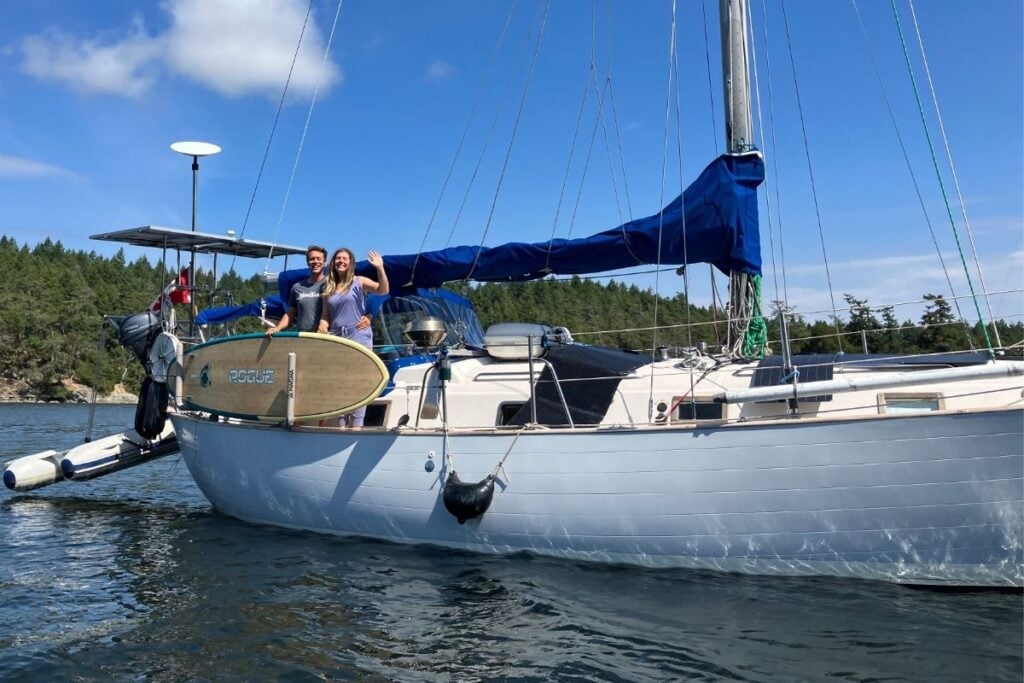
When we say we’re “on the hook,” we mean we’ve anchored instead of tying up at a dock or picking up a mooring.
We spend a lot of time on the hook while cruising. Anchoring lets us avoid marina fees and wake up in wild places.
When we’re ready to stop, we look for a bay that’s sheltered from the wind and swell and lower the “hook” – our anchor – so it bites into the seabed and keeps us put.
Here’s how it works. Chain, rope, or a combination of both connects the anchor to the boat; we call this the rode. We let out plenty of rode, then gently reverse the boat to help the anchor dig securely into the seabed. Once we settle in, the boat swings around the anchor as the wind or tide changes.
Busy anchorages make this process a little more complicated because we need to leave enough room for every boat to move. If someone anchors too close, our boats may swing into each other and crash, or our anchor rodes may become tangled. Sorting them out can turn into a real headache.
2. “The dink’s in the water.”

When we say, “The dink’s in the water,” we mean we’ve launched the dinghy.
Our dinghy acts as a car when we live at anchor. We use it to go to the beach, visit other boats, go buy groceries, carry fuel and water, and go out for dinner.
Getting the dink into the water can take some work. We might lower it from davits (the lifting arms at the back of the boat), hoist it over the side using one of the lines that normally raises our sails, or slide it off the deck.
We usually power it with a small outboard, although we can always row if the engine refuses to cooperate or if we feel like getting a workout.
We also need to decide what to do with the dink before every passage. We can tow it in calm, protected water, but rough seas can flip it, swamp it, or tear it free. For longer or rougher passages, we usually lift it onto the deck or secure it in the davits.
3. “We’re making water.”
When we say, “We’re making water,” we mean we’ve switched on the watermaker.
A watermaker turns seawater into fresh drinking water. It draws saltwater from beneath the boat and pushes it through a very fine membrane under high pressure. The membrane blocks the salt and other impurities but allows fresh water to pass through.
A watermaker gives us more freedom while cruising. Instead of heading to a marina or lugging heavy jerry cans back from shore, we can refill our tanks while we sit at anchor.
That doesn’t mean we stop thinking about how much water we use, though.
4. “I’m going to the head.”
When we say, “I’m going to the head,” we mean we’re going to the toilet.
Sailors use “head” for both the toilet itself and the small compartment that contains it. The name goes back to old sailing ships, when sailors went to the toilet at the head, or front, of the boat. The wind carried the smell away, and the waves washed the waste away.
Thankfully, we have better options on cruising boats today. An electric marine toilet flushes with seawater and sends everything to a holding tank, which we empty at a pump-out station. A cassette toilet collects everything in a small tank that we carry ashore, while a composting toilet uses no water and keeps liquids and solids separate.
Every option comes with trade-offs. Whichever type of head we use, no one enjoys fixing it or dealing with what comes out of it.
5. “We’re waiting for a window.”
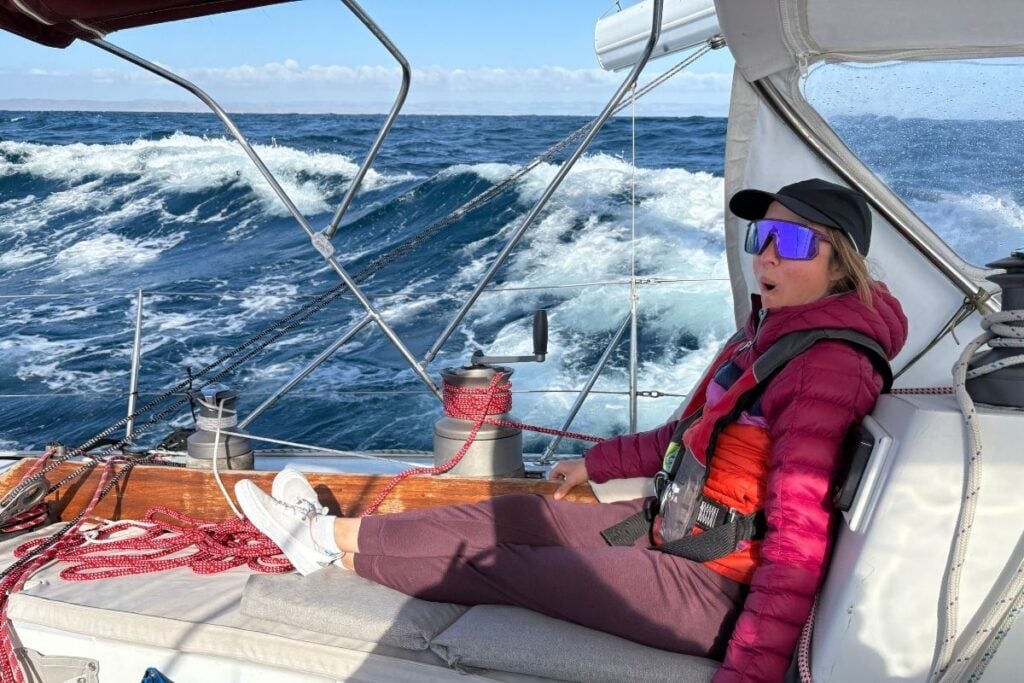
When we say, “We’re waiting for a window,” we mean we’re watching the forecast for a good time to set sail.
Before going sailing, we need to check the wind strength and direction, wave height and period, tides, currents, visibility, and the risk of thunderstorms or strong weather fronts. Sometimes that means leaving at 4 a.m. to catch a favorable tide, avoid stronger afternoon winds, or make sure we reach the next anchorage before dark.
The length of the passage also affects the window we need. For a short hop along the coast, we may only need a few hours of settled weather. An offshore passage can take several days or even weeks, so we need to look farther ahead and leave ourselves a bigger margin in case the forecast changes.
6. “The holding is good.”
When we say, “The holding is good,” we mean the seabed grips the anchor securely. Good holding helps us relax. We still monitor the weather and set an anchor alarm, but we feel confident that the boat will stay in place.
We check the charts and cruising guides before dropping anchor, but we don’t know exactly what’s down there until we try. One part of a bay might have perfect sand, while another might have thick weed that stops the anchor from digging in.
When the holding is poor, we usually pull up the anchor and try another spot. If we have no choice but to stay, we’re in for a restless night. We watch our position on the chartplotter, check landmarks on shore, and investigate every unexpected sound or movement. If the anchor starts to drag, we have to reset it, no matter what time it is or how hard it’s raining.
7. “The boat is on the hard.”

When we say, “The boat is on the hard,” we mean we’ve hauled it out of the water and stored it in a boatyard.
We usually haul out every year or so to clean the hull, apply fresh antifouling paint, and check everything below the waterline. But sometimes the boat comes out unexpectedly – maybe we’ve hit a rock, damaged the rudder, or discovered a leak that we can’t fix in the water.
No matter why we’re on the hard, a quick haul-out rarely stays quick. Often, one small repair leads to another, and we end up waiting weeks for a part to arrive.
Living in a boatyard feels very different from being afloat. If the yard allows us to stay aboard, we climb a ladder every time we come and go. We can’t use the toilet or sinks, and dust seems to find its way into every corner of the boat. Nothing makes us appreciate life on the water more.
8. “We’re dragging.”
When we say, “We’re dragging,” we mean the anchor has lost its grip on the seabed and the boat has started to move. Nothing gets us out of bed faster than hearing those two words.
Most of the time, we notice the boat moving, but sometimes another cruiser sees it first and alerts us by sounding a horn, flashing a light, or calling over the radio.
As soon as we realize we’re dragging, we start the engine and try to reset the anchor. Strong winds, poor visibility, and a crowded anchorage make the job a lot more stressful.
9. “Ease the sheet.”
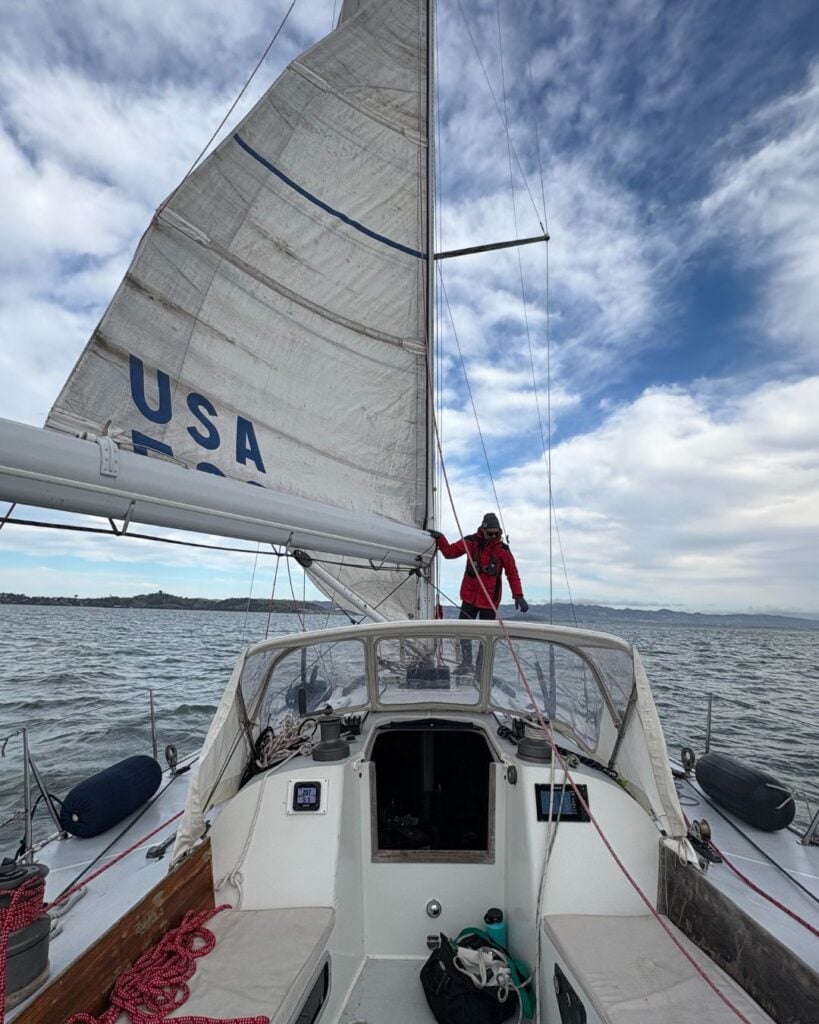
When we tell someone to “ease the sheet,” we mean they should let out the line that controls a sail. It has nothing to do with bedding.
Each sail has its own sheet. We control the mainsail with the mainsheet and use the jib or genoa sheets to control the sail at the front of the boat. On many boats, we wrap the sheets around winches so we can pull them in without taking the full force of the wind ourselves.
When we ease a sheet, we let the sail move farther away from the center of the boat. When we “trim” or “sheet in,” we pull the line and bring the sail closer. We make these adjustments as we change direction or the wind shifts.
10. “We have a dirty bottom.”
When we say, “We have a dirty bottom,” we mean algae, slime, barnacles, and other marine life have accumulated on the hull below the waterline.
All that growth creates drag. It slows us down under sail and makes the engine work harder, increasing our fuel consumption.
Where local rules allow it, we can clean the bottom in the water by diving down and wiping or gently scraping the hull. It sounds easy, but we have to scrub awkwardly above our heads while holding our breath and trying to stay in one place.
For a more thorough clean, we haul the boat out and pressure-wash the hull.
11. “We need to blow up the dink.”
When we say, “We need to blow up the dink,” we mean we need to inflate the dinghy, not destroy it.
Many cruisers use an inflatable dinghy because they can deflate it, roll it up, and store it on deck or below when we don’t need it.
Blowing it up takes a bit of work. We unroll the dinghy, pump up each tube, put the floor and seats in place, and check that none of the valves leak. If we use a hand or foot pump instead of an electric one, we feel like we’ve already had a workout before we even climb on board.





Enjoy your articles .
None of your sayings are unusual to me . I have lived and made a career from being a Maritime Professional my whole life . Cruise these days in a pocket trawler , summer in a small beach cottage in NC . Most folks suggest that living on a small boat would be like ” being in jail ” . I consider it Freedom !
with my boat living on a mooring, “it’s wrapped”, is the end of a good day when getting back on the mooring. “Get the gear” means all that dive stuff you need to unwind your prop. That can be a fix for those anchor wars you were talking about. I keep a very small tank with a regulator that you can just carry under your arm for quick fixes.