I Bought My First Van Off Craigslist and Got Lucky. Here Are the 12 Mistakes That Turn a Used Campervan Into a Money Pit.

Twelve used campervan buying mistakes, from the inspection I skipped on my Craigslist Astro to the weight sticker nobody reads, with the cheap checks that catch each one.

*This post may contain affiliate links. Please read our disclosure policy for more info.
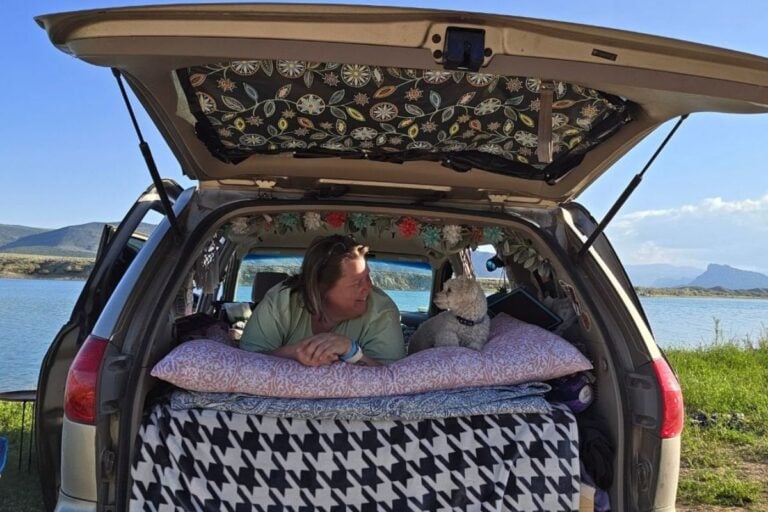
My first van came from two grandparents on Craigslist. It was a 1994 Chevy Astro conversion van with a TV, bucket seats and a back bench that folded flat at the push of a button, and they had spent years driving their grandkids to Disneyland in it. Someone else wanted it too, so I offered $1,000 more than the other buyer and drove it home for about $6,000 with roughly 57,000 miles on the clock.
We lived in that van for three years, and we still own it. The honest part: I never paid for my own inspection. The seller told me the other buyer had already had a mechanic look it over, I did a test drive, and I took the gamble. It paid off, which makes it a lucky story, not a smart one. Most used campervan stories do not end that way, and the difference usually comes down to a dozen checks that cost less than a tank of gas.
Here are the 12 used campervan buying mistakes I see over and over, from the inspection people skip to the weight sticker nobody reads, with what to do instead. The one that costs the most money is number four. The one that ends van life before it starts is number ten.

1. Shopping before you know what you want
The first mistake happens before you open a single listing: scrolling every van for sale in 200 miles with no idea what you actually need. I looked for about a month, and I knew from day one that I wanted a Chevy Astro. Small enough to park on a city street, all-wheel drive for dirt roads, cheap enough that a mistake would not ruin me. When a conversion van showed up, with the higher fiberglass roof, rear slider windows and the fold-flat bench already in it, I knew it was a better find than a plain passenger Astro and I could move fast.
Pick your model first, then your budget, then the three things the van must have. Our guide to small camper vans and the one on what a camper van actually costs will get you to a short list. A buyer who knows the market can tell a fair price from a fantasy in ten seconds, and can bid with confidence when the right van appears.
2. Skipping your own inspection
A pre-purchase inspection by an independent mechanic costs about $100 to $200, and it is the single best money you will spend on a used van. Edmunds puts the typical range at $100 to $200; Consumer Reports has seen it as low as $75 and up to $220 for a mobile inspector who comes to the van. For that you get a written report on the engine, transmission, brakes, suspension, fluids and frame, plus a repair estimate you can use to negotiate.
I skipped mine. The seller mentioned that the previous interested buyer had paid for an inspection, and I let that stand in for my own. The van turned out to be incredible, with no issues for a long time, but I never saw that report, and a report I never saw protects nobody. Pay for your own, from a shop that will not profit from the sale, and ask the seller first. The Federal Trade Commission’s advice on private sales is blunt about it: a seller who refuses to let your mechanic look is a warning sign on its own.
3. Not pulling the title history
A vehicle history check takes ten minutes and can save you from a van that was totaled, flooded or stolen. Start with the free one: the National Insurance Crime Bureau’s VINCheck tells you whether a VIN has been reported stolen and not recovered, or declared salvage or flood-damaged by its member insurers, who cover more than 92% of the market. You get five lookups a day, and it is not a full history, so treat a clean result as a starting point.
Then buy the federal one. The National Motor Vehicle Title Information System (NMVTIS), run by the Department of Justice, shows the title and brand history, the last odometer reading and nationwide salvage and total-loss records, through approved providers that charge a small fee per report (the program’s own FAQ cited $8 to $12.99). A “brand” is a permanent label on the title such as salvage, rebuilt, junk or flood. Any of those changes what the van is worth and whether some insurers will touch it. Paid reports from Carfax or AutoCheck add service and accident records, and the FTC suggests a second report from a different company, since none of them sees everything.
Two checks that take thirty seconds: the name on the title should match the ID of the person selling, and the VIN on the title should match the VIN on the dash and the door jamb. If either does not line up, walk.
4. Trusting the odometer
The federal government estimates that more than 450,000 vehicles are sold every year with false odometer readings, costing buyers over $1 billion. Carfax’s own data puts more than 2.45 million vehicles on the road today with rolled-back odometers, and says the average buyer loses about $4,000 in value when they unknowingly buy one. Older vans with mechanical odometers are the easiest to tamper with, and old vans are exactly what most first-time buyers are shopping for.
The number on the dash is a claim, not a fact. Compare it with the readings on the history report, with the dates on oil-change stickers and service receipts, and with the wear you can see: a brake pedal rubbed smooth, a driver’s seat bolster worn through and a steering wheel polished shiny do not belong on a “57,000 mile” van. Since 2021, federal rules require an odometer disclosure on every title transfer for the first 20 years of a vehicle’s life, so the paperwork should carry a number too. If the numbers disagree with each other, the seller owes you an explanation, and the price owes you a discount.

Kristin’s road toolkit
What I actually use in the van
- Harvest HostsOvernight stays
- RoamlyVan insurance
- Campervan HQBuild parts
- Free Facebook GuideFund the trip
5. Buying the conversion without checking the build
When you buy a converted van you are buying two things, a vehicle and a tiny house, and the house is the part a regular mechanic will not inspect. Ask who built it. A professional conversion, like the factory high-top on my Astro, comes with known seams: check the fiberglass roof where it meets the body, the headliner for water stains and the window seals for cracking. A home-built conversion can hide anything behind a pretty cedar wall, and the three things that go wrong behind walls are electrical, propane and water.
Electrical: turn on every 12-volt light, fan and outlet, plug the van into shore power if it has it, and ask how long the house batteries hold a charge and when they were last replaced. Look at the wiring itself. Loose connections, undersized wire and missing fuses are how van fires start. Propane: with the appliances off, brush soapy water on every fitting and watch for bubbles, then light every appliance. A professional propane inspection is cheap compared with the alternative. Water: run every faucet, cycle the pump, and lift the mattress and the floor hatches. A pin-type moisture meter costs about as much as a tank of gas; readings in the 20 to 25% range mean there is a leak to find, and 30% or more means the subfloor is probably rotten. Our list of van build mistakes is a good checklist of what a rushed builder gets wrong.
6. Ignoring the weight sticker
Every van has a gross vehicle weight rating on the sticker inside the driver’s door, and a converted van is often already over it before you add water, food, two people and a bike. Insulation, cabinets, a bed platform, batteries, solar, a fridge and a full water tank add up fast, and the number on the sticker is the legal ceiling. An overloaded van brakes longer, eats tires and suspension, and can give an insurer a reason to deny a claim.
Ask the seller if they have ever weighed it. If they have not, do it yourself before you hand over money: a CAT scale at any big truck stop weighs the van for $15.25, and you can pull the ticket in two minutes. We weigh our Sprinter the same way, with the tanks full and the gear in.
7. Not knowing your model’s weak spots
Every van has a short list of things that break. Learn it before the test drive.
Chevy built the Astro from 1985 to 2005, with all-wheel drive from 1990 on, and the ones still on the road have a well-known list. The lower intake manifold gasket on the 4.3-liter V6 is the famous one: it leaks coolant, sometimes into the oil, and the warning signs are a slowly dropping coolant level, orange or pink crust around the manifold and milky oil on the dipstick. The in-tank fuel pump fails without much warning. Owner complaint databases list brakes, the ABS and electrical gremlins as the most reported problems, and the AWD transfer case can clunk or grind when its encoder motor goes. In the salt belt, check the frame and rocker panels for rust.
Your model has its own list, and it is one search away: the model name plus “common problems,” then the official recall lookup by VIN at NHTSA. Walk into the test drive knowing where to look, and ask the seller directly whether each known item has been done. A seller who says “the intake gaskets were replaced at 90,000, here is the receipt” is the seller you want.
8. Not asking why they are selling
“Why are you selling it?” is the most useful question in a private sale, and the answer tells you as much about the seller as the van. Mine was easy: the grandkids had grown up and the Disneyland trips were over. A clear story, a title in their name, a van parked in their own driveway.
The seller to avoid is the curbstoner, an unlicensed dealer posing as a private owner, flipping vans with hidden problems and none of the protections a real dealer has to offer. State motor vehicle agencies list the tells: the same phone number on several listings, a seller who asks “which one?” when you call, a meeting in a parking lot instead of a home, a title that is not in the seller’s name, an offer to “handle the paperwork for you,” and cash only. Check the title against their ID and ask how the van was used. One of those red flags is a question; two is an exit.
9. Sending money for a van you have not stood next to
Never buy a used campervan sight unseen, and never send a deposit to hold one. The FTC’s warning signs for online vehicle scams read like a checklist of the listings that look too good: a seller who cannot meet in person or will not let you inspect, a VIN that does not match the van in the photos, a price well under market, and a demand for more money after the sale for “shipping.” A real seller with a real van will let you sit in it, start it cold, and drive it on a hill, a highway and in stop-and-go traffic, which is exactly the test drive the FTC recommends.
If the van is far away, pay a local mobile inspector to be your eyes before you buy a plane ticket. It is the same $200 you should be spending anyway.
10. Forgetting insurance until after you own it
A used DIY conversion can be surprisingly hard to insure, and finding that out after you have paid for the van is how people end up driving uninsured or paying a fortune. My Astro was easy: nothing was built in, so it stayed on a plain auto policy for about $50 a month. Our Sprinter was a different story. Geico dropped it partway through the conversion, State Farm quoted $329 a month, and we ended up with Roamly, which writes full coverage on self-converted vans in every state except Hawaii and Washington, D.C. Progressive will also cover a DIY build if it has six permanent habitation features and an RV title.
Call before you buy. Get a quote on the exact van, with its VIN and a description of the build, and ask whether the conversion needs to be retitled as an RV. The whole story, including what each insurer asked us for, is in our guide to campervan insurance for DIY conversions.
11. Spending your whole budget on the van

The purchase price is the first bill, not the last. We bought the Astro and then kept finding things it needed: a fridge, a roof fan, solar, a lift kit so it could handle real dirt roads, and the tires we put off for far too long. One day in the Mojave we popped two tires at once, patched them on the side of the road and limped 65 miles to a tire shop, where we finally bought the all-terrain tires we should have started with. Every used van has a version of that list.
Keep a real cushion after the sale for the first round of repairs and the gear the van is missing, and read our list of the hidden costs of van life before you set the budget. A $6,000 van with $3,000 in reserve beats a $9,000 van with nothing left, every time.
12. Buying a van you have never slept in
The last mistake is buying the size, the layout or the lifestyle without trying it. Rent something close to what you are shopping for and sleep in it for a week; campervan rental companies exist for exactly this. You will learn in three nights whether you can live with a bed you have to make every evening, a fridge under the seat and a partner less than six feet away.
We had already spent four months in a Prius before the Astro, so we knew a minivan would feel like a mansion. It did. Living in that Astro showed us how good a small, cheap, used van can be, and it is still the one I tell first-timers to look for: low stakes, easy to park, easy to sell if van life is not for you.
Where to actually find a used campervan
Mine came from Craigslist, and Craigslist is still where the grandparents of the world list the van they no longer need. It is also where the curbstoners work, so everything above applies double. The listings are local, the prices are honest more often than not, and a tool like SearchTempest lets you search every Craigslist region and Facebook Marketplace at once instead of city by city.
Facebook Marketplace has quietly become the biggest used-van lot in the country, and the van life groups on Facebook are where the already-converted vans change hands between people who know what they are selling. For converted vans specifically, three sites exist for nothing else: Conversion Trader, Vanlife Trader and Vancamper. Van Viewer leans toward older and vintage vans. If you want a factory Class B with a real RV title, RV Trader and eBay Motors carry the most of them, dealers and private sellers mixed together.
Wherever you find it, the checklist is the same. A van that passes all twelve is a good van no matter which website it was on, and a van that fails number three or number eight is not a bargain at any price.
The van I would buy again
Our Sprinter was brand new from the dealer, so the Astro is the only used vehicle I have ever bought, and I got most of this list right by luck and one of them wrong by trusting a stranger’s inspection. The lesson is not that Craigslist vans are risky. It is that the checks are cheap, the regrets are expensive, and the van that passes all twelve is usually the one worth paying $1,000 more for.
If you want the full story of what we did with the Astro once we owned it, the no-build setup, the lift and the tires are all in our Chevy Astro van conversion post. And if you are shopping right now, the section above on where to look is the short list of sites we would check first.
Questions people ask before buying a used campervan
Should I get a pre-purchase inspection on a used campervan?
Yes, from an independent mechanic who will not profit from the sale. A pre-purchase inspection costs about $100 to $200 and covers the engine, transmission, brakes, suspension, fluids and frame, with a written report and repair estimate. For a converted van, add a separate check of the build: electrical, propane and water. A seller who refuses an inspection is a warning sign on its own.
How do I check a used van’s title history?
Run the VIN through the National Insurance Crime Bureau’s free VINCheck for theft, salvage and flood records, then buy a report from an approved NMVTIS provider (the federal title database) for brand history, the last odometer reading and total-loss records. A Carfax or AutoCheck report adds service and accident history. Confirm the name on the title matches the seller’s ID and the VIN on the title matches the van.
How can I tell if a used van’s odometer has been rolled back?
Compare the dash reading with the odometer readings on the vehicle history report, the dates on service stickers and receipts, and the physical wear on the pedals, seat and steering wheel. Federal estimates put more than 450,000 vehicles a year on the market with false readings, so treat the number as a claim to verify, not a fact.
Can I insure a used DIY camper van?
Usually, but check before you buy, because some insurers will not write a policy on a self-converted van. Roamly covers DIY conversions in every state except Hawaii and Washington, D.C., and Progressive will cover one with six permanent habitation features and an RV title. A van with no build-out can usually stay on a regular auto policy, which is what our Chevy Astro did.
Is a Chevy Astro a good first campervan?
It was for us. We bought a 1994 Astro conversion van off Craigslist for about $6,000 and lived in it for three years. It is small enough to park in a city, available with all-wheel drive, and cheap enough that a mistake will not ruin you. Known weak spots to check are the lower intake manifold gasket, the in-tank fuel pump, the brakes and rust on the frame.
What is the biggest red flag when buying a van from a private seller?
A title that is not in the seller’s name. It is the clearest sign of a curbstoner, an unlicensed dealer posing as a private owner, and it can leave you unable to register the van. Other red flags are the same phone number on several listings, a meeting in a parking lot instead of a home, cash only, and an offer to handle the paperwork for you.
Sources
Prices checked October 2026. Pre-purchase inspection costs: Edmunds and Consumer Reports. Private-sale advice, as-is sales and scam warning signs: Federal Trade Commission, Used Cars and FTC consumer alert on phony online car sales. Title and theft checks: NICB VINCheck and the NMVTIS consumer FAQ. Odometer fraud: NHTSA, NHTSA on the 2021 disclosure rules and Carfax. Curbstoning: Maryland Motor Vehicle Administration and Utah DMV. Conversion checks and moisture readings: Quirky Campers and Camper FAQs. Scale pricing: CAT Scale. Chevy Astro history and known problems: Wikipedia, CarComplaints.com, ChevyTrucks.org on the 4.3L Vortec and ChevroletProblems.com.