

The 20 Best Liveaboard Boats by Size, and What They Really Cost Used

The best boats to live on, sorted by size from under 30 feet to 50, with used asking prices and what hundreds of sailors told us about the brands that hold up for decades.
*This post may contain affiliate links. Please read our disclosure policy for more info.

I’ve been living on sailboats with my partner Tom since 2016. Our first boat is a 1972 CT-41 ketch, and in 2025 we added a second one, a 1996 Nelson Marek that had been sitting in the water in Tiburon for 10 years.
It’s pretty easy to see the appeal of living on a boat. While it can be a dream, it’s not all rainbows and dolphin flips.
The ocean is dangerous. Anyone who says otherwise just doesn’t know it well enough. Picking the best liveaboard boat is absolutely essential for both the safety and enjoyment of your time aboard.
I asked hundreds of sailors on my sailing Facebook page, That Sailing Life, which boat they’d own if money didn’t exist and which brands still hold up after 40 years. Their answers are in here, along with the best boats to live on, sorted by size, and what they cost used.
So, What are the Best Boats to Live On?

There is no one right boat for everybody, otherwise, there wouldn’t be so many different types. In this article, we’ll discuss some of the best liveaboard boats and hopefully help you find the perfect boat for you.
We’ve compiled a list of the best boats to live on. Further down in this article, we’ll talk about all the considerations to make when choosing the perfect liveaboard boat for you. We will also explain where and how to buy the boat of your dreams.
The prices here are ASKING prices from SailboatListings and Rightboat, not what the boats actually sold for. If one looks too good to be true, it’s probably a project boat.
Here we go, from smallest to largest.
Liveaboard boats up to 30 feet
This is the cheapest way onto the water. Marinas and boatyards charge by the foot, so a smaller boat means smaller bills.
You won’t find any catamarans or trawlers in this group. They’re all monohulls. For ocean passages, we also have a list of the best small bluewater sailboats.
1. Albin Vega 27
Used price range: $1,500 to $15,000 · Built: 1965 to 1979 · Length: 27.1 ft · Beam: 8.1 ft · Draft: 3.7 ft

The cheapest boat on this list. It’s a Swedish boat, and 3,450 were built. People have sailed these across oceans! But it’s small, and the water tank only holds 17 gallons. Two people max.
2. Cape Dory 28
Used price range: $7,500 to $18,000 · Built: 1974 to 1988 · Length: 28.1 ft · Beam: 8.9 ft · Draft: 4 ft
A Carl Alberg design with a full keel and 60 gallons of water, twice what the Alberg 30 below carries. Owners hang on to them. One reader wrote, “Our 1985 Cape Dory CD26 – we have had for 26 of those 41 years!”
3. Catalina 30
Used price range: $7,000 to $21,900 · Built: 1976 to 2008 · Length: 29.9 ft · Beam: 10.8 ft · Draft: 5.3 ft
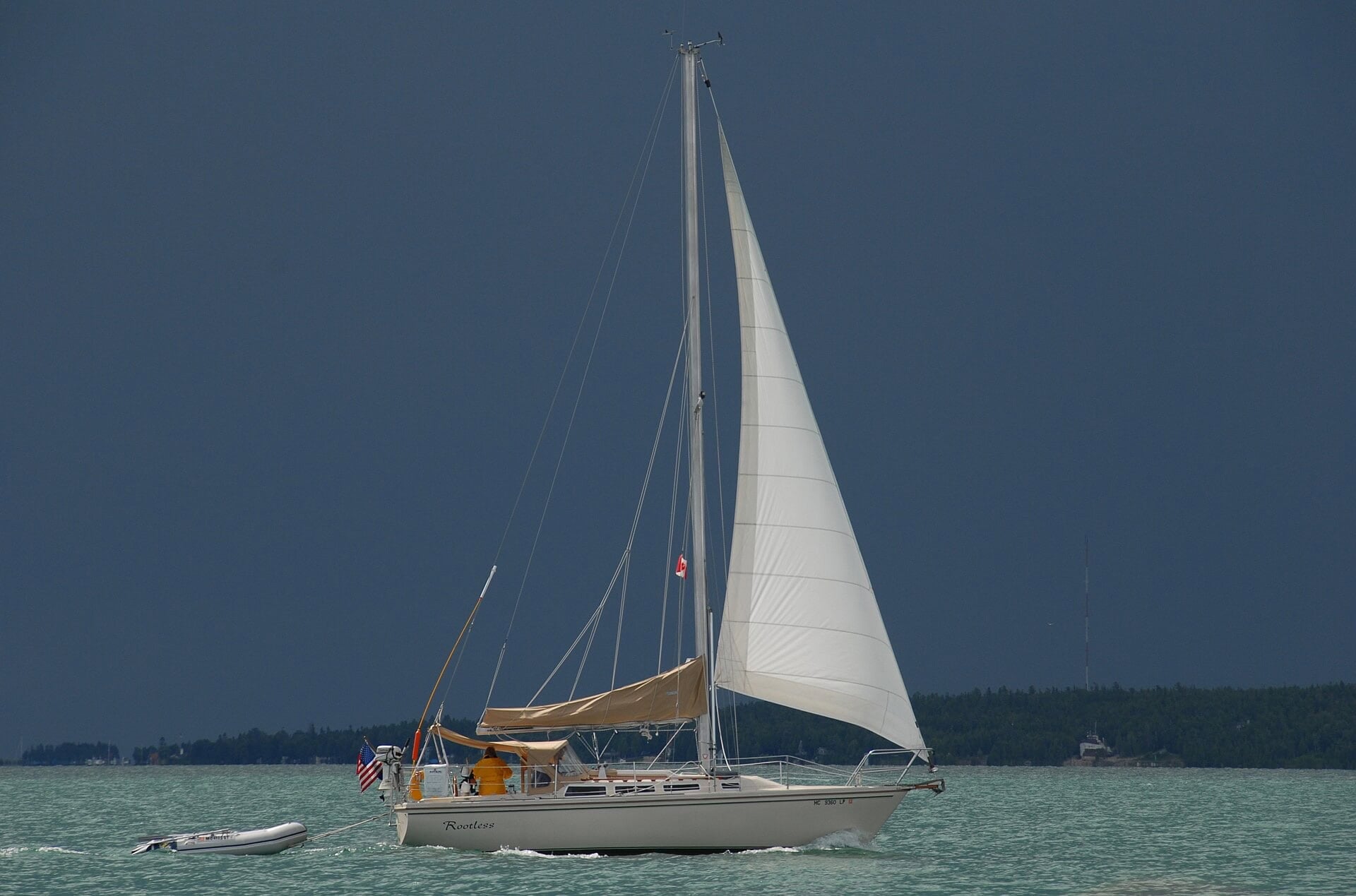
Catalina built 6,430 of these, so they’re everywhere, and so are the parts and the people who know how to fix them. It’s almost 11 feet wide, which is a LOT for a 30-foot boat. The water tank only holds 43 gallons, so this one is better for coastal sailing than crossing oceans.
4. Alberg 30
Used price range: $10,000 to $22,000 · Built: 1962 to 1987 · Length: 30.3 ft · Beam: 8.8 ft · Draft: 4.3 ft
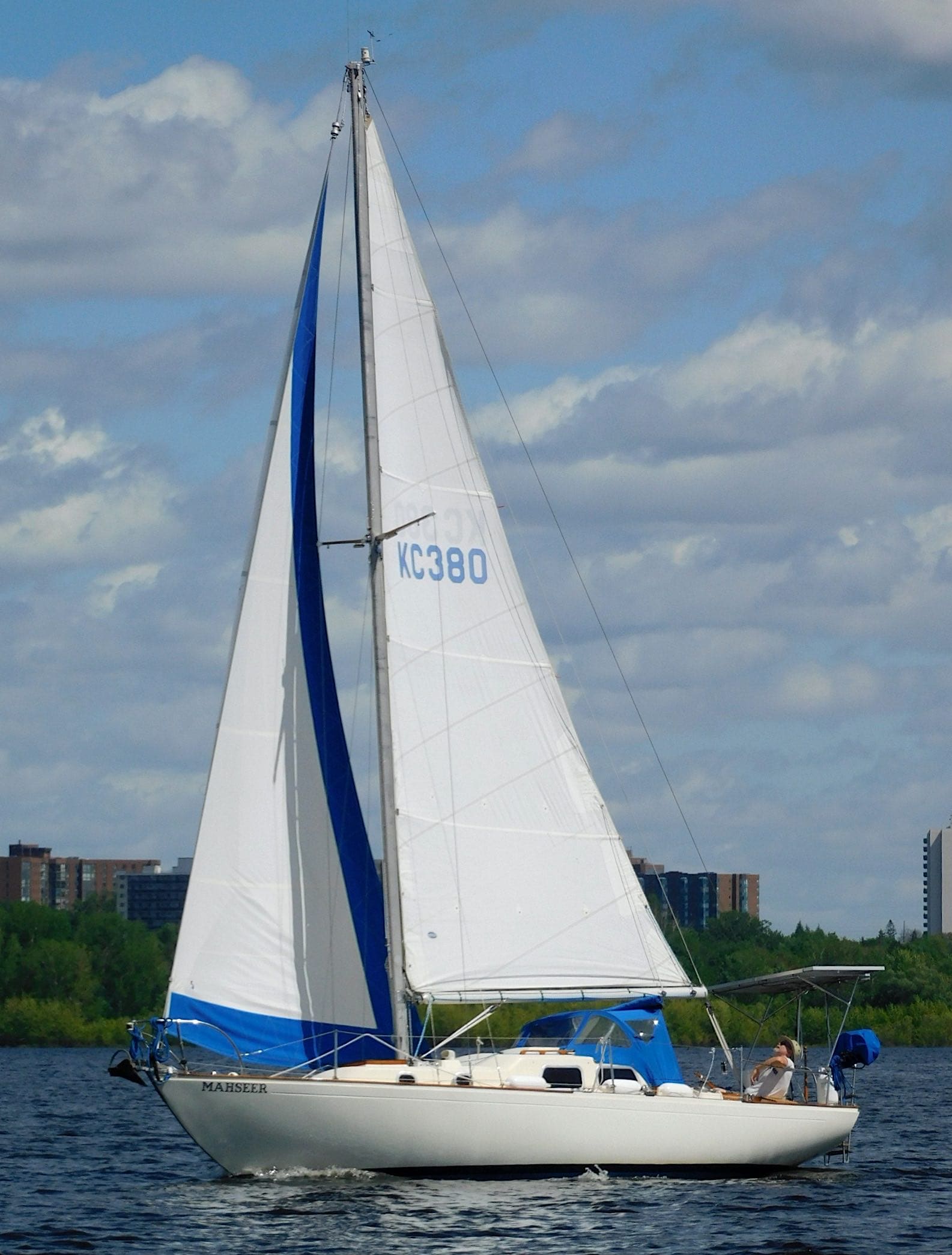
Whitby Boat Works in Canada built 700 of these, and Practical Sailor and Good Old Boat both praise how seaworthy it is. The downsides? It’s narrow, it only carries 30 gallons of water, and a lot of them still have the original gas engine.
Liveaboard boats from 30 to 40 feet
Now we’re getting into boats with bigger water and fuel tanks, so you can stay out longer. This group has sailboats, a catamaran and two trawlers.
5. Westsail 32
Used price range: $19,000 to $28,000 · Built: 1971 to 1981 · Length: 32 ft · Beam: 11 ft · Draft: 5 ft
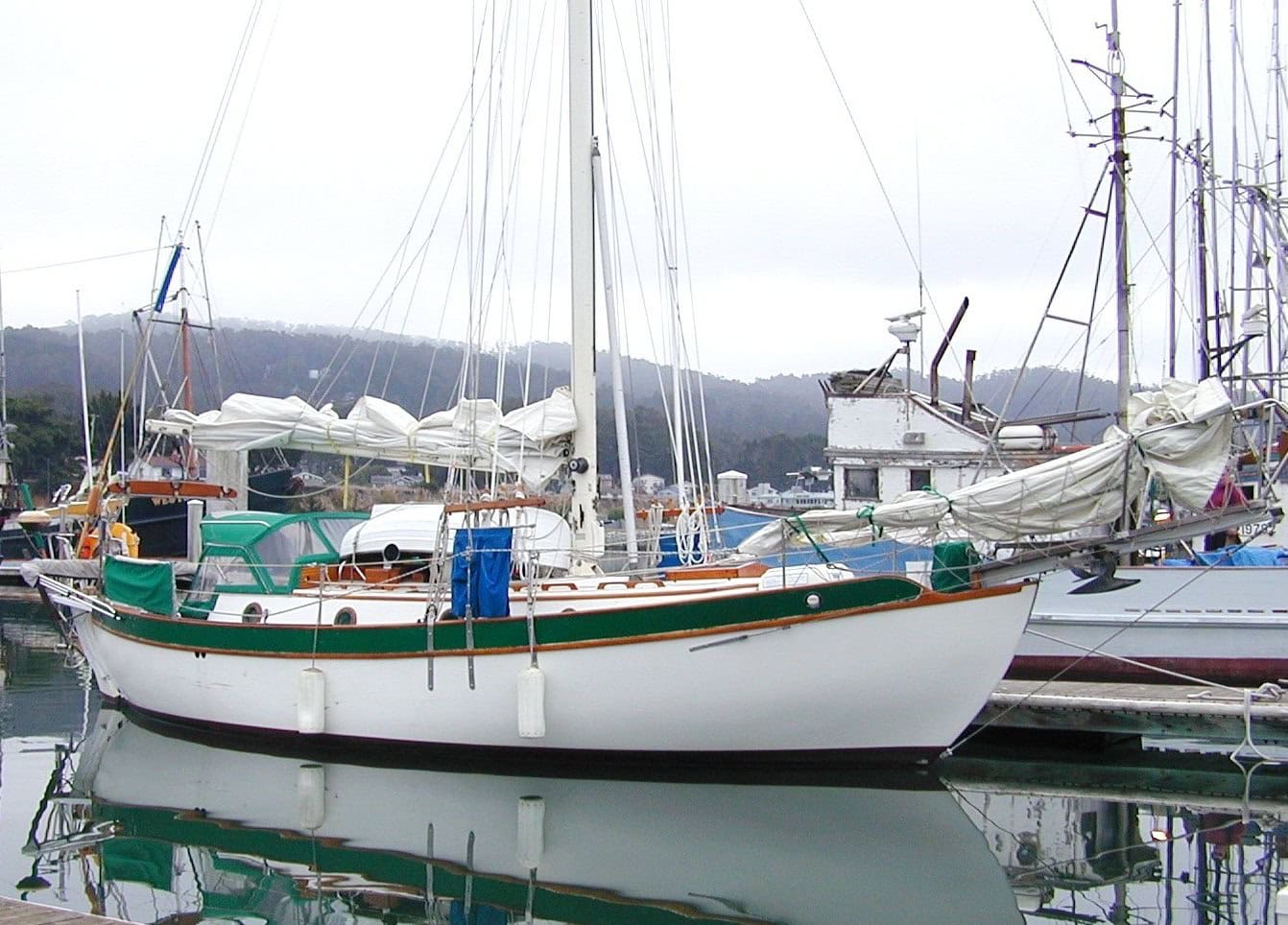
A heavy double-ender with 80 gallons of water. A lot of Westsails were sold as kits and finished by their owners. So every one is a little different. A reader who says they surveyed boats for four decades wrote that factory-built Westsails from the 1970s “often survey quite well decades after construction.”
6. Gemini 105MC (catamaran)
Used price range: $44,000 to $130,000 · Built: 2003 to 2011 · Length: 33.5 ft · Beam: 14 ft · Draft: 1.5 ft with the boards up
The least expensive catamaran on this list. At 14 feet wide, it fits in a lot of regular marina slips, which most catamarans can’t do. And it only needs 18 inches of water with the boards up. Want something bigger? Here are the best sailing catamarans.
7. Island Packet 35
Used price range: $35,000 to $89,900 · Built: 1988 to 1994 · Length: 35 ft, 38 ft with the bowsprit · Beam: 12 ft · Draft: 4.5 ft
A wide, shallow boat with 90 gallons of water. It isn’t fast. Many marinas charge for the bowsprit too, so plan on paying for 38 feet.
8. Catalina 36
Used price range: $24,900 to $99,900 · Built: 1982 on · Length: 36.3 ft · Beam: 11.9 ft · Draft: 5.8 ft
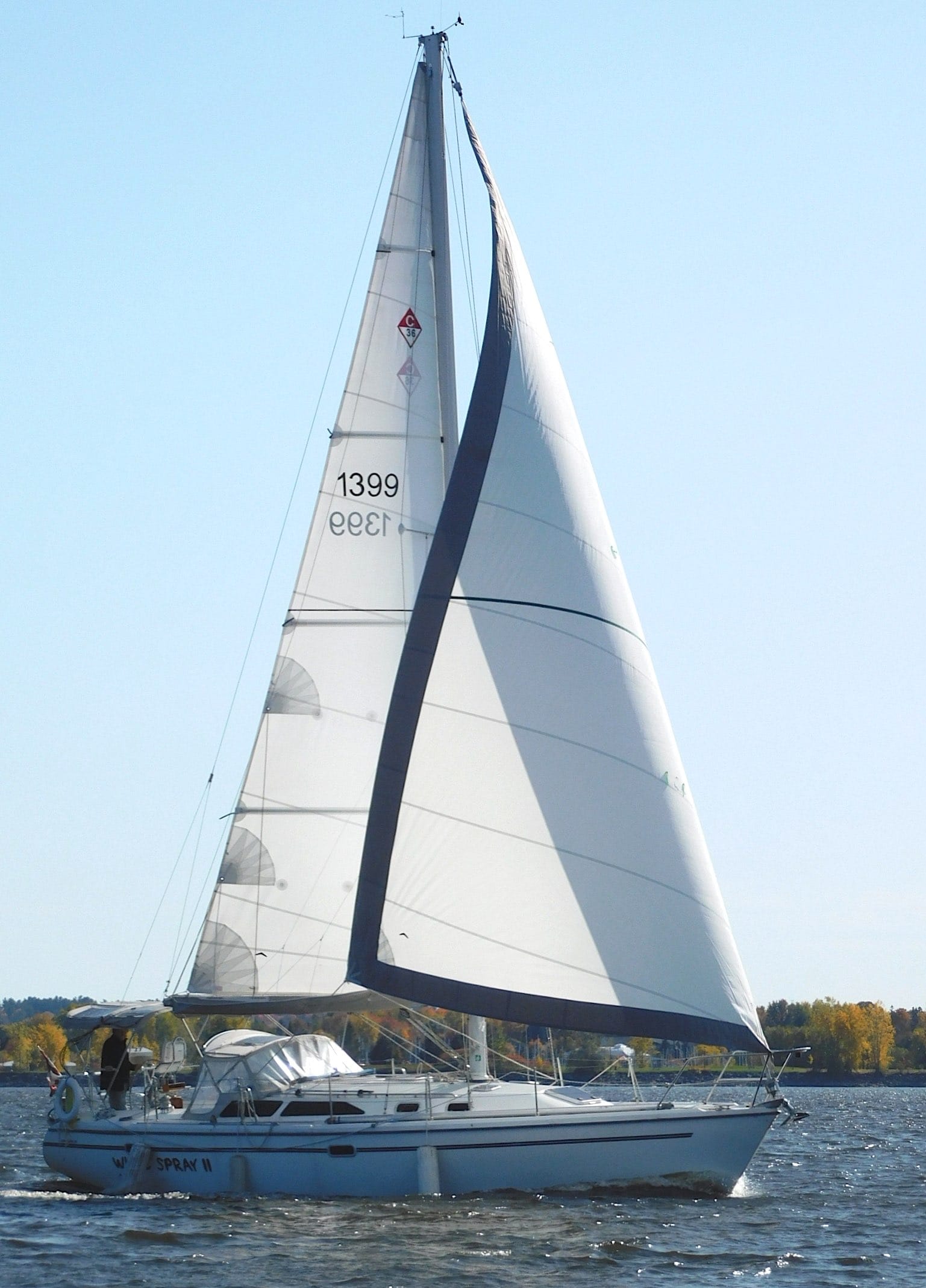
The bigger sister of the Catalina 30, and just as easy to find: about 30 were listed when we checked prices. It’s a coastal cruiser, not an ocean boat.
9. Grand Banks 36 Classic (trawler)
Used price range: $60,000 to $187,000 · Built: until 2004 · Length: about 37 ft · Beam: about 12.7 ft · Draft: about 4 ft
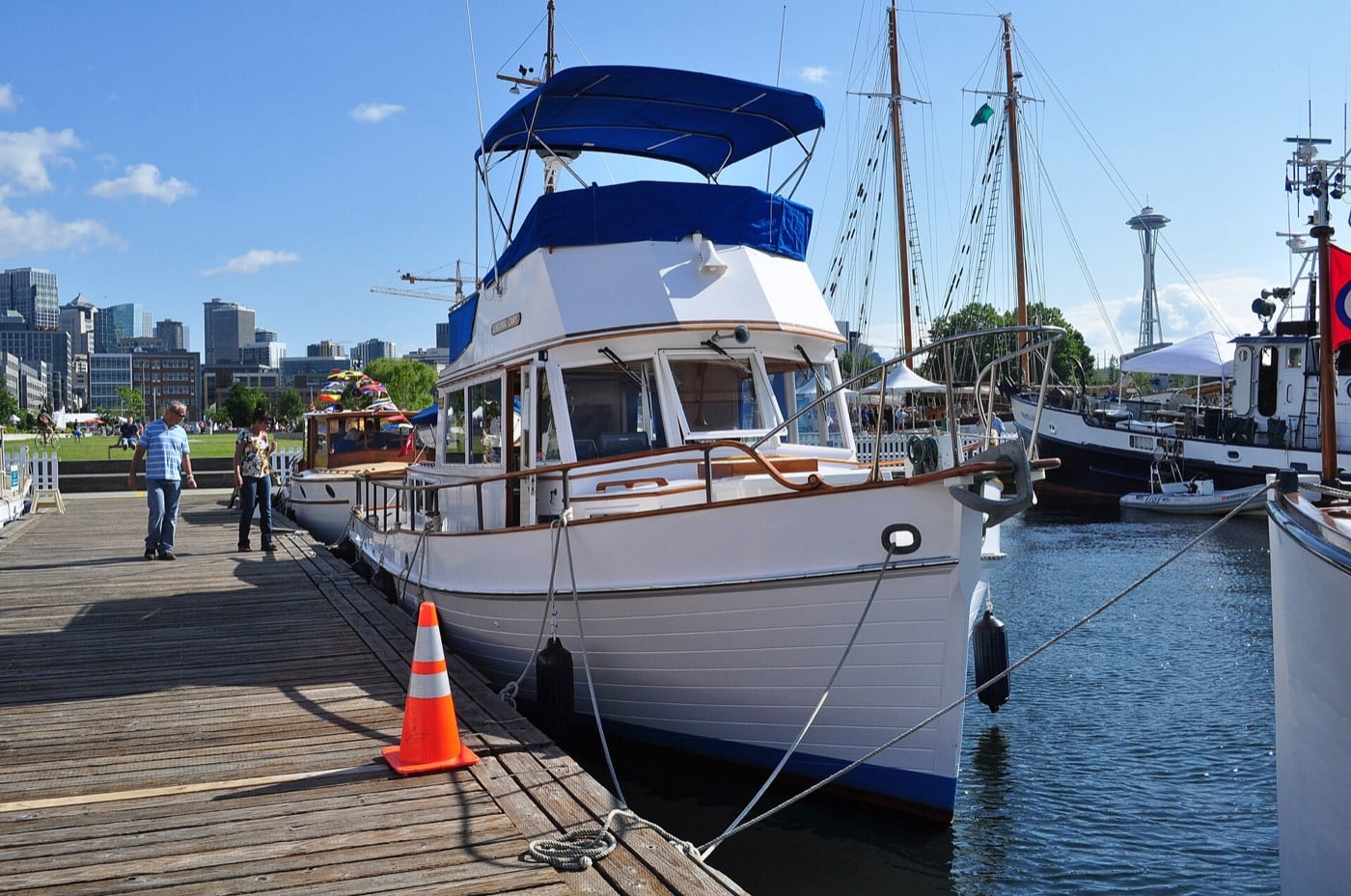
The classic liveaboard trawler, with an aft cabin. Many have twin diesels, which means two engines to maintain, and hulls built before about 1973 are wood. Here’s why one of our writers chose a trawler for full-time boat life.
10. Tayana 37
Used price range: $39,000 to $85,000 · Built: 1976 on · Length: 36.7 ft · Beam: 11.5 ft · Draft: 5.7 ft

Designed by Robert Perry and built in Taiwan, with huge tanks for 37 feet: 90 gallons of fuel and 100 of water. The original iron tanks rust and the teak decks leak, so ask what’s already been replaced.
11. Pacific Seacraft 37
Used price range: $45,000 to $139,000 · Built: 1980 on · Length: 36.9 ft · Beam: 10.8 ft · Draft: 5.5 ft
Also sold as the Crealock 37, with a reputation as one of the best offshore boats this size. The cabin is smaller than a modern 37-footer’s, and it’s the most expensive monohull in this group.
12. Cheoy Lee Offshore 38
Built: 1975 to 1990 · Length: 37 ft 11 in · Draft: 5 ft 8 in
The Cheoy Lee Offshore 38 is a bluewater sailboat with a fantastic reputation for offshore passages. It’s ketch or sloop rigged.
The ketch version features two cockpits – one midship and one at the stern. The original engine was an 15hp diesel; however many owners have now replaced it with a newer and bigger one. The long keel makes it a comfortable vessel in rough seas and when the anchorage gets rolly.
Inside, there are a medium-sized galley, two aft cabins, a small head and two settees on board. This cruiser makes the most of the space available while being very practical.
13. Nordhavn 40 (trawler)
Built: 1998 to 2004 · Length: 39 ft 9 in · Beam: 14 ft 6 in · Draft: 5 ft 2 in
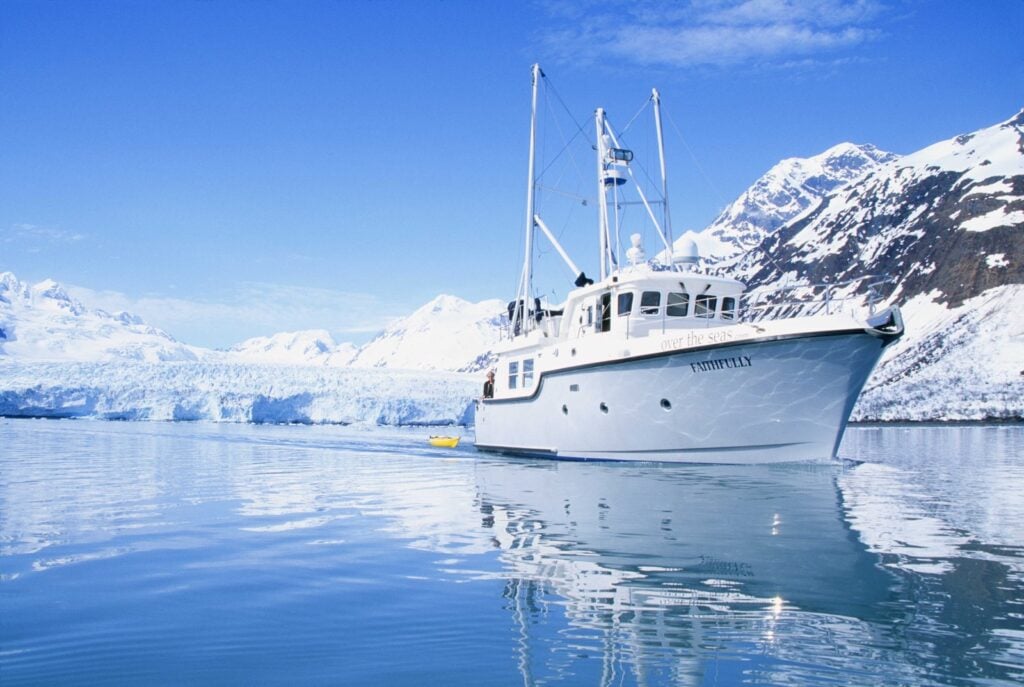
Are you an adventurous cruiser? This Nordhavn 40 has an impressive autonomy of 2,450nm at roughly 7 knots. It’s a rugged, durable and seaworthy trawler, which will allow you to travel long distances in rough conditions. This is not a boat to push at high speed, but rather a comfortable and safe trawler to take to high latitudes.
The Nordhavn 40 features a forward master cabin with an island queen berth and a midship guest cabin with two bunks. There are also a spacious head with a shower stall, a large galley, and a cozy salon. The teak table in the salon can accommodate up to seven people and turns into an extra berth. The pilothouse is up four steps from the salon and offers 270-degree views, thanks to the wide windows. The cockpit isn’t huge, but there’s enough space to fish and sit outside.
With such a legendary brand name behind it, it’s no surprise this boat is rather expensive.
14. Valiant 40
Used price range: $14,500 to $69,900 · Built: 1973 on · Length: 39.9 ft · Beam: 12.3 ft · Draft: 6 ft
Robert Perry’s first production design, with 125 gallons of water. Check the hull number first: many of the hulls built by Uniflite, roughly numbers 101 to 259, blistered badly.
Liveaboard boats from 40 to 50 feet
Both of our boats are in this group. There’s so much more room on a boat this size. But you pay for every foot at the marina and the boatyard.
15. CT-41
Used price range: none for sale in the listings we checked · Built: 1972 on · Length: 41 ft · Beam: 12.1 ft · Draft: 6 ft
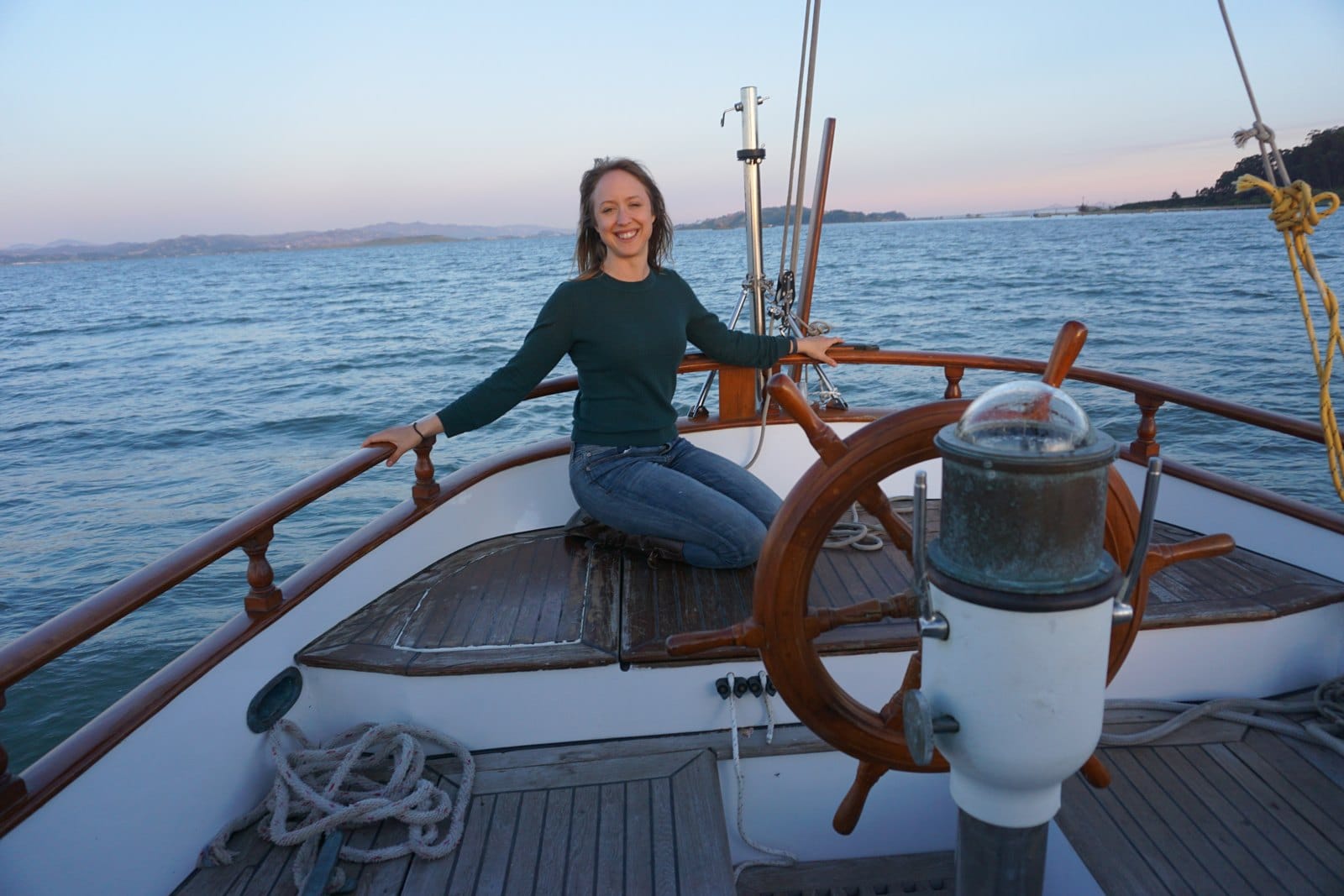
This is the boat I’ve lived on since 2016, a 1972 ketch built in Taiwan. She has two masts and a long keel, and she’s HEAVY: 27,500 pounds on paper. The design calls for 120 gallons of fuel and 120 gallons of water.
Tom was in the middle of restoring her when I moved aboard. For the first year, we didn’t have a stove or running water. We sailed her to Mexico in 2020.
I can’t point you to a magazine review of the CT-41, because there isn’t one. If you’re shopping for one, look closely at the teak decks. A lot of owners have torn them out or replaced them. There’s a reason they are known as “leaky teakies”. One 1974 boat for sale had new chainplates and new masts, too. Want to see inside ours? Here’s a tour of our 41-foot sailboat.

We also have a second boat, Payah Kun, a 1996 Nelson Marek 46 we bought in 2025. She’s a race boat with a cruising interior, and very rare, so she isn’t on this list.
16. Morgan Out Island 41
Used price range: $15,000 to $44,000 · Built: 1971 on · Length: 41.3 ft · Beam: 13.8 ft · Draft: 4.2 ft
A wide, shallow boat that sells for less than almost anything else this size, with 170 gallons of water. It doesn’t sail as well as the others here. But as one reader put it, “I think over-built Morgans from the 70s are unbelievably resilient.”
17. Hallberg-Rassy 42
Used price range: $87,000 to $157,000 · Built: 1980 to 1991 · Length: 42.4 ft · Beam: 12.4 ft · Draft: 6.7 ft
This is the 1980s center-cockpit ketch, not the newer 42. Hallberg-Rassy was one of the two brands readers dreamed about most (more on that below), and this is one of the cheaper ways into one. All three we found for sale were in Europe.
18. Lagoon 42 (catamaran)
Used price range: $349,000 to $659,000 · Built: 2016 to 2025 · Length: 42 ft · Beam: 25.3 ft · Draft: 4.1 ft
One of the newest boats on this list, and it shows in the price. It’s 25 feet wide, so you’ll pay catamaran slip rates, and the tanks are small for the size (79 gallons each of fuel and water).
19. Carver 4207 (motor yacht)
Built: 1985 to 1991
The Carver 4207 is one of the best-selling motor yachts in her class from the 80s. It has a 350 hp gas engine with a cruising speed of 13-14 knots and a 22-knot top speed.
The Carver 4207 has two staterooms, a decent-sized head, a dinette, a linear galley and a large cockpit with a hardtop. This boat has wider side decks than most yachts, which are very comfortable to walk on.
If you’re on a budget, this motor yacht will be a comfortable cruiser, which can travel fast. While it’s an old vessel, it features solid fiberglass hull construction from the waterline to the keel, which means moisture intrusion is unlikely. The hull will last a very long time.
20. Leopard 45 (catamaran)
Used price range: $335,000 to $800,000 · Built: 2016 to 2024 · Length: 45 ft · Beam: 24.2 ft · Draft: 4.9 ft

Built in South Africa, and it carries far more than the Lagoon 42: 206 gallons of water and 185 of fuel. Many were charter boats first.
The boats sailors would own if money didn’t exist
I asked our sailing Facebook page which boat they’d own if money didn’t exist. Make and model, no cheating.
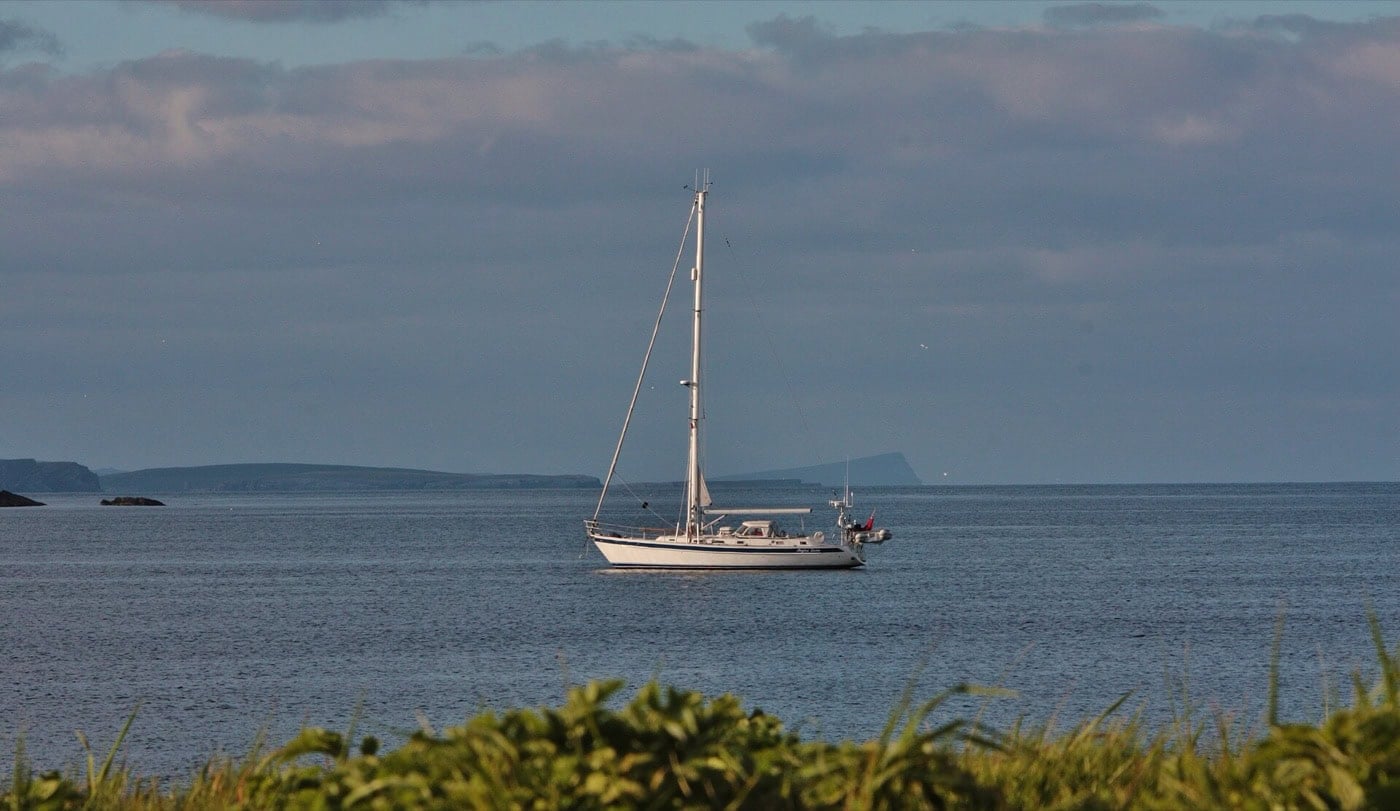
Two brands came up over and over: Swan, which is built in Finland, and Hallberg-Rassy, from Sweden. Plenty of people wanted a catamaran, too. Gunboat, Outremer, Lagoon and Leopard were the favorites.
“AMEL! Built and equipped from the moment of launch to sail around the world with no need to add any gear,” one reader wrote.
But a lot of sailors named the boat they already own, or something smaller.
“I actually own my dream boat, the one I would pick above all others. Morgan 60 Schooner. Now all I have to do is to get her fully functioning,” one wrote. Another just said, “My own. She doesn’t have a brand.”
The sailboat brands that hold up after 40 years
Most of us can’t afford a brand-new Swan. So I also asked which sailboat brands hold up best after 40 years.
Swan came up the most again. But Catalina and Pearson were right behind it, ahead of Hallberg-Rassy. Tartan, Pacific Seacraft, Morgan and Cape Dory all had fans.
“I’ve got a 40yo Catalina and it’s holding up surprisingly well,” one reader wrote. Another: “Pearson, my 79 P-32 is still winning races. The family love it too.” And another: “Tartan definitely, just acquired 1985 T40, and it is the best sailboat I had.”
One answer wasn’t about a brand at all:
“As long as the hull is sound, it doesn’t seem to make much difference. Rigging, sails, engines, bottom paint, etc. are the expensive stuff, and no matter what brand the boat is, the same stuff still wears out the same.”
I asked which brands people stay away from, too. Hunter and MacGregor got the most votes, and Catalina came in third, even though so many owners love theirs.
One reader had the last word on that: “Not all can afford a Hinckley, a Swan, Baltic, a HR, or such. Let us agree some boats are better than others and leave it at that.”
Buying your first boat? Read what hundreds of sailors told me to do before you buy your first sailboat, and find out how much a sailboat really costs.
The best size boat to live on
Not all boats are created equal. A 30 ft. sailboat will have just a fraction of the living space a 30 ft. houseboat has.
Before figuring out exactly what size boat you need, it can be helpful to walk through a few. Getting a feel for a few different size boats you can live on will help you better understand what you’ll need.
Space on your liveaboard boat
Before deciding how much space you need, it’s also important to consider where you’ll be spending most of your time.
Will you spend your days aboard the boat? Out on the sun deck? Inside the cabins? Will you anchor or moor and spend your days on land?
Think about what your life will actually look like once you’re living aboard.
If you’re moored near rainy Seattle and know you’ll be spending a lot of time inside your cabins, you will need to prioritize interior living space. If you’re going to be in the Caribbean and are lucky enough to never get sunburn, you might spend most or all of your time above deck, and should prioritize outdoor spaces.
Also, consider your travel companions. If you’re on your own, you can get away with a much smaller liveaboard boat than a small family with a pet or two.
Some space-saving solutions like foldaway beds or multipurpose use areas might seem like an ideal way to fit more into less, but when you’re living full-time in cramped quarters, those solutions can quickly turn into problems.
Where you’ll moor your liveaboard boat
It’s also important to think about where you’ll be keeping the boat. If you plan to anchor or tie up to a mooring buoy, size isn’t super important.
Most people keep their liveaboard boats in marina slips, which are priced and assigned based on boat length. Also, some marinas are overwhelmed by certain length boats, and you might not be able to find available slips in those lengths. So if you’re hoping to moor at a particular marina, it might benefit you to check what slips they have available.
Catamarans pay more, too. At the City of Corpus Christi Marina in Texas, a slip costs $11.25 per foot a month for a monohull and $20 per foot for a catamaran. That’s $450 a month for a 40-foot monohull and $800 for a 40-foot cat.
And not every marina lets you live aboard. Here’s where living on a boat is restricted.
How you’ll travel in your liveaboard boat
How you’ll be traveling in your boat also impacts what size you’ll need. The larger the boat, the more difficult it will be to maneuver. If you’ll be traveling through small waterways, bays, or lakes, a small profile can make for much more comfortable navigation.
Final considerations on boat size
Smaller boats are also more cost-effective to operate. If you’re relying on an engine for power, a few less feet of length could mean thousands of dollars in gas savings down the road.
On the other hand, smaller boats are easily tossed around by large, ocean waves. On many waters, small vessels aren’t just inconvenient, they’re dangerous. It’s important that your boat is big enough to weather whatever conditions you plan to use it in.
Learn more about the best size boat for ocean crossings.
Finding the best liveaboard boat for you
Life on a liveaboard boat really can be a dream. If you spend the time to pick out the perfect boat for your needs, you can easily make that dream a reality.
Hopefully, this article has helped you start seeing what that reality could look like. If you still have any questions, let us know in the comments below and we’ll do our best to help figure it out.
What boat do you live on, or dream about?
Other posts you might like:
- 14 things nobody tells you about living on a boat
- 13 brutal truths about sailboat living
- 22 ways we save money living on our sailboat
- How to find remote work from your boat
Liveaboard boat questions
What size boat is best to live on?
It depends on how many people are aboard and where you’ll keep the boat. Up to 30 feet is the cheapest to dock and haul out, 30 to 40 feet gets you bigger tanks and more storage, and over 40 feet you get more room and bigger bills, because slips and haul-outs are charged by the foot.
What is the best boat to live on full time?
There’s no single best boat. At a dock, a trawler or a houseboat gives you the most living space for its length. For cruising, the sailors on our Facebook page most often named older Swan, Catalina, Pearson and Tartan sailboats as the ones that hold up for decades.
How much does a used liveaboard sailboat cost?
Asking prices in current listings start under $10,000 for an Albin Vega 27 or a Catalina 30, run $35,000 to $90,000 for an Island Packet 35, and start around $335,000 for a recent catamaran like a Leopard 45. The low end of any range is usually a project boat.
Is a catamaran or a monohull better to live on?
A catamaran has more living space and stays level, but it costs far more to buy and to dock. At the City of Corpus Christi Marina, a catamaran slip is $20 per foot a month, against $11.25 for a monohull.
Sources: boat specifications from sailboatdata.com; asking prices from SailboatListings.com and Rightboat listings, checked November 2026; reviews in Practical Sailor, Good Old Boat, SpinSheet, Cruising World; City of Corpus Christi Marina slip rates; and hundreds of answers to three questions on our sailing Facebook page, That Sailing Life.






3 Comments